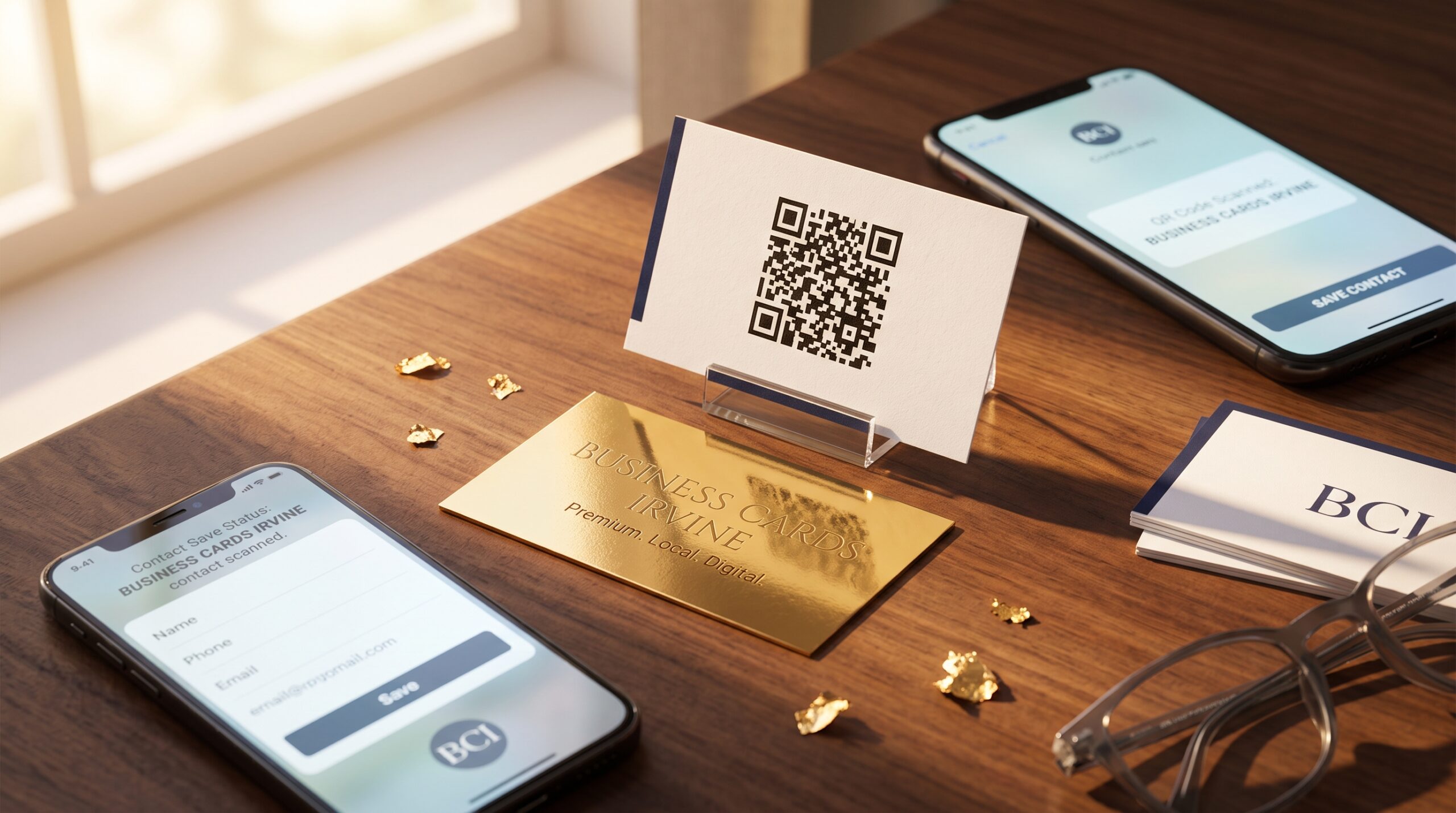
If you are networking in Orange County, the choice between QR cards and foil cards comes down to one question: do you want a card that gets scanned or a card that gets kept? QR cards prioritize instant digital action, while foil cards prioritize a premium physical impression. For most professionals in Irvine, the right answer isn’t either/or—it’s understanding where each shines. This guide breaks down the cost, durability, and practical use cases for both, so you can order the right tool for your specific networking style.
The Core Difference: Digital Utility vs. Physical Prestige
The distinction is straightforward. A QR card is a business card with a scannable code that leads directly to a digital profile, website, or payment link. A foil card is a traditional card with metallic, reflective accents (usually gold, silver, or rose gold) applied to the text or logo. The QR card is a bridge to your online presence. The foil card is a statement about your brand’s quality.
Neither is objectively better. The right choice depends on your industry, your follow-up process, and the specific event you are attending. A real estate agent might prefer foil for a luxury open house, but a software consultant might get more mileage from a QR card at a tech meetup.
QR Cards: Built for Immediate Connection
QR cards have moved past the pandemic-era novelty phase. They are now a standard tool for anyone who wants to eliminate the friction of manual contact entry. The primary benefit is speed. A prospect scans your card, saves your contact, and visits your site in under five seconds.
When a QR Card is the Smarter Choice
You should lean toward a QR card if your networking success depends on immediate digital action. This applies to e-commerce sellers, content creators, consultants with a lead magnet, or anyone who uses a scheduling link. The card is not just a reminder of who you are; it is a functional tool that routes people to a specific destination.
- Trackable engagement: Most QR code generators provide analytics. You can see how many people scanned and when.
- Updateable content: You can change the landing page behind the QR code without reprinting the card.
- Cost-effective: Standard QR cards are often cheaper than foil because they don’t require specialty finishing.
One common mistake is putting a QR code that just opens a plain PDF of your business card. That wastes the opportunity. Point the code to a mobile-optimized landing page, a Calendly link, or a specific portfolio piece.
Foil Cards: The Art of the Lasting Impression
Foil stamping adds a metallic layer to your card that catches light and feels different to the touch. It is a tactile experience. In a stack of fifty matte cards collected at a conference, a foil card is the one that stands out when you flip through them later. It signals that you are established and willing to invest in your brand.
Where Foil Justifies the Cost
Foil is the right call for high-ticket B2B sales, financial advisors, luxury services, and creative professionals where the card itself is a design sample. If you hand someone a card and they immediately say, “This is nice,” you have already made a positive impression before you say a word. That physical reaction is hard to replicate with a standard digital-first card.
However, foil has a downside: the information is static. If your phone number or title changes, you are stuck with a box of outdated cards. Foil also requires a heavier paper stock to look premium, which increases cost and mailing weight.
Cost Factors: What You Actually Pay For
Pricing varies significantly based on the print shop and the specifications. At Avanti Printing in Irvine (15321 Barranca Pkwy, you can get a quote for both options, but here is what drives the price.
| Feature | QR Card (Standard Digital) | Foil Card (Premium Finish) |
|---|---|---|
| Base Paper (14pt or 16pt) | Low cost per unit | Higher cost per unit |
| Printing Method | Digital (fast, cheap) | Offset or Digital + Foil Stamp |
| Finishing | Matte or Gloss (included) | Foil (adds a setup fee + per-sheet cost) |
| Turnaround | 1-3 days | 3-5 days (foil requires die setup) |
| Minimum Order | Usually 100 | Often 250-500 to be cost-effective |
The foil setup fee is the hidden cost. If you only need 100 cards, the setup fee makes each card expensive. If you order 1,000, the per-unit cost drops significantly. QR cards have no setup fee, so they are easier to test and iterate on.
Durability and Practicality in the Real World
Networking cards live in pockets, wallets, and cardholders. They get bent, scratched, and exposed to moisture. Standard QR cards printed on thin paper will show wear quickly. Foil cards, because they are usually paired with thicker stock, tend to hold up better physically. The foil itself can scratch if it is a soft metallic finish, but a good lamination or a thicker foil layer can resist normal abuse.
If you are at an outdoor event in Irvine during the summer, a card left in a car dashboard will warp. That applies to both types. The practical difference is that a scratched QR code might fail to scan, rendering the card useless. A scratched foil card still looks like a business card. If you choose QR, ask for a matte or textured finish that protects the code area from scuffs.
How to Decide: A Practical Decision Tree
Stop debating and run through this quick checklist. It will tell you which card to order today.
- What is your primary call to action? If it is “visit my website” or “book a call,” go QR. If it is “remember me when you need X,” go foil.
- Who is your client? Tech startups and younger demographics are QR-savvy. Established executives in law or finance often respond better to a heavy, foil-stamped card.
- How often do you update your info? If you change jobs or titles frequently, QR is the safer investment because you can update the link destination without reordering.
- What is your budget? If you need 500 cards for a trade show and you are on a tight timeline, QR is the faster, cheaper option.
If you still cannot decide, order both. Use foil for your top-tier client meetings and QR for general networking events where volume matters. Many professionals keep two sets for this exact reason.
Common Mistakes to Avoid When Ordering
I have seen the same errors happen repeatedly at print shops. Avoid these to save money and time.
- QR code too small: The code must be at least 20mm (about 0.8 inches) to scan reliably from a phone held at a normal distance.
- No contrast: A gold foil QR code on a white background looks elegant but often fails to scan because there is not enough contrast. Keep QR codes dark on a light background.
- Foil on the back only: If you put foil on the back of the card, the front looks standard. The impact is lost. Use foil on the logo or name on the front.
- Ignoring the landing page: A QR card is only as good as the page it points to. If that page is slow or not mobile-friendly, you lose the lead.
Local Printing Considerations in Irvine
Working with a local printer has tangible benefits. You can see and feel the paper samples before you commit. You can also get same-day pickup if you have a last-minute event. If you are in Orange County, visiting Business Cards Irvine at Avanti Printing allows you to compare a foil sample and a QR sample side-by-side. This tactile comparison is the best way to make a final decision, because photos online do not convey the weight or reflectivity of the foil.
Local print shops also offer a hybrid option: a foil card with a small QR code printed in a contrasting color. This gives you the prestige of foil and the utility of a scan code. It costs more than a standard QR card, but less than a full foil card with a foil-stamped QR code. This is often the best compromise for professionals who want both benefits.
FAQ
Can I put a QR code on a foil card?
Yes, but print the QR code in standard ink, not foil. Foil QR codes look nice but often fail to scan due to low contrast. A small, dark QR code in the corner of a foil card gives you the best of both worlds.
Which card is better for a trade show?
For high-volume trade shows, use QR cards. They are cheaper, so you can hand out more. They also let you track which scans came from the event, which helps you measure your ROI on the booth cost.
How long does foil printing take?
Foil adds about 2-3 business days to the production time compared to standard digital printing, due to the die setup and stamping process. Plan ahead if you have a specific event date.
Ultimately, the best card is the one that gets you the follow-up meeting. If you are still unsure, order a small batch of each and test them at your next two networking events. The data from your QR analytics or the comments you get on your foil cards will tell you which one to scale up.
Visit Business Cards Irvine