
Recycled uncoated business cards in Irvine are mill fiber boards with named recycled content, no clay coat, and a surface a ballpoint can bite. Color sits drier than coated stock. Specks and ink holdout come from the mill, not a cart. Avanti will not invent an FSC mark for your box. Name the mill percentage on the quote, not a leaf.
That is the whole product, stated without a leaf icon. The rest of this page is how post-consumer fiber differs from a mood word, why navy dries down on an open sheet, why a thumb leaves a stain instead of a shine, and which Irvine law, CPA, and architecture cards actually belong on this stock. I estimate this work at Avanti Printing, 15321 Barranca Pkwy, Irvine, CA 92618. If you want a pen and a mill swatch in the same hand, call (949) 387-0787 and come in. Quotes still confirm size, material, quantity, finish, and date. “Eco cards” is not those five facts.
People search recycled uncoated business cards after a partner asked for something that looks like paper, after a coated sample rejected a ballpoint, or after a designer dropped an FSC lockup onto a file the mill never certified. Those are three different jobs. Recycled is a fiber claim. Uncoated is a surface. Writing is a test. A logo of a tree is none of those. If you want the fiber, say the mill and the percentage. If you want the pen, keep film and flood off the face you write on.
Who this sheet is for in Irvine and Orange County
This write-up is for the person who has to approve a card that will be judged as an object, not as a sustainability slide. That is usually a partner, a principal, an office manager, or a marketing lead at a firm that already talks about paper in the conference room and still has to hand a 3.5 × 2 inch rectangle at a mixer. You are buying for Irvine Company towers, Spectrum offices, UCI-adjacent studios, medical and professional suites along Alton and Barranca, and the quieter rooms in Newport and Costa Mesa where a plastic-feeling card is the wrong greeting.
I split the buyers, because the sheet should follow the handshake:
- Law firms. Michelson, Jamboree, Airport-area towers, and the smaller suites that still keep a notepad culture. Partners jot a department, a hearing date, or a direct extension on the back. Cream or warm-white uncoated reads like stationery. A laminated navy tile reads like a restaurant menu. Recycled content is a true claim if you name it. It is not a substitute for readable type or a State Bar line that actually fits.
- CPA and advisory firms. Tax season is a reprint machine. Names and titles move. A paper-forward uncoated card is right for the brand. A mill-poetry 100% post-consumer sheet with a six-week special-order habit is wrong for a staff of twenty who will be wrong again in March. Recycled uncoated at a named, stocked grade, modest quantity, writable back. That is the adult spec.
- Architecture, interiors, and landscape. Studios along Alton, Barranca, and University that already live in trace, chipboard, and pencil. The card should look like a drawing, not a credit card. Visible specks are a feature if you chose them. A sketchable back is the product. Full-bleed dusk photographs of a stairwell will sit duller on this sheet than they did on a coated proof. Design for fiber, or pick a different board.
- Everyone else who actually means paper. Nonprofits, some environmental consultants, landscape contractors who want the claim to match the truck, founders who hate film. The test is still the pen, the stain, and whether you will print a claim you can stand behind when a client asks “recycled how.”
If you are ordering standard business card printing in Irvine for a whole floor, do not force every seat onto a speckled 100% post-consumer cover because the principal liked the swatch. Principal cards and staff cards can share a layout and split the mill grade. That is a normal two-line quote. Recycled uncoated is not a personality. It is a sheet.
The other person holds the card for two seconds. They feel tooth. They see whether the navy is a panel or a stain. They either pocket it or write on it. Fiber shows up in those two seconds as warmth, specks, and a duller color than the coated card they were handed two tables ago. Fiber shows up a week later as a fuzzy edge, an oil spot from sunscreen, and a ballpoint note that actually stayed. If that week is the point, you are in the right article. If you wanted wipe-down and courtyard glare control, you wanted a coated or filmed sheet, recycled or not.
Recycled and uncoated are two specs, not one mood
Start here or you will argue with a quote that was never wrong. Shops and carts mash “eco,” “uncoated,” “cotton,” and “recycled” into one SKU. I do not. On a card quote in this plant, the words mean this:
- Uncoated is the mill surface. No clay coat. Fibers are the finish. A ballpoint can bite. Ink goes into the sheet. Color dries down. Abrasion shows. This is a surface, not a virtue.
- Recycled content is fiber that was recovered before or after a consumer used it. It is a percentage and a class: pre-consumer (post-industrial) or post-consumer. It is not a color, not a speck pattern, and not a certificate until the mill sheet says so.
- Virgin uncoated is still uncoated. It still writes. It may be brighter, cleaner, and more even than a high post-consumer sheet. If you only needed the pen, you did not need the recycled line.
- Recycled coated (C1S/C2S) is recovered fiber with a clay coat. You can print a recycled claim on a slick card. You will not get the writing surface or the fiber read. Do not order recycled C2S and then get angry at the pen.
- Cotton is a different fiber. Some cotton sheets are recycled cotton; some are virgin rag. Cotton is not automatically recycled. Recycled wood-fiber uncoated is not cotton. If you want rag, say rag. If you want post-consumer kraft-adjacent specks, say that. They are different objects.
Recycled is a fiber claim with a percentage. Uncoated is a surface with no mill clay. Writing is a test. FSC is a chain-of-custody mark you only print if the job actually carries it. If any of those four is missing from the email, you have a mood, not a spec.
Use this as the counter conversation, not as a lab report. Caliper is assumed in the usual 14pt–16pt cover neighborhood unless you say otherwise. Finish on this page means none: no aqueous flood, no UV flood, no film, unless you are deliberately building a hybrid.
| Sheet | What it is | Writes? | Fiber look | Ink holdout | Claim you can print | Best default job |
|---|---|---|---|---|---|---|
| Virgin uncoated cover | New fiber, no clay coat | Yes | Even, often brighter | Open; drier than C2S | None, unless you invent one — do not | Write-on without a recycled sentence |
| Named PCR uncoated | Mill grade with a stated post-consumer % | Yes | Warmer; specks rise with PCR | Often more open; more dryback | The mill’s % and class, as written | Law / CPA / architecture paper brands |
| High-PCR “speckled” | 100% recovered or similar, visible inclusions | Yes | The point of the sheet | Lowest holdout of this table | Only what the mill sheet allows | Studios that want the sheet to show |
| Recycled C2S | Recovered fiber, clay coat both sides | No | Looks like any coated card | High; color pops | Fiber %, not a fiber photograph | Recycled claim without a writing test |
| C1S hybrid | Coat or print front; uncoated back | Back only | Front can hide the fiber | Split personality | Still the mill’s fiber %, if true | Color front, notepad back |
| Cotton rag | Cotton fiber, usually uncoated | Yes, with more tooth | Rag, not recycled specks | Soft, thirsty | Cotton %; recycled only if the mill says so | Stationery-forward principals |
If you are torn only between “recycled” and “uncoated,” you are not torn about one object. You are mixing a claim and a surface. Write both on the quote, or I will ask. That is not pedantry. A recycled silk-coated card and a virgin uncoated card fail different tests. The search phrase recycled uncoated business cards is the overlap: recovered fiber, open surface, pen, dry color, honest sentence on the box.
Get pricing for recycled uncoated cards
Honest claims: what Avanti will and will not put on a box
This is the part carts skip and partners notice. Environmental claims on a card are advertising. They are also, if you print them, your problem in a client meeting. I will print the mill’s sentence. I will not decorate your file with a mark we cannot support.
The Federal Trade Commission’s Green Guides are the adult language for this. Read the current summary of environmental marketing claims under the FTC Green Guides before you lock a leaf, a percentage, or the word “eco” into 10-point type. I am not your counsel. I am the person who will refuse to typeset a fantasy.
What that means at this counter, in plain shop talk:
- Name the percentage and the class. “Printed on 100% post-consumer recycled uncoated cover” is a claim if the mill sheet is that grade. “Printed on recycled paper” with no percentage is the kind of vagueness the Guides warn against. If the mill is 30% post-consumer and 70% something else, you print 30% post-consumer, not “recycled” as a halo.
- Pre-consumer is not post-consumer. Mill broke and converting scrap can be recovered fiber. It is not a yogurt tub that hit a blue bin in Irvine. If you want the sentence clients actually mean, you want post-consumer. Say PCR. Do not let a vendor swap in “recycled content” that is all pre-consumer and then smile.
- Do not print an FSC, SFI, or PEFC logo because it looked official in a mockup. Those marks are chain-of-custody systems. The mill roll, the merchant, and the printer all have to be in the chain for the job if you put the logo on the card. Avanti Printing will not invent an FSC certification for your box. We will not “just drop the lockup in” because a brand guide included a PNG. If a documented chain-of-custody job is required, that is a different conversation with paperwork, not a checkbox on a card cart. Default card quotes in this shop are mill-grade quotes, not certified-logo quotes.
- “Eco-friendly,” “green,” “planet-positive,” “sustainable card.” No. Those are unsorted praise. The Guides treat broad environmental benefit claims as the kind of thing you must substantiate or drop. Drop them. The sheet is a sheet. The claim is a percentage.
- Recycled is not recyclable, and recyclable is not recycled. An uncoated fiber card is generally easier to put in mixed paper than a film-laminated card. That is a disposal sentence, not a fiber sentence. A virgin uncoated card can be recyclable. A laminated recycled card can be a recycling problem. Do not print “please recycle” as a substitute for a PCR number, and do not print a chasing-arrows mark as if it were a content claim.
- Soy ink, vegetable ink, carbon-neutral, carbon-offset, “zero waste print.” Separate claims, often oversold, often not true of the actual run. I will not put them on your card because a blog said digital ink is automatically soy. If you need an ink claim, we talk chemistry and the press that will actually print the job, in writing.
Federal purchasing language is useful even if you are not selling to a government desk. The EPA’s Comprehensive Procurement Guidelines for paper and paper products talk in recovered fiber and post-consumer percentages, not in leaves. Steal that vocabulary. It is boring. Boring is how you stay honest.
What I will put in the quote instead of a poem:
- Mill and grade if you named one we can put on press, or a house uncoated recycled equivalent I can show you as a swatch.
- Stated recycled content as the mill publishes it, split PCR / pre-consumer if the mill splits it.
- Caliper or basis, shade, and whether the surface is uncoated.
- A note that no forest-certification logo is included unless the job is set up as that job.
If your brand committee wants a sentence on the back of the card, write the sentence in the quote. I will check it against the mill sheet. I will shorten it. I will not “make it punchier.” Punchy is how you get a percentage you cannot defend. A quiet line in 7-point type, accurate, on the back, is the professional version of this entire page.
House stock versus named mill: we keep uncoated and recycled-uncoated options that change with merchants. I will not pretend a blog post is an inventory list. Come feel the sheet, or name the mill you already standardized on letterhead. Matching letterhead and cards is a proofing problem across two surfaces, not a reason to invent a certification. If the letterhead is a mill you love, put that mill on the card quote and we will tell you whether the cover weight exists.
Ink holdout: why the navy looks like a stain, not a tile
Holdout is mill language for whether ink sits on the sheet or sinks. Coated cover holds ink on a clay skin. Uncoated drinks. Recycled uncoated often drinks more, because formation can be more open, bulk can be higher at a given weight, and the surface is less sealed. That is the look you are buying. It is also the reprint if nobody said it out loud.
What you will see on press, stated as typical behavior, not as a lab certificate for your carton:
- Dryback. Color is richer when wet and duller when dry. Recycled uncoated dryback is larger than C2S dryback. A navy that looked corporate on a coated proof can look like washed denim on the real sheet. That is not a press operator in a bad mood. Ask for a proof on the real mill grade when the navy is the brand.
- Mottle on solids. Large 4-color or 100K panels show the formation of the sheet. Specks become islands. A full-bleed forest green on 100% PCR uncoated is a landscape, not a tile. Some architecture brands want that. Most law-firm navies do not. If you need a flat panel, you are fighting the sheet. Shrink the panel, switch to type on open paper, or pick coated recycled and give up the pen.
- Type gain. Ink wicks along fibers. Fine serifs and 0.25-point rules get heavier and a little hairy. Hairline reverses fill. Script at 8 point on a thirsty sheet is how a name becomes a smudge. Add weight, add size, or stop reversing type out of a photograph.
- Photographs go matte and a little muddy. Highlights sink. Shadows open. That can look like a print from a nice book. It can also look like a bad inkjet. Crop tighter, add contrast in the file for this sheet, and proof. Do not judge a recycled uncoated photo against a coated contract proof.
- Screen tints look grainy. A 10% gray panel on uncoated is a weather report. Use it as atmosphere or do not use it. Do not use it as a “clean” law-firm box.
- Setoff in the stack. Ink that sits in fibers still transfers if you riffle a fresh pack. Let the job sit. Do not rubber-band a thousand cards in a hot Civic on Barranca the afternoon they come off the press. Uncoated offsets. Recycled uncoated offsets with extra personality.
Holdout is also why recycled uncoated is not a discount grade. You are paying for a mill sheet and then asking ink to behave on a thirsty, sometimes speckled ground. Coverage that would be easy on 16pt C2S is a fight here. I would rather you design a type-forward card than flood the sheet and then accuse the mill of being dirty. The mill is dirty on purpose if you bought specks. The mill is thirsty on purpose if you bought uncoated.
Black: 100K for small type, always. A rich black (a common coated starting recipe is C60 M40 Y40 K100) on a large uncoated panel can still mottle, and the extra water vehicle does not help a thirsty sheet. For recycled uncoated, I often want less ink in the panel, not more, and more of the paper showing. If the brand black is a rectangle to the edge, we will talk about whether this is the right surface. Quotes confirm material. Material includes this behavior.
PMS-adjacent brand colors: simulation on uncoated recycled is a second mapping after CMYK conversion. Teals, oranges, and the Spectrum-bright blues take the worst dryback. If a hospital teal or a firm navy is contractual, proof on the sheet. A PDF on a phone in a parking structure is not a proof of holdout. Holdout is physical.
The writing surface is the product. Test it like one.
You are not ordering recycled uncoated because it photographs like a coated luxury tile. You are ordering it because someone will put a gate code, a suite, a next appointment, a job number, or a department on the back. That is the architecture-and-law reason this stock still exists in a world of film. Run the tests the card will face. I keep a ballpoint, a gel, a pencil, a highlighter, and a Sharpie at the counter for this. Bring the pen your people actually carry.
The pen test
Write a phone number and a time. Wait five seconds. Rub with a thumb. Wait a minute. Pocket-rub.
- Ballpoint on recycled uncoated: this is the pass. The line sits in the fiber. It may feather a hair on a very open 100% PCR sheet. If it feathers into unreadability, that mill is too thirsty for a notepad, or you need a slightly denser uncoated. Test the mill you will print, not a different merchant’s swatch.
- Pencil passes. Architects still do this. The back of a fiber card is a tiny tracing pad. Do not film it and then ask for pencil.
- Gel and rollerball usually pass, then smear if you stack immediately. Give gel ten seconds. Recycled uncoated is not a drying rack in a parked car.
- Fountain pen writes and may feather or bleed through on lighter calipers. If fountain ink is a partner’s personality, test it. Do not assume 14pt PCR will hold a wet italic nib.
- Highlighter works on uncoated and looks fluorescent in a way film will never allow. Fine for CPAs who still mark a card in a file. The highlight will show through to the front on thin sheets. 16pt helps.
- Sharpie marks everything and then transfers. Uncoated absorbs more of it than film, which is better, and still not a reason to sign a whole pack while it sits in a stack. Let it dry. Do not rubber-band wet marker.
If half the firm writes and half the firm wanted a coated recycled claim, that is two finishes or a C1S-style hybrid, not a group vote for the speckled swatch with film “for protection.” Film is protection that cancels the pen. Say which face is the notepad.
C1S and other hybrids
Coated one side, uncoated the other, is the honest compromise when the front needs color holdout and the back needs a ballpoint. Recycled C1S exists at some mills; not every mill, not every caliper. The front will not look like fiber. The back will. Curl is the tax. A moisture imbalance between faces shows up in inland Irvine heat. Store inside. Do not coat or film only one face of a C2S sheet and hope. If you want a hybrid, say C1S or “uncoated back, coated front,” and we will talk about the mill that can actually do it.
Aqueous flood on uncoated is another compromise people request without using those words. A light satin AQ can add a little rub resistance and still leave some tooth. It is not uncoated anymore. It is a light coat on a recycled sheet. The pen becomes a maybe. Test it. Do not write “uncoated” on the quote if we are flooding AQ. Words on the quote should match the chemistry.
I spec true uncoated, no flood, no film, when the brand is paper and the back is a tool. I spec a hybrid when a rainmaker wants a quieter front and the field staff still write. I do not spec recycled uncoated with a plastic skin and then compliment the fiber. You cannot see the fiber under film except as a rumor at the edge.
Fingerprints, lotion, and the stain you cannot buff
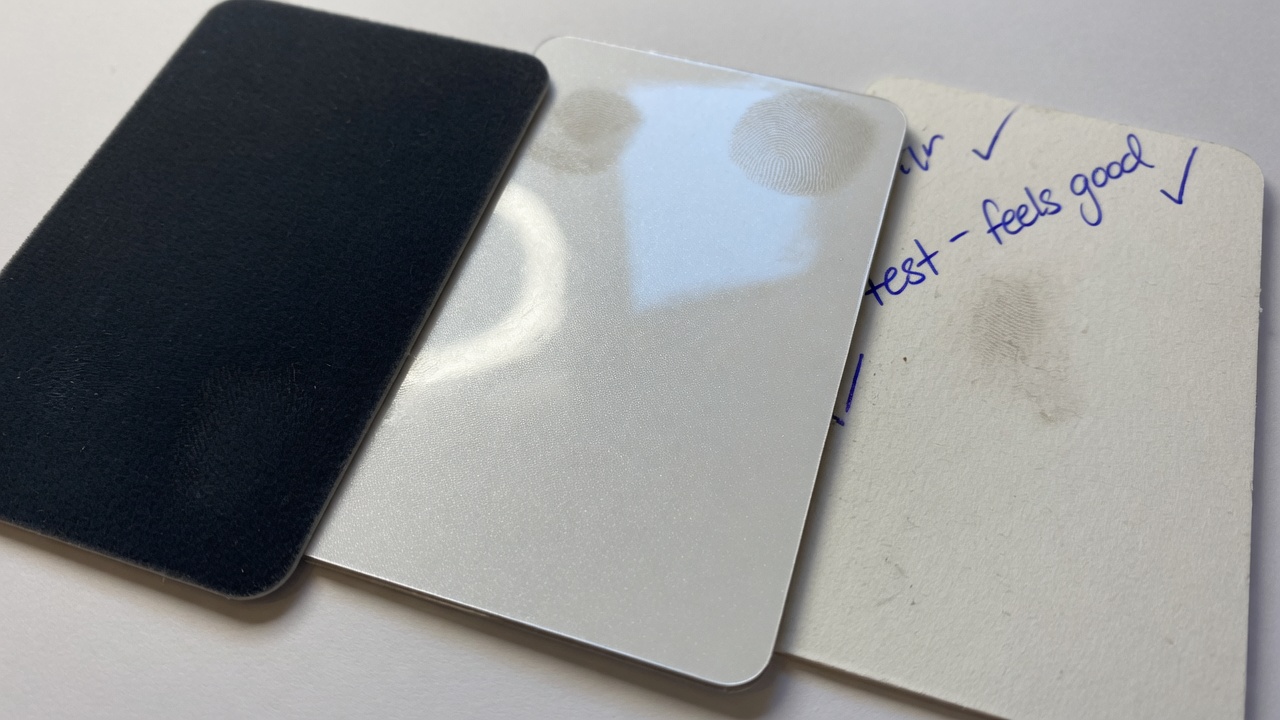
Coated and filmed cards show oil as a shine. Recycled uncoated shows oil as a darker patch in the fiber. There is no buff. There is no microfiber cloth moment. You chose a porous sheet. Porous sheets stain. That is the fingerprint story on this stock, and it is the one people forget because the mockup was a clean beige rectangle.
What actually happens in Orange County hands:
- Sunscreen and lotion. Outdoor opens, clinic desks, anyone who walked across a plaza at noon. Oil goes in. On a cream PCR sheet it becomes a translucent spot. On a dark printed panel it becomes a blotch that looks like press damage and is not.
- Kitchen and hospitality. Grease. Uncoated dies here. Recycled uncoated dies with specks in the grease. If a chef’s personal card is paper-forward and lives in a shirt pocket, fine. If the card lives in an apron, pick a sealed surface and a recycled coated claim if you still need a sentence.
- Job-site dust and cup holders. Grit abrades fibers. Edges go fuzzy. Dark ink rubs onto the next card. Contractors who love the recycled story still destroy the sheet next to screws. Silk-free uncoated is a poor cup-holder product. Say so before we print 1,000 for a superintendent.
- Wallet and denim. Uncoated pills at the corner. Recycled can pill a little more if the sheet is bulky and loosely formed. A week in a jeans pocket is a wear test. A month is a display of honesty or a display of regret, depending on the brand.
Dark full bleeds are the fingerprint multiplier on every surface. On recycled uncoated they are also the mottle multiplier. Navy flood plus sunscreen plus a speckled mill is how a principal card looks handled before lunch. Fixes, in order: light field, type on paper, smaller panel, accept the stain as the aesthetic, or change surface. I will not “make the navy more coated” in the press settings to save a layout that belongs on C2S.
Light fields forgive. Warm white, cream, pale gray, a lot of unprinted fiber — that is how law and architecture cards stay clean-looking on this stock. The paper is the color. Ink is drawing. If you treat the sheet as a billboard, the billboard will look thirsty.
Stacking and rub: uncoated ink sits where a thumb can move it. A rubber band across a fresh dark panel is a reprint with a stripe. Interleave if the coverage is heavy, or keep coverage modest, which is the better design on this sheet. Box the cards. Do not dump them loose in a tote with a water bottle and a battery pack and then ask why the recycled run looks older than the coated run from last year. It is older in fiber years. That was the point, until abrasion made it the problem.
Request a mill-sheet and quantity quote
Law, CPA, and architecture: three Irvine brands on one kind of sheet
The same mill grade does not serve those three rooms the same way. Layout, shade, and quantity do the splitting. The sheet stays uncoated and, if you mean it, recycled.
Law firms in the towers
The card has to look like a document, not a product launch. Warm white or a quiet cream PCR uncoated, 16pt if the drawer can take it, type-forward, name readable, one phone, one email, firm mark modest. Back blank or nearly blank so a partner can write. Navy is usually type or a small band, not a full-bleed piano. A full-bleed navy on thirsty PCR will mottle and then stain at every handshake in a courtyard.
Claims on a law card should be quieter than the letterhead poem. A 7-point line on the back — mill name and PCR percent — is enough if the partnership wants it. A leaf next to the State Bar number is how you look like a nonprofit brochure. Skip the leaf. If the firm already standardized on a mill for letterhead, put that mill on the card quote so we are not matching two creams by eye on a monitor.
Quantity: partners and of counsel on the nicer mill and caliper; associates on a house recycled uncoated if the budget is the constraint. Same grid. Different stock line. High-churn seats should not trap a special-order 100% PCR cover in a box that will be wrong when the title changes. Paper-forward is not the same as luxury-ply sentimentality.
What I push back on for counsel: coated recycled that looks like every other card in the mixer, then a speech about values. Either the object matches the sentence or the sentence comes off the card. I can print both. I will not pretend they are the same.
CPA and advisory practices
Tax season, new hires, manager promotions, a January rewrite of titles. Recycled uncoated is still the right surface if people write appointment times and if the firm wants paper. It is the wrong place to fall in love with a mill that is a special order and a shade that cannot reprint in February.
Start with a named, repeatable grade. 14pt or 16pt uncoated with a stated PCR percent. Type-forward. Credentials that change the appointment go after the name, not in a paragraph. Back: writing space, not a service menu of twelve items. Seasonal slogans about the tax year belong on a mailer, not on a card that will be handed in August.
Color: a conservative navy or charcoal on cream. Avoid large teal floods that dry back into something the brand committee will reject. If you have a bright brand from a website, proof it on this sheet or keep the bright mark small.
Staff versus partner: same as law. Partners can carry a more speckled, more expensive uncoated if that is the culture. Staff should reprint without a eulogy for a mill. Recycled uncoated is easy to over-romanticize in a partner meeting and easy to hate in a coordinator drawer when 400 cards still say last year’s title.
Architecture, interiors, landscape
This is the room where recycled uncoated is not a compromise. Specks, bulk, pencil, a slightly irregular edge after a week in a bag — those read as care if the layout is spare. Designers already know paper. They will notice if you put film on a sheet you described as chipboard-adjacent.
Layout: name, credential letters that matter (AIA, ASLA, PE as the ones people actually look for), firm, one contact path. Back: empty enough to sketch a north arrow or a job number. A dusk photograph of a stairwell as a full bleed will go dull and mottled. If the photograph is the brand, this may be the wrong surface, or the photo needs to be a small plate on a field of paper, like a print in a margin.
Shade: gray, warm white, genuine kraft-adjacent if the mill is that grade and you accept even lower holdout. True kraft cover prints like cardboard because it is close to cardboard. Ink holdout will be poor. Type must be robust. Reverse type is a dare.
Principals sometimes want cotton instead of recycled wood fiber. Say so. Cotton is a different handshake: rag tooth, often cleaner, not speckled unless you bought speckled cotton. Do not file cotton under “recycled uncoated” in an email and expect one swatch. If the studio’s drawing paper is the muse, bring a piece. We will not match it by telepathy, and we will not call it FSC because the drawing pad had a logo.
If the lockup is still a fight between a monogram and a fiber field, that is a design job. Custom business card design in Irvine should follow the sheet: uncoated recycled wants type, margins, and paper showing. It does not want a coated-style navy tile with 6-point reverse contact. We will set the name first and let the fiber do the rest. That sentence saves reprints.
Premium uncoated and specialty card stocks live in this mill-and-caliper world. Recycled uncoated is premium when the sheet is named and the layout is spare. It is not premium when it is a cart label on 14pt that still flexed in the partner’s fingers. Caliper is a different line from fiber. Say both.
Files, shade, and proofs that tell the truth on fiber
The press does not care that you paid for post-consumer fiber if the file is a coated layout. Spec the file as a 3.5 × 2 inch card with 0.125 inch bleed, live matter 0.125 inch off trim, CMYK, 300 ppi images, fonts outlined or embedded — then design as if the paper is a color.
- Let paper be a color. Open margins. Cream showing. A band or a rule instead of a flood. If you need a flood, expect mottle and dryback, and keep reverse type out of the 6-point basement.
- Build black on purpose. 100K for names and contact. Panels: a modest rich black or a warm dark, proofed, not RGB 0-0-0 left to chance.
- Avoid hairline reverses and 0.25-point rules. Fibers eat them. Bump weight.
- Photographs: add a little contrast and expect a matte, bookish read. Crop. Do not full-bleed a low-contrast dusk shot and then reject the mill.
- Specks are not a Photoshop overlay. Do not illustrate specks in the file on a smooth mill, and do not try to hide mill specks with a flood. If specks bother the brand committee, you wanted a cleaner PCR grade or a virgin uncoated, not a retoucher.
- Back file: light field if anyone writes. A full-bleed photo on the notepad defeats the pen and still scuffs.
Shade matching: recycled uncoated lots move. Warmth and gray cast vary by mill and by run. If the card must match letterhead, envelopes, and a presentation folder, we are matching several objects, not one hex. Budget proofs. A single mill family across collateral is the sane path. Mixing a cool digital house white with a warm PCR cover is how the card looks dirty next to the letterhead when both are “white.”
Brightness numbers you may see on mill sheets are often TAPPI brightness, a directional laboratory method, not a promise that two “92 bright” sheets will look the same in a Barranca window. Recycled uncoated commonly reads creamier than virgin uncoated at the same published number because shade is not brightness. Look at the sheet. Do not shop brightness alone.
Do not send a flattened 72 dpi PNG of a coated mockup and then specify recycled uncoated. You will buy the sheet twice: once to see the dryback, once to fix the file. PDF with bleed. If you need us to rebuild the layout for fiber, say that on the quote instead of hoping a Spectrum-teal flood will charm its way through an open sheet.
Rounded corners on uncoated recycled: the radius can show a slightly fuzzy board if the die is tired or the sheet is bulky. Mention corners. They are not “standard cards.” They also eat the corner of your safe area. Pull type in.
Caliper, bulk, and mill sheets worth naming
In North American shops, cover “pt” is caliper: thousandths of an inch. 14pt is specified around 0.014 inch. 16pt around 0.016 inch. Recycled uncoated can bulk higher than a dense C2S at the same point, which means your fingers may read “thicker” while a micrometer argues. Stiffness is not bulk. A puffy 14pt PCR can feel tall and still taco-bend. Bend the sample. Do not shop a speckled swatch against a laminated 16pt and call the recycled sheet thicker.
Gsm is mass per area. It does not equal height. Two 270 gsm uncoated covers from two mills can caliper differently if one is dense and one is bulky. Typical shop talk, as ranges rather than a formula: a 14pt recycled uncoated cover often lives in the same mass neighborhood as other 14pt covers, sometimes a little lighter or loftier depending on the mill. Confirm caliper on the quote. Write 14pt or 16pt, uncoated, recycled content as published, not “thick eco.”
I start most Irvine professional recycled uncoated cards at 16pt when the drawer and the wallet allow it, because the extra stiffness helps a thirsty sheet feel like a card instead of a notepad that got lost. 14pt is enough for high-churn CPA staff, campus titles, and any seat that will reprint before the box is empty. Duplex uncoated — two uncoated sheets glued — exists as an object card. It will still write on the faces if those faces stay uncoated. It will not impersonate cotton. It will show a ply at the edge. If you want that object, say duplex uncoated on the quote as its own line. Do not call it 32pt recycled and assume I know which sandwich you meant.
Named mills you may already have on letterhead — the usual North American uncoated and PCR families — are a starting point, not an inventory promise in a blog post. Mohawk, Neenah, Domtar, and similar merchant grades show up in this market; availability moves. Write the mill and the grade you want. I will tell you whether we can put it on press, what cover caliper exists, and what the mill’s recycled sentence actually is. If you do not have a mill, come to the counter and pick a swatch. Ten minutes of fingers beats a paragraph of “something like that brown craft one.”
Through-color and kraft: some recycled sheets are dyed in the fiber. Edges match the face. Holdout is worse. Type must be bigger. These read as packaging, which some studios want and most law firms do not. Say through-color if you want it. Do not say “kraft” when you meant “cream PCR with a few specks.”
Reprint mistakes we see from the Barranca counter
These are recycled-and-uncoated reprints. Not theoretical. Not a customer named in a testimonial.
- Ordering “eco uncoated” and receiving a coated recycled sheet. The cart said recycled. The surface was clay. The pen failed. Fix: write “uncoated” and the PCR percent as separate facts.
- An FSC lockup in the file on a house sheet with no chain of custody. We will not print the mark. The file comes back. Fix: delete the logo or set the job up as a documented certified run, which is not the default card quote.
- “100% recycled” on the back of a 30% PCR mill. Someone’s brand guide had a sentence. The mill sheet disagreed. Fix: copy the mill sentence. The FTC will like you better, and so will the partner who gets asked.
- Navy full bleed on 100% PCR uncoated, rejected for mottle. The PDF was a flat rectangle. The sheet was a landscape. Fix: type on paper, or a coated sheet, or accept the landscape in writing before we print 1,000.
- Color approved on a coated proof, then shock at dryback. Holdout is the job. Proof on the mill grade.
- Film or heavy AQ “for protection” on a card that was supposed to take pencil. The architecture studio could not sketch. Fix: keep the notepad face uncoated. Protection and tooth are a fight. Pick the winner per face.
- Cotton specified in a meeting, recycled kraft delivered in a memory. Different fibers. Different claims. Fix: name rag or name PCR wood fiber.
- Sunscreen stains on a dark panel at an outdoor mixer, blamed as a press flaw. Oil in fiber. Fix: light field, or a sealed surface if stain is unacceptable.
- Rubber-banded pack, dark coverage, hot car, setoff stripes. Uncoated transfers. Store inside. Let it sit. Do not bind a fresh stack with a band across the face.
- Special-order mill for twenty associate names, then a title change in six weeks. The remaining box is an honest paperweight. Fix: house-repeatable PCR uncoated for churn seats; named mill for stable principals.
- Matching a letterhead cream by memory. Two whites, one dirty-looking card. Fix: same mill family, or a proof pair.
- No finish named, then surprise that “recycled” arrived glossy. Quotes confirm size, material, quantity, finish, and date. Finish on this product is usually none. Write “uncoated, no flood, no film.” If one of the five facts is missing, the spec is a wish.
The cheapest reprint is the one you do not do. Swatches exist so you can be boring and correct. A PDF cannot take a pen test, cannot show specks, and cannot stain under a lotioned thumb.
Orange County handling that actually changes this sheet
Not every local color belongs on a card spec. These do, because they change oil, heat, abrasion, and who is allowed to write on the back.
Courtyard glare is not your enemy here. Uncoated recycled is a low-glare surface. Type stays readable in Irvine Company plazas, University Center tables, and Spectrum outdoor meetings where gloss cards become mirrors. That is a real reason to pick it even if you never print a PCR sentence. The tax is stain and scuff, not glare.
Sunscreen and lotion. Newport and Laguna meetings, weekend opens, anyone who walked from a parking structure at noon. Oil is the enemy of dark fiber panels. Light fields. Shirt pockets. Do not expect a recycled uncoated navy flood to survive a waterfront handshake looking new.
Heat and parked cars. Inland Irvine in late summer cooks a cabin. Uncoated stacks dry, can take a wave, and will setoff if ink is still moving. Film is not the only finish that hates a dashboard. Fiber hates the rubber band and the riffle. Keep boxes at the office. Keep a day’s carry in a bag, not on the dash of a Civic on Barranca.
Coastal humidity versus inland dry. Newport rooms are kinder to uncoated curl than a warehouse on a dry windy day, until salt air and sunscreen join the party. Inland offices with air conditioning are the easy home for this sheet. If your team works both, the sheet is still fine; the storage is the spec. Do not warehouse in a trunk between Tustin job sites and a Barranca office.
Convention weeks. Anaheim Convention Center traffic means tote-bag abrasion and stacks that strangers riffle. Uncoated recycled will look handled by the afternoon. That can be honest. It can also look tired next to a filmed card on the same table. If the card is a booth stack for three days, this may be the wrong surface. If the card is a principal leave-behind in a folder, it is the right one. Pick for where it spends the day.
HOA and office-park culture. This is not a yard-sign problem. It is a lobby problem. Irvine Company towers are full of quiet materials: stone, glass, walnut, cream paper. Recycled uncoated belongs in those rooms when the layout is spare. A speckled kraft flood with loud type does not. Match the lobby, not a craft-fair memory of “recycled.”
UCI-adjacent and high-churn offices. Labs, startups, medical groups adding associates. Reprint names. Do not trap a mill-poetry sheet in a carton that will be wrong in ninety days. A repeatable recycled uncoated 14pt or 16pt is enough. Fiber is not where you spend money that titles will outrun.
Job sites between Tustin, Santa Ana, and Costa Mesa. Dirt, cup holders, one-handed reads. Recycled uncoated will scuff. Some GCs still want it for the claim. Give them a light field, robust type, 16pt, and a quantity that assumes replacement. Do not give them a dusk photograph and a 7-point URL.
Medical and dental adjacent to these professional buildings. Lotioned hands, a front-desk bowl. Uncoated stains. Public bowls want a sealed card. A provider’s personal leave-behind in a consult folder can still be paper. Split the spec. Do not put the principal’s PCR uncoated into the candy bowl.
Local does not mean a different physics of paper than the rest of California. It means your oil, sun, tote, and title weather are specific. Tell me where the card lives after the handshake. I will tell you whether recycled uncoated is a brand or a cleanup problem.
What to send so the quote names the mill claim
A usable quote request is short. Missing fiber class is how you get a number for the wrong sheet, or a pause while we reverse-engineer “eco.”
- Size. 3.5 × 2 inches, or the custom size in inches.
- Quantity. Per name and total. If partners and staff split mills, two quantities.
- Material. Uncoated; caliper (14pt / 16pt / duplex if you already know); recycled content as you want it stated (for example 30% PCR or 100% PCR), or “recommend a repeatable grade.” Cotton only if you mean rag.
- Finish. None — write “uncoated, no flood, no film” if that is the truth. If you want a hybrid, write which face stays writable.
- Sides. 4/4 or 4/0. If the back is a notepad, say so in those words.
- The claim, if any, in the words you want on the card. I will check it against the mill. Do not send an FSC PNG as if it were a finish.
- Writing. Yes or no, which face, which pen. This sentence prevents the film-and-anger reprint.
- Date. The date you need them in a hand in Irvine. Named mills that are not in the room can add merchant time. Put the date on the quote; do not assume a house sheet if you named a rare grade.
- Pickup or ship. Pickup at 15321 Barranca Pkwy, Irvine, CA 92618, or a ship-to address.
- Files or a note that you need design. PDF with bleed preferred. If the layout is a coated navy flood, write that. We will quote a print-ready layout that belongs on fiber instead of pretending the press can invent holdout.
Helpful extras: letterhead mill name if matching matters; whether specks are wanted or forbidden; whether dark panels are mandatory; longest title if this is a batch; whether anyone will highlighter-mark the card.
That list is the job. I can estimate from it. I cannot estimate from “eco cards, usual amount, soon.” If you want to feel PCR uncoated, virgin uncoated, and a recycled C2S before you lock the line, say that. Ten minutes at the counter will save you a paragraph of adjectives and a mark we would have stripped from the file anyway.
Walk-ins Monday–Friday, 8:00 a.m. to 5:00 p.m. Call (949) 387-0787 if you are coming with a pen and a letterhead sample. Send the same spec through the quote form if you cannot come in.
For a broader view of what we print besides mill-claim debates, start at the Business Cards Irvine home page and then send the quote with the five facts: size, material, quantity, finish, and date. Daily-carry work still runs through Irvine business cards we print for ordinary professional carry; the fiber line is what this page is for. If you already know you want a quieter, heavier uncoated object, look at premium business cards on named uncoated stocks and still write PCR as a number, not as a mood.
FAQ
What are recycled uncoated business cards, exactly?
A mill cover stock with no clay coat, printed as a 3.5 × 2 inch card, using a sheet the mill publishes as containing recycled fiber. Uncoated is the writing surface. Recycled is a percentage and a class, usually post-consumer if you want the sentence clients mean. Color sits drier than coated. Specks and shade come from the mill. Film and flood, if you add them, change the product into something else. Quotes still need size, material, quantity, finish, and date.
Will Avanti print an FSC logo on my cards?
Not as a default, and not because a mockup included a PNG. FSC and similar marks are chain-of-custody systems. Avanti will not invent an FSC certification for your box. We will print the mill’s recycled-content sentence when the mill sheet supports it. If you need a documented certified job, that is paperwork and a specific supply chain, not a cart checkbox. Delete the lockup or ask for that job in writing before we quote ordinary cards.
Can I write on recycled uncoated cards with a ballpoint?
Yes. That is half the reason to buy them. Pencil and most gels also work. Fountain pens may feather on a very open 100% PCR sheet. Sharpies mark and can still transfer if you stack wet. Test the mill you will print. Do not film both faces and then get angry at the pen. If only the back must write, say so; a hybrid is allowed.
Why does my navy look dull or mottled on this stock?
Ink holdout. Uncoated drinks. Recycled uncoated often drinks more. Wet color dries down, solids show formation, specks become islands. That is the sheet, not a dirty press. Design type-on-paper, proof on the real grade, or pick a coated recycled sheet if a flat tile is the brand. Do not approve a coated PDF and expect the same navy on PCR fiber.
Do fingerprints show on recycled uncoated cards?
They show as stains, not as shiny prints. Oil from lotion and sunscreen goes into the fiber. You cannot buff it out. Light fields hide this. Dark floods advertise it. If wipe-down matters more than tooth, this is the wrong surface. If you stay with fiber, keep the layout spare and the pockets clean.
Is 100% post-consumer always the better card?
No. It is the stronger content claim and often the more speckled, thirstier, bulkier sheet. Law-firm type and a flat navy usually prefer a moderate PCR uncoated or a cleaner grade. Architecture studios often want the 100% look. CPA staff cards often want a repeatable mill that can reprint in February. Match the percentage to the room and the reprint cycle, not to a contest.
What should Irvine law, CPA, and architecture firms spec?
Law: warm-white or cream uncoated, named PCR if you want the sentence, 16pt when it fits the drawer, type-forward, writable back, no leaf next to the bar number. CPA: repeatable recycled uncoated, modest quantity, writing space, no seasonal slogan. Architecture: fiber showing, specks allowed, sketchable back, photographs as small plates not floods. All three: write uncoated, write the percent, skip invented marks.
What do I send to get an accurate quote?
Size, material (uncoated, caliper, PCR percent or mill grade), quantity, finish in chemistry words (usually none), and the date you need them in a hand. Add sides, whether anyone writes, the claim sentence if any, pickup on Barranca versus ship, and a PDF with bleed or a note that you need design. I will not invent a mill or an FSC mark to fill a blank. Call (949) 387-0787 if you want to match swatches and a letterhead first.
Name the fiber, keep the tooth, then print
Recycled uncoated business cards are a mill sheet plus a refusal to coat it. The writing surface is the product. The recycled sentence is a percentage you can defend. Ink holdout is why navy dries down. Fingerprints are stains. Irvine law, CPA, and architecture brands get this sheet when they want paper in the hand, not a tile and a leaf. Avanti will print the mill’s claim. Avanti will not invent a forest logo for your box. Quotes confirm size, material, quantity, finish, and date — write all five, and write material as uncoated plus a real PCR number.
If you want this decided with a pen and a swatch instead of a mood board, come to Avanti Printing, 15321 Barranca Pkwy, Irvine, CA 92618, bring a ballpoint and a letterhead if you have one, and ask to see recycled uncoated next to virgin uncoated and a recycled coated sheet. Or send the spec and the date through the quote form. Call (949) 387-0787. Run the pen test. Read the mill sentence. Then we can print the fiber you meant.