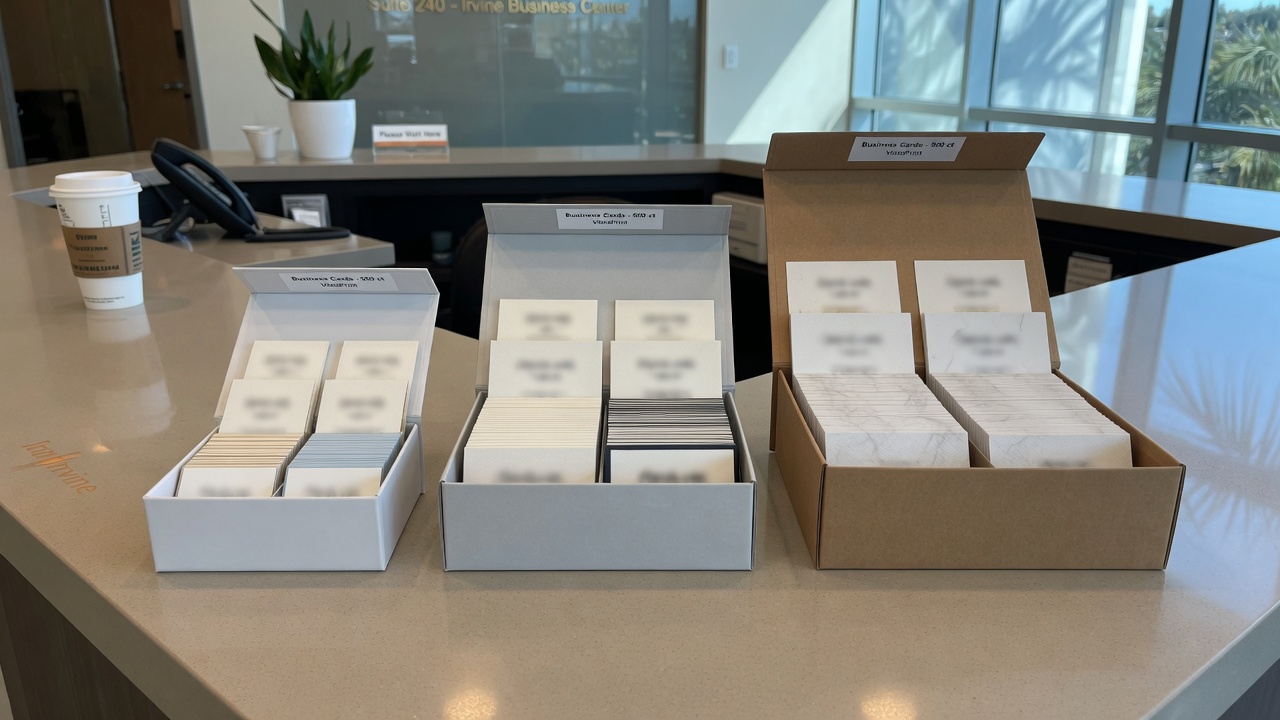
Order 250 cards for one stable Irvine name you will actually hand out. Order 100 if titles still move. Order 500 if you network weekly and the name is frozen. Order 1,000 only if that identity lasts a year. A cheap thousand is expensive when 800 still say last year’s title.
That is the quantity decision, stated as a stack you can empty. The rest of this guide is burn rate, Irvine networking cadence, title changes, box storage, and when a reprint of 250 correct cards is cheaper than a drawer of 800 wrong ones. I estimate this work at Avanti Printing, 15321 Barranca Pkwy, Irvine, CA 92618. If you want to look at actual cartons instead of a cart badge that says “best value,” call (949) 387-0787 and come in. Quotes still confirm size, material, quantity, finish, and date. Quantity is one of those five facts, not a mood.
People type how many business cards to order after an online menu offered 100, 250, 500, and 1,000 at four different unit prices and did not ask whether the title would survive the box. Unit price is not inventory cost. Inventory cost includes the cards you will throw away, the cards you will keep handing with a crossed-out suite, and the week you run out in the middle of an Anaheim convention. Those are different bills.
Who this quantity question is for in Irvine and Orange County
This write-up is for the person who approves the line on the quote and then has to live with the carton. Founders in Irvine Company suites, brokers working Spectrum opens and Newport showings, clinic administrators on Barranca and Alton, attorneys who hand six cards a month, contractors who keep a rubber-banded pack in a cup holder, consultants on BNI and chamber calendars, restaurant managers whose staff list changes faster than the lunch special. You are buying a stack for Orange County, not a discount tier.
If you hand cards at a mixer, the other person takes one. If you sit a booth, they take three and lose two. If you hire three associates this quarter, you do not have one quantity. You have four names and four likely expiration dates. The carton does not care that the cart called 1,000 a savings.
I split buyers into jobs, because the count should follow the job:
- High-churn names. New hires, rotating sales seats, event staff, resident physicians, postdocs and lab staff near UCI, interns at Spectrum-area companies. Start at 100. You will reprint. Design the spec so reprinting is boring.
- Daily professional names. Brokers, attorneys, CPAs, clinic directors, consultants who work Irvine Chamber breakfasts and BNI tables. 250 is the usual first box. 500 if the name, cell, email, and suite are frozen and you actually leave the office.
- Frozen identity. A practice name with no personal title, a shop owner who has used the same cell for a decade, a company card for a booth with a URL and a main line. 500 or 1,000 can make sense if storage is indoors and the identity will not move.
- Whole offices. Do not order one thousand of each person because the unit price dropped. Order by seat. Owner and rainmakers can sit on a different count than the coordinator who started last Monday.
If you are ordering standard business card printing in Irvine for a whole floor, send a name list with a quantity next to each name. One number for the company is how you end up with 800 cards for a person who has already left for a job in San Diego.
100 vs 250 vs 500 vs 1,000, side by side
Use this as a counter conversation, not a lab report. Burn-rate weeks are typical ranges I see in this market, not a promise about your calendar. Cards per week means cards that leave your hand, not cards that sit in a glove box.
| Count | Who it fits | Supply at ~8/week | Supply at ~25/week | Title-change risk | Storage |
|---|---|---|---|---|---|
| 100 | New seat, moving title, first layout, quiet practice | ~3 months | ~1 month | Low leftover if the email changes | One small box in a bag or drawer |
| 250 | Default Irvine professional with a stable name | ~7 months | ~2.5 months | Usually survivable; still not a two-year bet | One box on a shelf; easy to finish |
| 500 | Weekly mixers, listing season, sales in the car | ~1 year | ~5 months | High if a suite, cell, or title is even slightly soft | A real carton; needs indoor storage |
| 1,000 | Frozen company identity or a name that has not moved in years | ~2 years | ~10 months | Usually too high for a personal title | Drawer and overflow; heat and humidity matter |
Eight cards a week is a consultant who lunches, visits a job site, and hits a mixer twice a month. Twenty-five a week is a listing agent in a busy stretch, a booth week, or a sales seat that lives in Costa Mesa and Tustin offices. Neither number is a law. Both are more honest than “I will just take a thousand.”
The jump from 100 to 250 is usually the right upgrade when you already ran out once and the file is done. The jump from 250 to 500 is a calendar bet: you are betting the name, title, phone, email, suite, URL, and logo will all still be true when the second half of the carton is still full. The jump from 500 to 1,000 is rarely about running out. It is about a cart badge. Be suspicious of that badge.
Quantity is not a discount. Quantity is a forecast of how many correct cards you will hand before the file is wrong. If you cannot name the date the title might change, do not buy two years of that title.
Get pricing for 100, 250, 500, or 1,000 cards

Burn rate: cards per week, not a cart badge
Forget the menu for a minute. Count the last thirty days. How many cards actually left your hand? Not how many you meant to hand. Not how many are in the console. How many other people walked away with one.
If you cannot remember, you are probably in the single digits per week, or you work in bursts. Both are normal. A quiet CPA in an Irvine tower might hand two a week and still need a card that looks like a firm. A broker can hand forty on a Sunday open and twelve the rest of the month. Average those honestly. A burst week is not a 1,000-card argument unless you have those weeks often and the identity is frozen.
A simple forecast I use at the counter:
- Write down cards handed in a typical week. If you do not know, start a tally on your phone for two weeks. Guessing high is how leftover boxes are born.
- Write down the next date a line on the card might change: title, cell, suite, email domain, license number, logo. If that date is “maybe this year,” treat it as inside six months.
- Multiply weekly burn by the weeks until that date. That product is your ceiling, not your target. Then round down to 100, 250, or 500. Round down, not up. Running out is a reprint. Being wrong for eight hundred leftovers is a write-off plus a reputation problem.
- Add a small buffer only if you have a known event: a three-day Anaheim week, a UCI career fair, a chamber ambassador month. Add 100 or 250 for the event, as its own thought, not by leaping to 1,000.
Example, stated as arithmetic, not as a case study. You hand about ten a week. Your title is likely to change when the firm adds a partner in the fall, call it twenty-four weeks. Ten times twenty-four is 240. Order 250, not 1,000. If the partner vote slips a year, you reprint 250. That reprint is cheaper than 750 cards that still say Associate when you are a partner — cheaper in money, and cheaper in the ten seconds where a client looks at the old title and wonders whether you are sloppy or the firm is.
Second example. You sit booths. Twice a year you hand 150 in a weekend and otherwise you hand five a week. Annual burn is roughly 300 plus the booth weekends, call it 600 if both booths are real. That still does not automatically mean 1,000. It can mean 500 now and 250 before the second show, after you confirm the cell and the booth URL have not moved. Split orders are allowed. The cart hates them. Your drawer likes them.
Third example. You are a new hire. You do not have a burn rate. You have a probation period and a title that may add a credential. Order 100. If you empty them in six weeks, you have data. Then order 250. Paying for two small runs beats a carton of “Marketing Associate” after you became Manager.
Per-card price drops as the stack grows. I will not invent a price list here. You already know the shape: the second 750 is cheaper per card than the first 250, and still more expensive than a 250 reprint if you discard the 750. Estimators talk in jobs, not in the romance of a bulk tier. A job of 250 correct cards twice is two clean jobs. A job of 1,000 that you hide in a closet is one job you regret.
Offset-versus-digital quantity breaks belong in a different conversation for catalogs and long-run commercial work. For typical Irvine business cards, the usual steps on the quote are 100, 250, 500, and 1,000 because those are the counts people actually carry, box, and reorder. Ask for the count you will take. Do not ask me to “price it both ways” with no name list and no date. I can price four quantities. I cannot pick your title’s expiration date for you.
Irvine networking cadence and what a week actually uses
Orange County networking is not one behavior. It is a pile of rooms with different take rates. Match the stack to the rooms you actually enter, not to a generic “I network.”
Irvine Chamber and similar breakfasts. You may hand five to fifteen in a morning if you work the room. Monthly cadence, not daily. A year of monthly breakfasts at ten cards is 120 cards before any other work. That is a 250-card year if breakfast is most of your handing, and a 500-card year if you also do site visits. It is not a 1,000-card argument by itself.
BNI and weekly referral tables. You see the same people. You do not hand a card to the whole room every week. You hand cards to visitors and to guests those members bring. Typical range, not a study: a handful a week, with spikes when you speak. 250 still covers a long stretch. The failure mode here is not running out. It is still having last quarter’s title in the weekly pile while the group already knows you changed roles.
Coffee and suite meetings. University Center, Spectrum, Barranca corridors. One or two cards per meeting, and you may take one back if you wrote on it. Quiet burn. 100 or 250.
Listing opens and weekend traffic. Irvine, Tustin, Newport, Laguna. A busy open can empty a 100-pack if you staff it honestly and people actually take a card instead of a text. That is the case for 500 on a listing-agent name during a hot season — if the cell, photo, and brokerage line are stable. If the team is about to move offices, do not buy the season in one carton.
Medical and dental front desks. The desk stack is a community bowl. Strangers take two. Staff reprint names when a provider is added. 100 per new provider until the credentialing line is final; 250 for a stable director; a separate 500 of a generic clinic card with the main number and portal URL if the desk should never be empty. Do not print 1,000 of Dr. Name until the suite on Alton is the suite you will keep.
Campus, labs, and UCI-adjacent companies. Titles, appointments, and emails move. 100 is professional. 1,000 is a box of former postdocs. Keep the layout as a master and the names as a list.
Convention weeks at Anaheim. Badge sleeves, tote bags, and a counter stack that strangers riffle. You can hand 50 to 200 in three days if the booth is busy. That spike is real. It is also a known date. Put the date on the quote, order a show stack, and do not convert a three-day spike into a two-year carton of a title you took to look busy. Production time is quoted after quantity, finish, and the date you need them in a hand — the show date is a fact, not a reason to skip the name check.
Job sites between Tustin, Santa Ana, and Costa Mesa. Supers and PMs hand fewer cards than sales, and they hand them in dirt. Burn is modest. Being out at a trailer meeting is annoying. Being the person who still lists last year’s GC on 600 cards is worse. 100 or 250, laminated or coated as a separate line, stored in a bag, not on the dash.
Hospitality and restaurants in the Spectrum and Woodbridge. Managers change. Venues reprint. A house card with the reservation line can be 500. A person card should stay short. Do not print the sous-chef’s personal cell on 1,000 pieces.
Cadence is local because the rooms are local. It is not a different mill than the rest of California. Tell me which of those rooms is your week. I will not guess you are a chamber ambassador because you parked on Barranca.
Title changes and leftover inventory
The expensive part of a business card is not the extra 750 pieces. It is the line that becomes false while the pieces still look new. Titles, suites, cells, emails, license numbers, and logos all expire. They do not expire on the same day.
What actually moves, in this county, often enough that I ask about it before I cheer for 1,000:
- Title. Associate to Senior, Manager to Director, “Founder” to a real officer title once the LLC paperwork catches up. Startups in the Spectrum do this constantly. Law and accounting firms do it on a calendar. If a promotion is even being discussed, 100 or 250.
- Suite and address. Irvine Company floors reshuffle. A 92618 suite number is a print line, not a feeling. If the lease is in negotiation, do not freeze 1,000 cards to a suite you do not have. A main phone and a URL survive a floor change better than a suite. If you must print a suite, keep the count short until the first rent check clears.
- Direct cell. People switch carriers and stop putting the office board line on the card. A cell change makes every remaining card a wrong number. That is not a “use them up” situation. It is a reprint.
- Email domain. Acquisitions, rebrands, and “we finally bought the .com.” An old domain on a new card trains people to write to a mailbox you will stop reading. Remaining stock with the old domain is not inventory. It is a forwarding problem you will forget.
- License and credential lines. Real estate license numbers, medical credentials, “DRE” lines, “AIA,” “CPA.” If the number is pending, print 100 without it or wait. Do not print 1,000 with a blank where the number will go, and do not print 1,000 with a number you have not received.
- Logo and brand color. “We are refreshing the mark in Q3” is a 100-card sentence. It is not a 1,000-card sentence. If the identity is in custom business card design in Irvine and still moving, quantity should shrink, not grow, until the file is the file you will reprint from.
Leftover wrong titles do not sit harmlessly. Someone will hand them. Reception will refill the bowl. You will grab a pack on the way to a mixer because the new box is in the other bag. The market then learns the old title. Crossing out a line with a ballpoint is worse than being out. A sticker over a suite looks like a garage sale.
There is a version of leftover that is not a title error: you ordered 1,000, you hand four a week, and the cards are still correct. They are also two years old, slightly curled from a windowed office, and the coating has picked up drawer smell. Correct and shabby is still a bad card. Quantity has a freshness date even when the PDF does not.
When a reprint is cheaper than the leftover box
This is the sentence I wish more people wanted on the quote. A reprint is cheaper when the remaining wrong cards will either confuse someone or sit as a paperweight you already paid for. You do not need a spreadsheet. You need a leftover count and an honest look at the line that is wrong.
Reprint when:
- The title, cell, email, or suite is false. Remaining 400 of a false card is not a savings. It is four hundred opportunities to be wrong.
- You have more than a couple of months of burn left on a card you already distrust. If 600 remain and you hand 10 a week, that is more than a year of handing a card you are already tired of. Stop.
- The leftover is a mix of names from a departed employee. Do not “use up” a former coordinator’s cards at the front desk. That person does not work here. The bowl is not a recycling bin.
- You changed the layout enough that old and new in the same week look like two companies. Mixing generations in one mixer stack is how people ask which is current.
Do not reprint only because you are bored with the color. Do reprint because a fact is wrong. Those are different itches.
The leftover math, without fake prices: you already paid for the 1,000. The remaining 700 have a sunk cost of 700/1000 of that job. Handing them does not recover the job. It only spends the remaining usefulness. If usefulness is now negative — wrong title — the remaining value is zero. A new job of 250 has a new cost and a useful stack. Compare the new cost to the damage of the wrong stack, not to the sunk carton. Sunk cartons do not get less sunk if you hand them at a chamber breakfast.
A practical split that avoids the leftover trap:
- Lock the layout. One master. Names as data.
- Print 100 or 250 per person for anyone whose title is less than a year old.
- Print 500 only for names that have been stable through a prior box.
- Print 1,000 only for a company card with no personal title, or for a person who emptied 500 without a file change.
- When a line changes, throw the remainder. Do not donate them to the break room. Do not keep “just a few” in the glove box. The glove box is how the old title attends the next meeting.
Being out of cards for a week is a reprint and a short apology. Handing last year’s title for three months is a positioning error you cannot vacuum out of other people’s wallets.
Request a quantity quote for Irvine cards
Box storage, humidity, and parked-car inventory
A thousand cards are not a thousand ideas. They are a physical stack that takes up space, picks up moisture, and cooks in a cabin. If you do not have a home for the carton, you do not have a 1,000-card plan.
Paper is hygroscopic. It takes on and gives off moisture with the room. Labs condition paper at a stated atmosphere before they measure it; methods such as TAPPI T 402 exist because a sheet in a damp garage is not the same sheet as a sheet in a conditioned pressroom. You are not running a lab in an Irvine Company suite. You are still storing board. Typical commercial advice, stated as a range rather than a certificate: keep paper in a moderate indoor room, avoid damp garages, avoid sealed plastic in a hot car, and keep it wrapped until you need a pack. The Library of Congress notes on caring for paper make the same boring point in conservation language: stable temperature, moderate humidity, no attics, no basements, no sun. Your leftover carton is not an archive, but it fails in the same places archives fail.
What that means on Barranca:
- Do not store the carton in the car. Inland Irvine in late summer cooks a cabin. Film and adhesive dislike that. Uncoated stock waves. Rubber bands bite a curve into the edge. The Civic is not a warehouse. One working pack in a bag is inventory. The rest of the thousand on the back seat is a science experiment.
- Do not store against a sunlit window in a suite. The west glass in some towers will fade a stack and dry the cut edge. A closed cabinet is enough. A windowsill is not.
- Keep factory wrap on the unopened boxes. You open one pack. You do not open all four “to make sure they look good.” Every opened pack starts picking up dust, toner rub, and snack oil from the kitchen.
- Do not rubber-band a fat brick. Bands dent the long edge and leave a bow. If you need a pocket pack, use the small box or a simple card case. A band around 80 cards is how the top card looks used before the handshake.
- FIFO. Finish the open box before you crack the next. Mixing a two-year-old remainder with a fresh reprint is how you hand two whites of the same name.
- Heat and curl. Single-side coating curls more. Even a balanced card will take a dish if the pack sits in a trunk. If your team lives between Tustin job sites and the office, the working pack lives in a bag, not in the cup holder with screws.
How much space 1,000 cards occupy depends on caliper, which is a different quote line. In practical drawer language: 100 cards are a slim pack. 250 is the familiar small box most people picture. 500 is a carton you notice on a receptionist shelf. 1,000 is two of those, or one deeper carton, and it will migrate to a closet if nobody owns it. Closet migration is how you “run out” while 700 still exist in a banker box behind the holiday decorations.
Assign an owner. Reception, the office manager, or you. Someone has to know where the unopened boxes live and that they are not packing material for a trade-show crate. I have seen unopened card cartons used as a riser under a monitor. That was a 1,000-card order with a good unit price and a bad home.
If you do not have indoor shelf space, order 250. Storage is part of quantity. It is not a separate personality trait.
One name, many names, and company cards with no personal line
Offices get this wrong in a predictable way. They treat quantity as a company decision and names as a later paste. Quantity is per name. The press does not care that you think of it as one order.
Patterns that work:
- Per-seat counts. Eight people is eight quantities. 250 / 250 / 100 / 100 / 100 / 500 / 100 / 250 is a normal quote. It looks messy in an email. It matches reality.
- Owner versus staff. A principal who will still have the same cell in two years can take 500. The coordinator hired last month takes 100. Same layout, same color, different count. That is allowed.
- Company card plus person card. A booth or a front desk should not depend on a person’s cell. Print a company card with the main line, URL, and address — the lines that survive staffing — at 500 or 1,000 if the identity is frozen. Print short runs of person cards for the humans. Do not try to make one card do both jobs at 1,000 copies.
- Shared role cards. “Leasing Office,” “Property Manager,” “Reservations” with a main number. These are the rare good 1,000-card jobs, because the name on the card is the department. When a person leaves, the card is still true.
Patterns that fail:
- 1,000 of each employee because the estimator said the unit price dropped at 1,000. It dropped per card. You multiplied it by a roster.
- One name, 1,000 cards, then “we will just add the new people later” as if leftover board were a template. Later is a new job with a new file.
- A spreadsheet of twelve names, one quantity of 250, no indication whether that is 250 total or 250 each. I will ask. If you skip the ask because of a deadline, you may receive the wrong total. Write “250 each” or “250 total.”
Variable names are still one layout. Send the master and a list. The longest name and the longest title have to fit. Ordering 1,000 of a layout that collides on “Christopher, Vice President of Client Partnerships” is how you buy 1,000 collisions. Quantity does not hide a tight lockup. It multiplies it.
If several names are not ready, print the ready names. Do not hold the whole office hostage for one bio that marketing has not approved. Partial deliveries are normal. A missing name is not a reason to inflate the other names to 1,000 “while we are at it.”
Quantity is a file problem, not only a cart problem
The press will happily print 1,000 of a wrong PDF. Speed and volume are not quality control. Before you pick a tier, the file has to be the file you are willing to see 1,000 times.
Minimum file facts, because a fat order does not relax them:
- 3.5 × 2 inch trim unless you stated a custom size.
- 0.125 inch bleed on every side, with art that actually extends into it.
- CMYK, 300 ppi images at size, fonts outlined or embedded.
- Live type 0.125 inch inside trim.
- Two pages, front then back, or a clear 4/0 if the back is blank.
- The real name, title, cell, email, URL, suite. Not “Your Name Here.” Not last year’s suite. Not a personal Gmail you plan to retire.
If the layout is still a Canva draft, do not order 1,000 to “lock it in.” Order design, or order 100 as a field test. Print-ready layout and file prep exists so you are not using a thousand-card job as a proofing process. A paper proof of a 250 run is cheaper than a philosophical debate with a carton.
Name lists: one spreadsheet, columns for name, title, phone, email, extra line, quantity. Spell-check the cells. The longest title must fit the same template as the shortest. Export or send that list with the master PDF. Twelve separate Canva links are how one person loses a digit in a phone number and nobody sees it until the mixer.
Proofing at quantity: approve type as if you did not design it. Read the suite. Read the cell. Read the URL out loud. Click the URL on a phone. Call the number. I am not being theatrical. The reprints I see at 500 and 1,000 are often one character, and that character was in the file you approved on a parking-lot screen.
A quantity change after proof is a new confirmation. “Make it 1,000” on a 250 proof is allowed. It is also the moment people stop looking at the title because they are looking at the price. Look at the title again.
If you need cards in a hand by a known mixer or show, put that date on the quote with the quantity. A broken file does not start the production clock. A clean file and a real count do. I will not invent a date to fill a blank, and I will not invent a count because the cart highlighted a tier.
Quantity reprints we see from the Barranca counter
These are count-related reprints. Not theoretical. Not a customer named in a testimonial.
- Ordered 1,000 because the unit price looked like a win, then changed title in nine weeks. The closet still has 820. Fix: 250 until a name has survived a box.
- Ordered 250 total for eight employees. Each person got a handful. The booth was empty by Wednesday. Fix: write each after the name. 250 each is not 250.
- Printed 1,000 of a new hire during the first month. The hire left. The cards remain. Fix: 100 for a seat that is not proven.
- Kept handing old-title leftovers “so they would not go to waste.” Clients learned the old title. Fix: throw them. Waste is already spent.
- Stored the carton in a car and in a window. Curl, fade, rubber-band scars. The count was still 900. The usable count was not. Fix: indoor cabinet, wrap on, one open pack.
- Suite number printed during a lease negotiation. The floor changed. 500 cards named a suite that is now a different company. Fix: URL and main phone until the suite is real; short run after keys.
- Mixed old and new layouts in one mixer stack. Two logos, one week. Fix: finish or dump the old box before the new box leaves this building.
- No quantity on the quote, “the usual.” Usual is not a number. Quotes confirm size, material, quantity, finish, and date. If quantity is missing, the spec is a wish.
- Approved a PDF on a phone, then ordered 1,000. The email had a transposed letter. Fix: read the proof at actual size, then pick a count.
- Used leftover personal cards at the front desk after the person left. Callers asked for a human who does not work here. Fix: a department card for the bowl; person cards for people who still exist.
The cheapest reprint is the one you do not do. The second cheapest is the small one you do on purpose when a line changes, instead of the large one you try to postpone by handing fiction.
Orange County conditions that change how many you buy
Not every local color belongs on a quantity spec. These do, because they change burn rate, title life, and storage.
Tenant moves in Irvine Company parks. Suite lines die in clusters. If your floor is in a shuffle, every personal card with a suite is on a short fuse. Shrink counts. Lean on URL and phone. Reprint after the move, not before, unless you like boxes of a dead suite.
Medical and device corridor turnover along Alton and Barranca. Providers, fellows, and sales seats rotate. 100 is not an insult. It is how you avoid a bio that outlived the person. Directors with a stable office can step to 250 or 500 once the credential line is done.
Campus and startup title weather. UCI-adjacent labs and young companies change email domains and job names. A 1,000-card order is a bet those companies are bad at winning. 100, then 250, is the grown-up sequence.
Convention and show spikes. Anaheim weeks are real. Buy a show increment. Do not redefine your annual identity around three days. Put the show date on the quote so bindery is working to a date, not to a vibe.
Heat. The storage problem is local even when the mill is not. Inland parked cars and west-facing glass wreck leftover inventory. If your “warehouse” is a trunk, your maximum honest order is the pack you can keep indoors. That is often 100 or 250, regardless of unit price.
Restaurant and hospitality churn in the Spectrum and Woodbridge. House cards at 500 can be rational. Person cards at 1,000 are almost never rational. Staff lists move faster than cartons.
Real estate seasons. Opens eat cards. Teams also restaff. A listing-agent 500 is a seasonal tool if the brokerage line is stable. A new agent’s 1,000 is a carton that will still be full when the photo and the team name have already changed.
Quiet professional practices. Estate attorneys, some CPAs, specialists who take referrals and hand six cards a month. 100 or 250 is plenty. They order 1,000 because a relative told them to “get a good deal.” They then find the box during an office clean-out and read a dead URL. Quiet practices should buy freshness, not bulk.
Local does not mean a novelty size. It means your rooms, your heat, and your title weather. Tell me those. I will map them onto 100, 250, 500, or 1,000.
What to send so the quote names a real quantity
A usable quote request is short. Missing quantity is how you get a number that does not match the box, or a pause while we guess whether “250” was each or total.
- Size. 3.5 × 2 inches, or the custom size in inches.
- Quantity per name, and the total. “250 each, 4 names, 1,000 total.” Or “100 for A, 250 for B, 500 company cards.” Do not write “a box.”
- Material. Board caliper and coated or uncoated, or ask for a recommendation. Quantity and board both affect the carton you have to store.
- Finish. Aqueous, film, uncoated, none — as a chemistry, not “nice.” Finish is a different line from count.
- Sides. 4/4 or 4/0, or plain English (“color both sides”).
- Date. The date you need them in a hand in Irvine. A mixer date, a start date, a show date. Quantity without a date is still an incomplete quote.
- Pickup or ship. Pickup at 15321 Barranca Pkwy, Irvine, CA 92618, or a ship-to address. 1,000 cards is still a small parcel. It is not an excuse to skip the address.
- Files or a note that you need design. PDF with bleed preferred. Name list as a spreadsheet. If the file is not ready, say so instead of inflating quantity to feel decisive.
Helpful extras:
- Which lines might change in six months. I will not gossip. I will push the count down if you tell me the truth.
- Whether a front-desk bowl needs a department card separate from person cards.
- Whether anyone still has leftover boxes. Sometimes the right order is 100 because 400 still exist.
- Where the unopened carton will live. If the answer is “the car,” we are not quoting 1,000 as if that were neutral.
That list is the job. I can estimate from it. I cannot estimate from “usual cards, best quantity, soon.” Walk-ins Monday–Friday, 8:00 a.m. to 5:00 p.m. Call (949) 387-0787 if you want to look at carton sizes on a shelf. Send the same spec through the quote form if you cannot come in.
For a broader view of what we print besides quantity debates, start at the Business Cards Irvine home page and then send the quote with the five facts: size, material, quantity, finish, and date. Daily-carry work still runs through Irvine business cards we print for ordinary professional carry; the count is what this page is for.
FAQ
How many business cards to order for one Irvine professional?
250 is the default if the name, title, cell, email, and suite are stable and you actually leave the office. 100 if any of those lines still move, or if you are new in the seat. 500 if you already emptied a 250 box without changing the file and you work weekly mixers or listing traffic. 1,000 is for a frozen identity, usually a company or department line, not a title you earned last quarter.
Is 100 enough, or will I look unprepared?
100 is enough for a quiet practice, a new hire, a title in motion, and a first layout test. You look unprepared when you hand a card with a dead suite, not when you have to reorder. If you have a known booth weekend, add a show increment. Do not treat 100 as a personality. Treat it as a short, correct stack.
When does 500 or 1,000 actually make sense?
500 makes sense when weekly burn is real and the file has already survived a prior box. 1,000 makes sense for a department card, a shop owner with a long-stable cell, or a company booth card with no personal title. It rarely makes sense for a first order, a startup title, or anyone whose suite is in play. If you cannot store the carton indoors, you do not have a 1,000-card plan.
Should I order 1,000 because the per-card price drops?
Not if the title can move. Per-card price is not leftover cost. Leftover wrong cards have zero usefulness and some negative usefulness if you keep handing them. Two jobs of 250 correct cards beat one job of 1,000 that you hide. I will price 1,000 if you ask. I will also ask what date the title expires.
We have leftover cards with the old title. Should we use them up?
No. Throw them. A crossed-out title looks worse than being out. A sticker over a suite looks worse than being out. Handing fiction trains the room. A reprint of 100 or 250 of the correct file is the clean cost. The leftover carton is already spent; handing it does not unspend it.
How should a whole office split quantities?
Per name. New seats at 100, stable professionals at 250, proven rainmakers at 500 if they emptied a box, department or booth cards at 500 or 1,000 if those lines do not carry a person. Write “each” or “total” in the email. Send one layout and a spreadsheet. Do not multiply 1,000 by the headcount because a cart badge glowed.
Where should we store unopened boxes in Orange County?
Indoors, wrapped, away from west glass and away from the car. Open one pack. Do not rubber-band a brick. Moderate indoor humidity is enough; a damp garage or a trunk is not. Paper takes on moisture and heat will curl a pack. Assign a shelf and an owner so 700 cards do not vanish behind a monitor stand.
What do I send to get an accurate quantity quote?
Size, material, quantity per name and total, finish, and the date you need them. Add sides, pickup on Barranca versus ship, the PDF or a note that you need design, and which lines might change. I will not invent a count to fill a blank. Call (949) 387-0787 if you want to look at carton sizes before you pick a tier.
Order the stack you will empty
100 is a correct short stack. 250 is the usual Irvine professional box. 500 is a calendar bet you should win only with a frozen file and a real weekly burn. 1,000 is a storage and identity bet, not a coupon. Title changes make leftovers expensive. Reprints of the right file are cheaper than drawers of the wrong one. Cars are not warehouses. Quotes confirm size, material, quantity, finish, and date — write all five, and write quantity as a number next to a name.
If you want this decided with actual cartons instead of a bulk badge, come to Avanti Printing, 15321 Barranca Pkwy, Irvine, CA 92618, bring the leftover box if you have one, and ask to map burn rate onto a count. Or send the name list, the date, and the file through the quote form. Order the stack you will empty. Then we can print it.