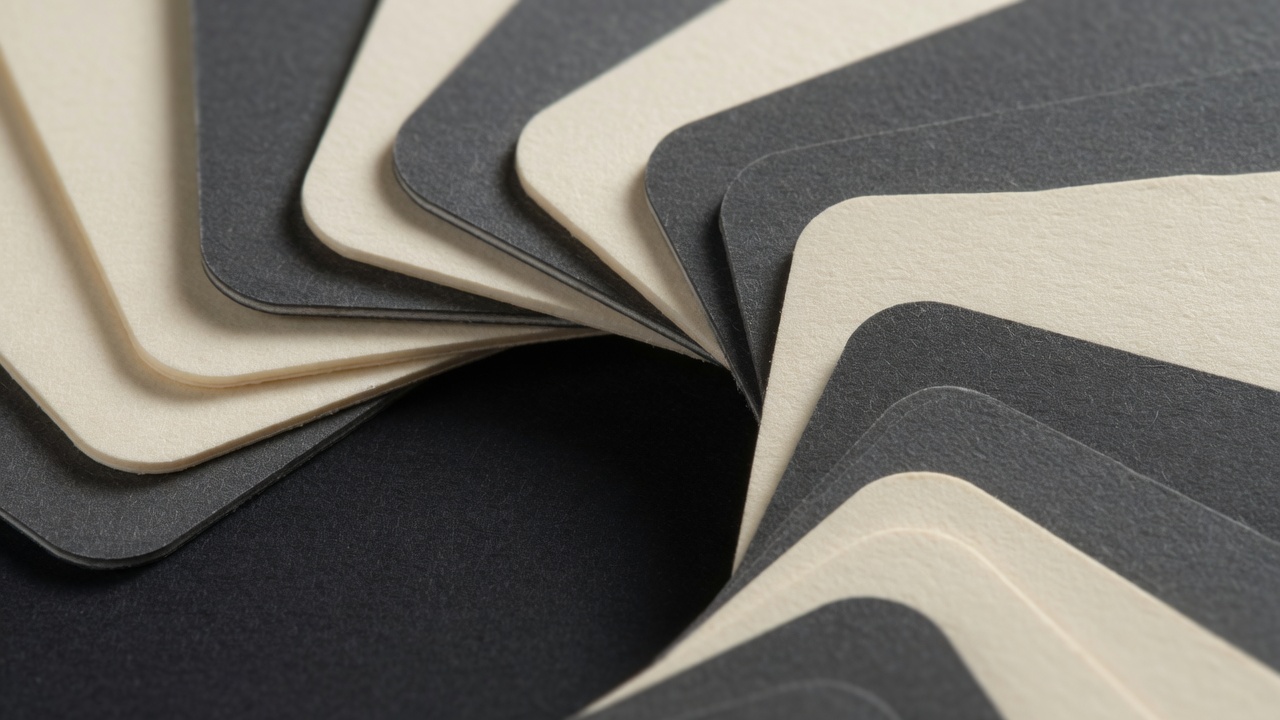
Use a 1/8 inch radius on a 3.5 × 2 card if you want rounded corner business cards that still look like a standard card. Use 1/4 inch if you want a visibly scooped corner and will keep type out of that scoop. Square-cut is the default cut, not a style. Mini, square, and fold-over sizes are separate quotes: they change wallet fit, die cost, and the file, not just the vibe.
That is the size-and-radius decision, stated in inches. The rest of this page is what 1/8 versus 1/4 actually removes from the corner, why a Canva rounded rectangle is not a die, when a custom size needs a steel-rule tool, how fold-over cards double the pocket, and what I need on the quote so we are not rounding a name off the card. I estimate this work at Avanti Printing, 15321 Barranca Pkwy, Irvine, CA 92618. If you want to hold a 1/8 next to a 1/4 and a square cut, call (949) 387-0787 and come in. Fingers beat a mockup. Quotes still confirm size, material, quantity, finish, and date. Radius is part of size. A mood board is not those five facts.
People search rounded corner business cards after a cart offered “round corners” as a checkbox, after a 1/4 inch radius ate a phone number, or after a 2.5 inch square refused a wallet that was happy with 3.5 × 2. Rounding is bindery. An odd size is a different product. Neither is a filter you apply to a PNG.
1/8 inch vs 1/4 inch vs a square cut
North American business cards trim to 3.5 × 2 inches unless you say otherwise. The corners of that rectangle are either left as a 90-degree cut or clipped to a radius. The two radii shops actually keep on a corner rounder are 1/8 inch and 1/4 inch. Other radii exist. They are special orders, not a slider in a template.
One-eighth of an inch is 0.125 inch, about 3.2 mm. One-quarter is 0.250 inch, about 6.4 mm. Those numbers are the radius of the quarter-circle that replaces the square corner. Along each edge, the straight cut stops that far from the corner. A logo, phone, or keyline sitting 0.10 inch from both edges is safe on a square card and clipped on a 1/8 radius. The same lockup is a guaranteed bite on a 1/4 radius.
| Corner | Radius | What you see | Type and logo | Wallet / sleeve | How we usually cut it |
|---|---|---|---|---|---|
| Square cut | None | Sharp 90-degree corners; the default professional card | Keep live matter 0.125 inch inside trim | Slides; corners can catch a tight slot | Guillotine. No die, no rounder. |
| 1/8 inch round | 0.125 in / ~3.2 mm | Softened corner; still reads as a 3.5 × 2 card | Pull corner marks in; 0.125 inch from trim is no longer enough at the corner | Usually easier into a sleeve than a square plow | Cut square, then a corner rounder. Standard radius. |
| 1/4 inch round | 0.250 in / ~6.4 mm | A scooped, toy-like or “pebble” corner; the shape is the design | Keep marks well clear of the scoop; treat the corner as gone | Soft entry; the card also looks smaller because more board is missing | Cut square, then a 1/4 rounder, or a true rounded-rectangle die |
| Custom radius | You name it in inches | Only if we have the tool or we cut a die | Build the file to that radius, not to a guess | Test the pocket | Steel-rule die or a rounder we actually own |
Square-cut is not “the cheap look.” It is how most 3.5 × 2 cards in Irvine law, accounting, medical, and engineering offices leave this building. A 1/8 radius is the usual upgrade when someone wants less of a paper-cut corner and a slightly friendlier hand-off. A 1/4 radius is a design choice you will notice from two feet. If you wanted a subtle round and ordered 1/4, you will think we rounded too much. If you wanted a pebble and got 1/8, you will think we forgot. Write the fraction.
A payment card under ISO/IEC 7810 ID-1 is 85.60 × 53.98 mm with a specified corner radius in a tight band around 3 mm. That is the neighborhood of a 1/8 inch round, not a 1/4. Your business card does not have to meet ISO 7810. Your wallet was cut for that family of corners. A 1/8 round on a 3.5 × 2 card is why rounded cards often slide into a phone-case slot more kindly than a square-cut of the same board. A 1/4 round is friendlier still, and it is also a different silhouette than the credit card next to it.
1/8 inch is the default rounded corner. 1/4 inch is a scooped corner you must design for. Square-cut needs no radius in the file. Draw none of these as a white-rounded rectangle on a colored field and call it bindery. Bindery is a blade. The file is a rectangle with bleed unless we asked for a die line.
Get pricing for rounded-corner and custom-size cards
Who this size and radius choice is for in Irvine and Orange County
This write-up is for the person who has to approve the line on the quote and then live with the stack in a wallet, a badge sleeve, or a front-desk bowl. Founders in Irvine Company suites, brokers working Spectrum opens, clinic administrators on Barranca and Alton, attorneys who still carry a slim case, contractors who keep a pack in a cup holder, consultants on chamber and BNI calendars, restaurant managers in the Spectrum and Woodbridge, labs near UCI that reprint names. You are buying a physical object for Orange County pockets, not a rounded rectangle in Figma.
I split the jobs because the cut should follow the job:
- Standard professional card, slightly kinder corner. 3.5 × 2, 1/8 inch radius. This is the usual add-on on standard business card printing in Irvine, not a redesign. Same file as a square card, more margin at the corners, then we round after the cut.
- The corner is the brand. 3.5 × 2 with a 1/4 inch radius, or a square card, or a mini. Layout has to be rebuilt around the missing board. That is a design decision. Pretending a square-cut file will “just get rounded more” is how a cell number dies.
- The card is a small booklet. Fold-over. Score, two panels, twice the thickness in a slot. Not a corner. Not a Canva page fold.
- The card is an object on a kitchen island. Square, thick, sometimes rounded. Often premium thick-stock business cards as well as an odd footprint. Size and board are two lines. Do not bury both in the word “special.”
If you are ordering for a whole office, pick one footprint and one radius for the set unless you have a reason not to. A principal on a 2.5 inch square and staff on 3.5 × 2 with mixed radii looks like two companies at the same mixer. Same layout, same radius, different names is a normal quote. Four shapes is a branding problem you will sort in a badge line at Anaheim, not at the cutter.
If the layout is still a draft, do not pick 1/4 inch and a mini size to “make it interesting.” Finish the hierarchy on 3.5 × 2 first. Odd sizes amplify a weak lockup. They do not hide it.
Mini, square, and other footprints that are not a rounded 3.5 × 2
A rounded corner is a treatment of a rectangle. An odd size is a different rectangle. Keep those sentences apart on the quote. If you only write “unique cards,” I still do not know the inches.
Sizes I actually quote, with the problems they bring. These are typical industry footprints, not a menu you must pick from, and not a promise that every mill sheet yields every size without waste.
| Footprint | Finished inches | What it is for | What breaks |
|---|---|---|---|
| Standard | 3.5 × 2 | Wallets, badge sleeves, card cases, almost every analog tray | Nothing structural. This is the tool. |
| European-ish | ~3.35 × 2.17 (85 × 55 mm) | Teams that also work Europe, or a designer who built a metric template | U.S. wallets and U.S. cases are cut for 3.5 × 2. Say the millimeters. Do not assume we will “know.” |
| Slim / mini | Often 3.5 × 1, 3.5 × 1.5, or 2.5 × 1.5 | A second card, a punchy leave-behind, a reel tag | Type room. A full name, title, cell, email, and URL will not fit at a readable size. Hierarchy has to drop lines. |
| Small square | 2 × 2 or 2.5 × 2.5 | A desk object, a hospitality feel, a mark-forward brand | Wallet fit. A 2.5 square is not a 3.5 × 2 slot. Cases gap or refuse it. |
| Large square | 3 × 3 | Leave-behind, not pocket carry | Almost no one has a 3 inch slot. Treat it as a mini card-flyer. |
| Oversize rectangle | 3.5 × 2.5, 4 × 2.5, 4 × 3 | More type room, a small handout | Pockets, envelopes, and badge sleeves. Also not a mailed piece just because it is bigger. |
| Fold-over | Commonly 3.5 × 4 flat, folded to 3.5 × 2 | A four-panel story: bio, map, hours, a service list | Score, grain, crack on coated board, double thickness, round after fold. |
3.5 × 2 is 88.9 × 50.8 mm. ID-1 is 85.60 × 53.98 mm. The U.S. card is longer and a hair shorter than a credit card. That is why a standard card peeks out of some credit-card slots on the long edge and sits a little loose on the short edge. A European 85 × 55 mm card is closer to ID-1 in both directions. If your designer built 85 × 55 because a template said “business card,” tell me. I will not silently stretch it to 3.5 × 2, and I will not silently trim it. Either move is a new layout.
Mini cards fail on type before they fail on the cutter. A 3.5 × 1 strip can carry a name and a cell. It cannot carry a medical directory. If you need the directory, you need 3.5 × 2 or a fold-over, not a smaller rectangle and 6-point type. I will say so rather than print a strip nobody can use at a dim table in the Spectrum.
Square cards fail on pockets before they fail on the press. 2.5 × 2.5 is a popular “interesting” size. It looks balanced. It does not live in a bifold slot cut for 3.5 × 2. People set it on a desk, which can be the point, or they lose it, which is also common. If the card must ride with a driver’s license, stay at 3.5 × 2 and spend the personality on stock and layout, not on a square that the wallet vetoes.
Oversize rectangles are not automatically mailers. The Postal Service has its own rules for what counts as a card or a letter in the mailstream; see the USPS Business Mail 101 notes on cards if you plan to mail the piece as a card rather than stuff it in an envelope. A 4 × 3 handout you pass at a mixer is still a handout. Do not mix those jobs. This page is about cards you hand. If you need a mailed piece, that is a different quote with a different size conversation.
Custom rectangles still cut on a guillotine if every corner is square. You pay for a different trim, not automatically for a die. The waste on the parent sheet can change the price more than the blade does. A size that tiles the sheet cleanly is cheaper than a size that throws a wide skeleton of unusable board. I will not pretend every “unique” size is the same cost per card. Send the inches. I will tell you if the sheet hates them.
If you do not have a size, start at 3.5 × 2. Personality is allowed on a standard footprint. Most of the “unique card” files I see would have been stronger at 3.5 × 2 with a real hierarchy and a 1/8 radius. Odd size is not a substitute for a layout. If you still want odd after we look at a 3.5 × 2 proof, we will quote the odd size as its own line.
Fold-over cards are a score, not a corner
A fold-over business card is a small booklet. Typical build: 3.5 × 4 inches flat, one score, folded to 3.5 × 2, four printable pages if you count covers and insides. Another build: 7 × 2 inches flat, folded to 3.5 × 2, opening like a tiny book along the short edge. Say which. “Folded cards” is not a spec.
What the quote has to name:
- Flat size and finished size, in inches, both of them.
- Fold direction. Long edge or short edge. Which panel is the cover.
- Score. Thick cover stock does not fold clean without a score. Coated 16pt will crack at a fold if you skip it. Duplex 32pt fold-overs are a special argument, usually a bad one.
- Grain. Fold parallel to the grain when the sheet lets us. Cross-grain folds crack more. This is a shop problem I will watch; it is still worth saying if you already have a dummy.
- Panel art. Page 1 cover, page 2 inside cover, page 3 inside back, page 4 back — or a two-page spread of the flat. Do not send a Photoshop mockup of a folded card photographed on a desk.
- Rounded corners, if any, after the fold. Round the folded packet so the four corners of the finished object match. Rounding the four corners of the flat sheet rounds the spine corners and looks like a mistake.
Thickness in the pocket doubles. A 16pt fold-over is two plies in the sleeve. A laminated 16pt fold-over is two laminated plies. That is how a “standard” card becomes a credit-card fight without anyone ordering 32pt. Test the wallet. A fold-over that will live on a reception counter can ignore that test. A fold-over you expect people to carry cannot.
Inside type is the reason to fold. A map to a Barranca suite, a short menu of services, a credential list, a second language block, a calendar of clinic hours. If the inside is a second logo and a motivational sentence, you bought a score for decoration. Decoration is allowed. It is not a reason to ignore the crack and the pocket.
File for a 3.5 × 4 fold-over, typical:
- Build the flat at 3.5 × 4 inches plus 0.125 inch bleed on all four outer edges.
- Score in the middle, 2 inches from each finished end, so each panel is 3.5 × 2.
- Keep live matter 0.125 inch from trim and from the score. Type that sits on the score will break. A rule that sits on the score will look drunk after the fold.
- Front cover is one panel. Back cover is the other outer. Insides read when the card opens. Dummy it with a piece of printer paper before you export.
- If you want 1/8 rounded corners on the finished card, note it. Do not draw four radii on the flat unless we are die-cutting the flat as a rounded 3.5 × 4, which is a different object.
Fold-over is bindery time. It is not a checkbox that prints itself. Put the date you need them in a hand on the quote with the size. I will not invent a date, and I will not treat a fold as a square-cut 3.5 × 2 just because the finished outline is 3.5 × 2.
Wallet, reel, and badge-sleeve fit
Fit is why odd sizes come back. Not ink. Not stock. The slot.
A U.S. 3.5 × 2 card is the size card cases, most badge holders, and most analog desk trays were built around. That is why most standard Irvine business cards we print for daily carry stay on that footprint even when we round the corners. Credit-card slots are ID-1, a little shorter and a little taller. Many people still force a 3.5 × 2 into a credit-card slot. Square-cut corners catch. A 1/8 radius helps the leading corner enter. A 1/4 radius helps more and looks like a different card once it is in. Thickness is the other veto; that is a caliper conversation. Shape is this one.
What actually happens in Orange County pockets:
- Leather bifold. Forgiving on 3.5 × 2, square or 1/8. Tight on 2.5 square. Hostile to 3 × 3. Fold-overs depend on board.
- Phone-case slot and MagSafe wallets. Cut for ID-1 thickness and a credit-card outline. 3.5 × 2 square-cut 16pt often goes in with a shove. 3.5 × 2 with 1/8 round goes in easier. 32pt and fold-overs often do not go in at all. Mini widths rattle. Squares do not enter.
- Metal money clips. Square corners plow and dog-ear. 1/8 is kinder. 1/4 can look lost next to the credit cards.
- Conference badge sleeves at Anaheim. Built for a badge, not for your card. 3.5 × 2 slides behind a badge. 32pt and fold-overs bulge. Squares sit wrong. If the plan is “card in the badge all day,” stay 3.5 × 2, 14pt or 16pt, square or 1/8.
- Badge reels at clinics and labs. A mini or a 3.5 × 2 with a punched hole is a different product (a tag), not a rounded card. If you need a hole, say punch size and location. A rounder is not a punch.
- Front-desk bowls. Size is free. Radius is free. This is where 1/4 rounds and squares earn their keep, because nobody has to pocket them to take one.
Bring the wallet. I keep ruined phone cases at the counter for this. A two-minute test is cheaper than 500 cards that live in the car because they do not live in the case. If you will not bring the wallet, stay at 3.5 × 2 with a square cut or a 1/8 radius and do not order 32pt fold-over as a surprise.
Rounded corners also wear differently. A square corner takes the first hit in a pocket and can fray or dog-ear, especially on uncoated stock. A 1/8 radius spreads that hit. That is a real, small durability gain. It is not a reason to pick 1/4 unless you like the look. Film lamination already does more for scuff than a radius does. Do not buy a 1/4 radius to solve a coating problem.
Request a radius and size quote
Corner rounder versus a steel-rule die, and what that costs
How the corner is made changes the file, the calendar, and the line on the quote. Two different machines get described as “rounded” in emails. They are not the same.
Guillotine, square card. Stack, cut, box. No radius. This is the default for 3.5 × 2 and for any other rectangle we can cut from the sheet. No tool charge for a die because there is no die.
Corner rounder. After the square cut, a machine (or a hand-held bench rounder on a tiny quantity) clips each corner to a radius we have a tool for. In this shop conversation that is almost always 1/8 inch or 1/4 inch. The card was a rectangle the whole time it was printed. The file should still be a 3.5 × 2 rectangle with 0.125 inch bleed. We do not need a die line. We do need you to keep type out of the clip. Rounding is a bindery add-on: extra handling, extra time, a clean stack so corners hit the tool the same way. It is not free, and it is not a custom die.
Steel-rule die. A wood die with steel rules bent to a shape, used in a platen or similar press to punch the card out of the sheet. This is how you get a rounded rectangle in one hit, a true oval, a circle, a tab, a notch, or a size we cannot efficiently guillotine. The die is a tool. Tools have a cost. Typical industry range, not a quote: a simple business-card-sized steel-rule die often lands in the low hundreds of dollars as a one-time charge, more if the rule work is intricate or the die is large. I will not invent a number for your shape. I will quote the tool if we need one. If we already have a die that matches your inches and radius, we reuse it and you may not see a new tool charge. If we do not, you are buying a tool plus the cards.
When you actually need a die instead of a rounder:
- The card is not a rectangle (circle, oval, rounded tab, house-shaped novelty).
- The radius is not 1/8 or 1/4, or not all four corners (one-corner round, two-corner round, ticket stub).
- You want the radius cut in the same hit as an odd outline so the edge is one operation.
- The run is a shape we cannot stack-round cleanly, or the board is so thick a bench rounder will crush the edge.
Thick board matters. 14pt and 16pt round clean on a decent rounder with a sharp tool. Laminated 16pt can show a white edge if the film and the board do not clip together, or a slight film thread if the tool is dull. Duplex 32pt needs a sharp tool and a controlled lift or the radius goes fuzzy and the ply shows. Mention board and radius on the same quote. A 1/4 radius on 32pt is a different bindery problem than a 1/8 radius on 14pt. If you are already on a duplex build, we price premium thick-stock cards with rounded corners as a different job than a 14pt rounder add-on.
Die-cut edges and guillotine edges look different under a loupe. A guillotine is a straight slice. A rounder is a punch of the corner. A steel-rule die can show a slight crush or a hair of board on the back if the make-ready is lazy. None of that is a design style. If you need a painted edge on a rounded card, say so; painting a radius is fiddlier than painting a square. That is its own line.
Short runs feel die cost more, because the tool does not care that you only wanted 100. A 1/8 round on a standard 3.5 × 2 is usually the cheaper path to rounded corner business cards because the rounder already exists. A custom pebble shape for 100 cards is how the tool outruns the paper. If you want the shape, own the tool charge. If you wanted “a little round,” pick 1/8 and a rounder.
We keep dies when they are ours. If you paid for a custom die, ask whether it lives here for a reprint. Reprints without a new tool are the point of paying for steel once. Do not assume a die from another plant will fit our press. Bring it and we will look, or we will cut a die that fits this room.
File setup for radii, die lines, and fold scores
The press does not round corners because you drew a rounded rectangle. The cutter does not read Canva’s corner slider. Build a rectangle unless we asked for a die line.
Standard 3.5 × 2 with 1/8 or 1/4 rounding (corner rounder):
- Trim. 3.5 × 2 inches. Not 3.5 × 2 minus the radius. The radius is removed after trim.
- Bleed. 0.125 inch on every side. Document 3.75 × 2.25 inches. Backgrounds extend into the bleed. The bleed is still square.
- Safe. 0.125 inch inside trim for square-cut. For 1/8 radius, keep logos, phones, emails, URLs, and rules out of a 0.125 inch square in each corner — more honestly, keep them 0.125 inch from trim and outside the quarter-circle. For 1/4 radius, treat 0.25 inch of each corner as gone. A name stacked in the lower-left corner is the usual fatality.
- Do not draw the rounded shape in the art. No white-rounded card on a colored canvas. No drop shadow of a rounded card. No keyline that follows a radius unless that keyline is inset far enough that a 1/64 inch cut shift still leaves it even.
- Do not put crop marks in the live card. If you use marks, they sit outside the bleed.
- Front and back. Two pages, same size, same bleed, long-edge flip unless you say otherwise.
If we are cutting a true rounded-rectangle die instead of rounding after the square cut, then I need a die line:
- A separate layer named something obvious: Die, Cut, or Thru-cut.
- A 0.5 point stroke, a spot color (often named “Die”), set to overprint, not a CMYK swatch that will print as a pink rule on the card.
- The die line is the finished edge, including the radii at the true radius in inches.
- Bleed still extends 0.125 inch beyond that die, following the curve, not stopping at a square that the die will ignore.
- Do not put the die line on the only layer and then flatten the PDF. I need to turn it off for print and on for the die maker.
Fold-over files, again, because this is where people send a 3.5 × 2 and write “please fold” in the email. Build the flat. Mark the score as a separate overprint stroke on a guide layer, or tell me in writing where it falls, in inches from a named edge. Do not use a hairline printed rule as the score unless you want a printed rule on the fold.
App-specific habits that break radii:
- Canva corner radius on a 3.5 × 2 design. That radius is a picture of a round corner. It does not drive our rounder. If the background is a rounded rectangle on white, the white becomes a corner halo after we cut square, or we have to rebuild the file. Fill the whole canvas. Mention the radius in the quote, not in the pixels.
- Illustrator rounded-rectangle tool as the trim. Fine as a guide on a non-printing layer. Bad as the only artboard with white outside it. Artboard should be trim or trim-plus-bleed, square. Put guides at the radius if you want to see it.
- InDesign corner options on a frame. Same problem. The frame is not bindery. Use the frame for layout, not as a pretend die.
- A PNG of a rounded card on a transparent ground. Transparency is not paper. Outside the round is either white board or a rebuild.
- Keyline 1 point from trim that also tries to round. After the cut, one side is fat. After the round, the keyline is clipped in four places. Inset 0.125 inch or drop the box.
- Logos, license numbers, and URLs parked in a corner. A 1/4 radius will bite a 0.6 inch mark that was “almost fine.” Center those marks or sit them on a long edge, inset.
- Front rounded in the mockup, back still square in the file. We print both sides of a rectangle, then round the stack. The back corners come off whether you drew them or not. Keep back type out of the same corners.
Color, resolution, and fonts are still the usual press rules: CMYK, 300 ppi at size or true vectors, fonts outlined or embedded. I will not rehash the whole prepress spec here. If the file is a draft, say you need custom design and print-ready file preparation instead of sending a rounded PNG and hoping the die fairy visits Barranca.
Variable names: the longest name and the longest title have to clear the radius, not the shortest. Test the template with “Christopher” and a long credential line before you export twelve PDFs that each die differently in the corner.
If you already rounded the artwork because an online center’s template demanded a rounded mask, tell me which template and which radius. I would rather rebuild a clean rectangle than try to guess how much white they hid in the mask.
Reprints we see when the radius or the size was a surprise
These are shape-related reprints. Not theoretical. Not a named testimonial.
- Ordered “rounded” with no fraction. The buyer meant 1/8. The file was built like 1/4 would be fine. Or the reverse. The box looked wrong from the first card. Fix: write 1/8 inch or 1/4 inch. Do not write “round corners” alone.
- Phone number in the lower-right corner, 1/4 inch radius. The last two digits left with the scrap. Fix: 0.25 inch of empty corner, or 1/8 inch, or move the number to a long edge.
- Canva rounded-rectangle on a white canvas, printed as a square cut. White ears at four corners on a navy card. Fix: full-bleed rectangle, radius in the bindery notes, not in the pixels.
- Drew a 1/8 radius in the file, we rounded 1/8 on the cut, double-rounded look with a halo. The art already scooped the color, then the blade scooped again. Fix: square color to the bleed; one radius, in steel, not in both places.
- 2.5 × 2.5 square that would not enter the phone wallet the owner uses every day. Desk sample looked clever. Monday failed. Fix: bring the wallet, or stay 3.5 × 2.
- European 85 × 55 mm file, trimmed to 3.5 × 2 without a rebuild. Type too close to the new edge, or a fat unprinted band. Fix: pick one size and build to it.
- Fold-over rounded on the flat. Spine corners nibbled; finished packet corners did not match. Fix: fold, then round, or die the finished outline.
- Fold-over with no score on 16pt gloss. Cracked panel, white board at the hinge. Fix: score, watch grain, do not surprise coated board with a hard fold.
- Custom oval, no die line, no tool budget. Someone thought “unique shape” was a checkbox. Fix: rectangle plus rounder, or a die as a line on the quote.
- 32pt duplex, 1/4 radius, fuzzy board at the clip. Thick sandwich, dull tool, rushed lift. Fix: name caliper and radius together; thick radii need time and a sharp die.
- Keyline border clipped at four corners. The box was drawn at trim. Fix: inset or delete.
- No size, no radius, no date on the request. Quotes confirm size, material, quantity, finish, and date. Radius lives under size. If it is missing, the spec is a wish.
The cheapest reprint is the one you do not do. A paper dummy of the radius, even scissors on a printout, is cheaper than 500 cards with a bitten URL.
Orange County pockets, mixers, and badge weeks
Not every local color belongs on a radius spec. These do, because they change the pocket and the hand-off.
Irvine Company towers and slim cases. Badge clips, thin bags, phone wallets. 3.5 × 2 with square or 1/8 is the card that actually leaves the suite. A 3 inch square stays on the desk next to the succulent. If the point is a desk object for a principal, say that and print a short run of squares. Do not force the whole sales team onto a size their case will reject.
Spectrum and Woodbridge hospitality. Front-desk bowls and host stands. Squares and 1/4 rounds read as designed in a bowl. They are the right place for a shape you would not carry. House cards can be odd. Person cards for a manager who still meets vendors should stay 3.5 × 2 if that person has to pocket them.
Alton and Barranca medical and device. Reels, badge sleeves, lotioned hands, name-and-credential density. Mini cards cannot hold the credential line. 1/4 radii eat license numbers parked in corners. 3.5 × 2, 1/8 or square, readable type. If you want a bowl card for the waiting room, that can be a second, simpler card, not a smaller version of the dense one.
UCI-adjacent labs and startups. Titles move. Do not spend a custom die on a name that will change in a quarter. 3.5 × 2, square or 1/8, reprint without a tool conversation. Save the custom outline for a frozen company mark, if you ever need it.
Anaheim Convention Center weeks. Badge sleeves, tote abrasion, stacks that strangers riffle. 3.5 × 2 survives the sleeve. Fold-overs bulge. Squares look handsome on the counter and then fail the lanyard. If the card has to ride behind the badge, pick the size for the sleeve, not for the Instagram flat-lay. Put the show date on the quote so bindery is working to a date. A custom die is extra operations; it is not a reason to skip the date.
Job sites between Tustin, Santa Ana, and Costa Mesa. Cup holders, grit, square corners that dog-ear in a bag with screws. Laminated 3.5 × 2 with a 1/8 radius is a practical mixer of durability and fit. A 1/4 radius mini will disappear in a trailer. A fold-over will pick up a crease you did not score.
Heat. Radius does not care about a parked car. Board and film do. Store the carton indoors. A rounded corner will not save a pack that cooked on Barranca in August.
Chamber and BNI tables. You hand one card. The other person must be able to file it. Odd sizes that do not fit their card book get left on the table or shoved in a notebook and lost. If your goal is to be kept, 3.5 × 2 is the filing system the room already owns. If your goal is to be remembered on a kitchen island, a square can work, and you accept the filing loss.
Local does not mean a novelty mill. It means the pocket, the badge, and the bowl you actually use. Tell me which of those is the job.
What to send so the quote names a real size and radius
A usable quote request is short. Missing size is how you get a number for 3.5 × 2 square-cut and a surprise at the rounder. Missing radius is how you get a debate at pickup.
- Size. 3.5 × 2 inches, or the custom finished size in inches, flat and folded if it folds. Metric only if the card is truly metric — write 85 × 55 mm if you mean that.
- Corner. Square, 1/8 inch radius, 1/4 inch radius, or a custom radius in inches. If only some corners round, say which. “Rounded corner business cards” without a fraction is not enough.
- Quantity. The number you will take, per name if several names. Custom dies make short runs feel the tool. Say the count honestly.
- Material. Board caliper and coated or uncoated. Thick board plus a large radius is a bindery note, not a surprise.
- Finish. Aqueous, film, uncoated, none. Film and a radius can show a white core at the clip; I would rather name that than argue with it later.
- Sides. 4/4 or 4/0, or plain English. Fold-overs have four pages; say if any panel is blank.
- Date. The date you need them in a hand in Irvine. Rounding, scoring, and dies are extra operations. The date belongs on the form.
- Pickup or ship. Pickup at 15321 Barranca Pkwy, Irvine, CA 92618, or a ship-to address.
- Files or a note that you need design. PDF with bleed, square artboard, radius in the email. Die line on its own layer if the shape is not a rounded rectangle we will round after cutting. If the art is a picture of a rounded card, say you need it rebuilt. We will quote a print-ready layout from your text and logo instead of pretending a rounded PNG is a die.
Helpful extras:
- A photo of the wallet or badge sleeve, or bring it. Fit is not a personality test.
- Whether this is a bowl card or a pocket card. That one sentence changes whether a 2.5 square is clever or useless.
- Whether we already cut this shape for you. Reuse the die if we have it.
- The longest name and title, if this is a set.
That list is the job. I can estimate from it. I cannot estimate from “cool rounded cards, unique size, soon.” Walk-ins Monday–Friday, 8:00 a.m. to 5:00 p.m. Call (949) 387-0787 if you want to hold 1/8 against 1/4 on the same board. Send the same spec through the quote form if you cannot come in.
For a broader view of what we print besides radii and odd footprints, start at the Business Cards Irvine home page and then send the quote with the five facts: size, material, quantity, finish, and date. Size includes the radius. Write the fraction.
FAQ
What radius should I use for rounded corner business cards?
1/8 inch if you want a standard 3.5 × 2 card with the corners softened. That is the usual rounded spec, close to the corner family of an ISO/IEC 7810 ID-1 payment card. 1/4 inch if you want a scooped corner and will keep type and logos out of that scoop. Square-cut if you do not have a reason to round. Write the fraction. “Rounded” alone is how 1/8 and 1/4 get swapped.
Does a 1/4 inch radius just look like a bigger 1/8?
No. It removes twice the radius and a lot more of the corner board. The card reads smaller. Corner-sitting type that survives 1/8 often dies at 1/4. Wallets notice the silhouette. If you have not held both, come to 15321 Barranca Pkwy and hold both. Do not order 1/4 because a slider in Canva looked friendly at 400% zoom.
Do I need a custom die to round the corners?
Not for a 3.5 × 2 rectangle with 1/8 or 1/4 on all four corners. We cut square, then use a corner rounder. You need a steel-rule die for non-rectangles, mixed corners, odd radii we do not have a rounder bit for, or a true rounded outline we will punch in one hit. Dies are a tool charge in a typical industry range that often sits in the low hundreds of dollars for a simple card die, then reusable here if we keep the tool. I will quote the tool if we need it. I will not bury it in silence.
How should I set up the file for a 1/8 or 1/4 radius?
Build 3.5 × 2 with 0.125 inch bleed, same as a square card. Fill color to the square bleed. Keep live matter 0.125 inch inside trim and fully out of the corner radius. Do not draw the rounded card on a white field. Do not put a die line on a job we will round after cutting unless we asked for one. For a true custom die, add an overprint spot die line on its own layer and bleed beyond the die, including around the curves.
Will rounded or odd-size cards fit my wallet?
3.5 × 2 with a square cut or a 1/8 radius fits most card cases and many badge sleeves. Credit-card slots are ID-1, a different rectangle; 1/8 helps the corner enter. 1/4 fits the slot more easily and looks less like the cards beside it. 2.5 inch squares, 3 inch squares, minis, and fold-overs are pocket vetoes unless you have tested the actual case. Bring the wallet. Fold-overs also double thickness.
When does a mini or square card make sense?
When the card is allowed to be a desk object or a bowl card, and you are willing to drop lines of type. A mini is a name-and-cell tool, not a clinic directory. A 2.5 square is a leave-behind, not a substitute for a card book. If the card must be filed with everyone else’s 3.5 × 2, stay at 3.5 × 2 and use a 1/8 radius if you want round corners. Personality on a standard footprint is underrated.
How is a fold-over card different from a rounded card?
A fold-over is a scored, folded sheet, usually 3.5 × 4 flat to 3.5 × 2 finished, with inside panels. A rounded card is a corner treatment. You can have both: fold, then round the finished packet. You cannot fake a fold with a radius. Coated board needs a score. Rounding the flat sheet before folding nibbles the spine. Send the flat file, name the score, and say whether corners are square or 1/8 or 1/4 after the fold.
What does Avanti need to quote rounded or odd-size cards?
Size in inches (flat and folded if it folds), radius as a fraction or “square,” material, quantity, finish, and the date you need them. Add sides, pickup on Barranca versus ship, and a PDF with bleed — or a note that you need design. I will not invent a radius or a date to fill a blank. Call (949) 387-0787 if you want to match samples first. Quotes confirm size, material, quantity, finish, and date. The fraction is part of size.
Name the inches, then print the card
Rounded corner business cards are a radius, not a filter. 1/8 inch is the default round on 3.5 × 2. 1/4 inch is a scooped corner you design around. Square-cut is still a correct professional card. Mini, square, and fold-over sizes are different products: they change the die or the score, the wallet, and the file. Corner rounders clip a rectangle. Steel-rule dies punch a shape and carry a tool charge. Do not draw the round in Canva and call it bindery. Quotes confirm size, material, quantity, finish, and date — write all five, and write the radius as 1/8, 1/4, or square.
If you want this decided with actual corners instead of a checkbox, come to Avanti Printing, 15321 Barranca Pkwy, Irvine, CA 92618, hold a 1/8 against a 1/4 on the board you think you want, and bring the wallet. Or send the inches, the fraction, and the PDF through the quote form. Name the size. Then we can print the card you meant.