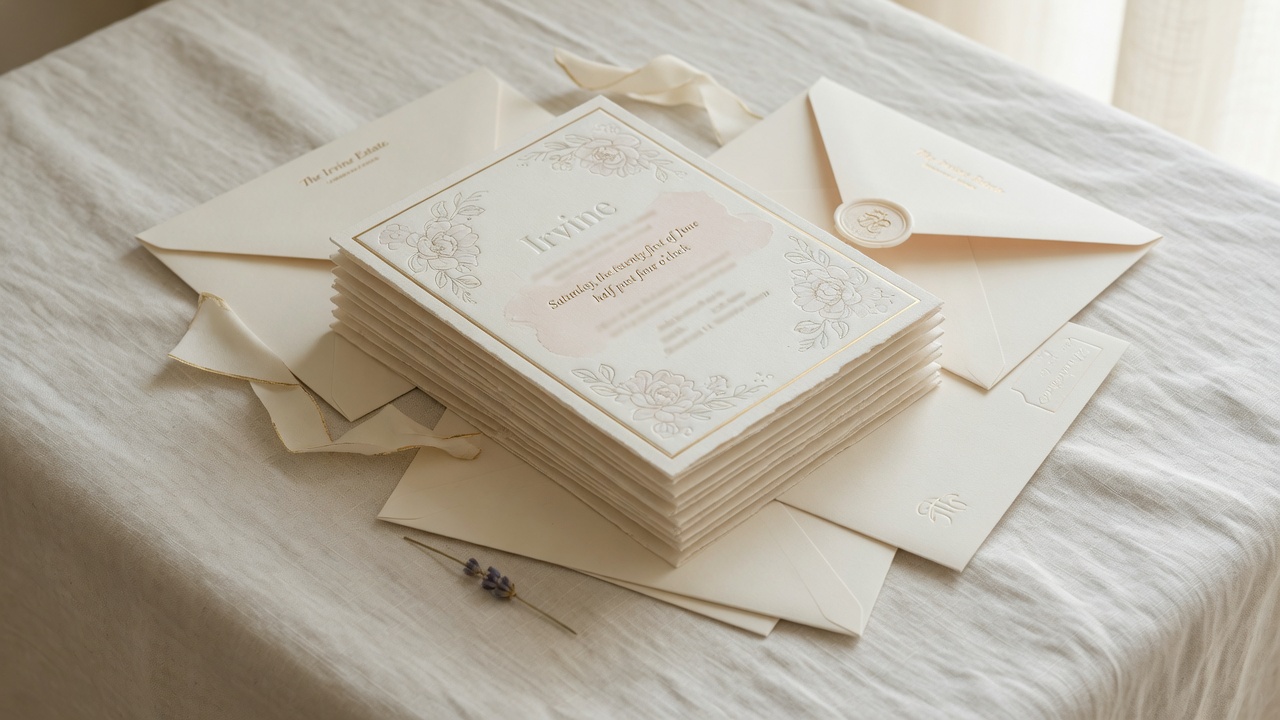
Print a 5 × 7 invitation in an A7 envelope for invitation printing in Irvine that mails as a letter. Add a 4.25 × 5.5 RSVP in an A2 envelope, name the stock and quantity, and send the guest list before the drop date. Square envelopes and wax seals add postage.
That is the suite, stated in inches. The rest of this page is which cards belong in the envelope, which boards feel like stationery instead of a flyer, how A7 and A2 actually fit, why guest addressing is a print job and not a Sharpie night, and what the Postal Service will charge you for a square or a rigid stack. I estimate this work at Avanti Printing, 15321 Barranca Pkwy, Irvine, CA 92618. If you want to hold an A7 next to an A2 and stuff a dummy, call (949) 387-0787 and come in. Fingers beat a Pinterest board. Quotes still confirm size, material, quantity, finish, and date. “Pretty invitations” is not those five facts.
People search invitation printing Irvine after a 5 × 7 file will not fit the envelope they already bought, after a guest list arrives in three spreadsheets the week of the drop, or after a corporate open house needs a card that does not look like a coupon. An invitation is a set of pieces that have to nest, stamp, and survive a mailstream. It is not a one-page JPEG.
A7, A2, and the other sizes that actually mail
North American wedding and event invitations still live on the A-series announcement envelope. A7 is the workhorse. The card is 5 × 7 inches. The envelope is 5.25 × 7.25 inches. That quarter-inch of play is how the card goes in without a wrestling match and comes out without a bruised corner. If you print a 5.25 × 7.25 card and then hunt for an A7, you have printed the envelope. Do not do that.
A2 is the usual RSVP. The card is 4.25 × 5.5 inches. The envelope is 4.375 × 5.75 inches. That RSVP envelope tucks into the A7 with the rest of the suite. If you print a 5 × 7 RSVP, it will not go in the A2, and it will fight the A7 once the invitation, a details card, and a reply envelope are already in there.
Use this as a counter conversation, not a catalog you must shop. These are typical U.S. announcement sizes, not a promise that every mill sheet yields every size without waste, and not a postage quote.
| Piece | Finished card | Envelope | What it is for | Mail note |
|---|---|---|---|---|
| Classic invitation | 5 × 7 in | A7, 5.25 × 7.25 in | Wedding, gala, corporate evening, milestone | Usually a First-Class letter if it stays rectangular, flexible, and under the letter thickness cap |
| RSVP card | 4.25 × 5.5 in | A2, 4.375 × 5.75 in | Written reply, meal choice, name line | Guest mails this back. Budget a stamp on the A2 if you want replies |
| Smaller invite | ~4.5 × 6.25 in | A6, 4.75 × 6.5 in | Rehearsal dinner, shower, tight corporate reception | Still a letter if the stuffed piece stays in spec |
| More type room | 5.5 × 8.5 in | A9, 5.75 × 8.75 in | Long program, bilingual block, donor list on the invite | Height is still under the letter maximum; thickness is the risk, not the inches |
| Square | Often 5.25 or 6 in square | Matching square envelope | A silhouette people notice | Aspect ratio fails the letter machine test. Extra postage. Not a surprise. A choice. |
| Reply postcard | Often 4 × 6 in | None | RSVP without a reply envelope | Postcard rates apply only if the piece meets postcard size and thickness rules. A 5 × 7 card is not a postcard. |
| Save-the-date | 4 × 6 or 5 × 7 | None, or A7 if it is a card in an envelope | Date lock months before the suite | A mailed 4 × 6 can be a postcard. A 5 × 7 in an A7 is a letter. |
A7 at 5.25 × 7.25 inches, mailed with the long edge as length, has an aspect ratio of 7.25 ÷ 5.25, about 1.38. The Postal Service wants letters in a ratio band from 1.3 to 2.5. A7 sits just inside that band. A square sits at 1.0 and is nonmachinable on purpose. That is geometry, not taste. Check current letter versus square and unusual-shape rates on the USPS First-Class Mail page before you buy a roll of stamps for 140 envelopes. Those numbers move. A stuffed dummy on a scale does not.
Letter mail also has a thickness cap, commonly a quarter inch for a letter. A 16pt invitation plus a details card plus an RSVP plus an A2 plus a lined A7 plus a wax blob can leave that cap. Then you are not arguing with a designer. You are arguing with a flat or a surcharge. Weigh the dummy. Do not guess from a flat-lay.
5 × 7 in an A7 is the default invitation. 4.25 × 5.5 in an A2 is the default reply. Square is a postage decision. Postcard RSVP is a format decision. Write the inches on every piece. “Invitation suite” is not a size.
Get pricing for an A7 invitation suite
Who this invitation work is for in Irvine and Orange County
This write-up is for the person who has to approve the quote and then live with the box: the couple mailing a Saturday in Irvine or Newport, the assistant locking a gala at a Jamboree hotel, the nonprofit coordinator stuffing donor dinners, the HOA social chair in Woodbridge or Northwood, the department admin at UCI, the venue coordinator who was handed a Canva file on a Thursday. You are buying a mail piece for Orange County guests, not a mood board.
I split the jobs because the suite should follow the job:
- Wedding and formal social. Invitation, envelope, RSVP, often a details or accommodations card. Guest addressing is part of the job. Names are households, not headcount. This is the core of custom invitation printing in Irvine, not a business-card reorder with flowers on it.
- Corporate evening, gala, ribbon cutting, open house. Often a 5 × 7 or an A6, branded, with an RSVP that is a URL or a coordinator email as much as a reply card. Still needs envelopes that match the card, a date, and a list. A flyer in a #10 window envelope is not an invitation. A 5 × 7 that looks like a postcard coupon is not an invitation either.
- Milestone and family. Baptisms, graduations near UCI, retirements, milestone birthdays. Smaller lists. Same A7 math. Do not skip the envelope because the list is forty names. Forty wrong sizes are still forty wrong sizes.
- Save-the-date and shower. Earlier, simpler, often a mailed card or a 4 × 6. If it is a postcard, it is a postcard spec. If it is a 5 × 7 in an envelope, it is an invitation spec. Do not mix those on one PO.
If you are ordering for a company and a wedding in the same season, they are two quotes. Corporate colors on a wedding suite look like a sales kickoff. Wedding script on a Series A after-party looks like you borrowed the file. Same shop. Different jobs.
If the wording is still a draft, do not pick a 6-inch square and a triple suite to “make it special.” Finish the hierarchy on 5 × 7 first. Odd sizes and extra cards amplify a weak lockup. They do not hide it.
What belongs in the suite, and what is just another card
A suite is a nest of pieces that share a paper family and a mail plan. It is not “as many cards as Pinterest.” Every extra card is caliper, weight, stuffing time, and a chance to print the wrong hotel phone.
Pieces I actually quote, with the job each one has:
- Invitation. Who, what, when, where, hosts. This is the legal-looking card of the set. If a guest throws everything else away, this card still has to work.
- Outer envelope. The mail piece. Guest address, return address, postage. If this fails, nothing else matters.
- Inner envelope (optional, formal). Names only, no street address. “Mr. and Mrs. Chen” or “Chen Family” and who is actually invited, including children or plus-ones. It is etiquette, not postage. Skip it if the event is corporate or the budget should go to stock.
- RSVP card and A2 envelope. A name line, a yes/no, a deadline, meal choices if the caterer needs them, and a way back. If you omit the name line, you will receive anonymous yeses.
- Reply postcard. Same job as an RSVP card, no reply envelope. See the postcard section below. Useful when you want less stuffing and you can live with a public-back card.
- Details / accommodations / weekend card. Hotel block, parking, shuttle, website, dress. This is where Irvine venues actually need local sentences: which parking structure, which hotel is Hotel Irvine versus Irvine Marriott, whether Great Park GPS dumps guests at the wrong lot.
- Reception card. When ceremony and reception are different sites. Not decorative. Informational. If both are in the same ballroom, you may not need it.
- Map card. Rarely needed if the details card has a URL and an address a phone can parse. A pretty illustrated map that omits the suite or the entrance is how guests circle Jamboree.
- Menu, program, escort, place, thank-you. Day-of pieces. They are printed with the suite for color match if you want them to match. They are not stuffed into the A7. Do not put “and programs” on the invitation quote without a size. A program is a different fold.
Corporate suites are thinner on purpose. Invitation, envelope, maybe a reply card, maybe a one-page details insert with parking and a registration URL. Donor galas can add a reply card with table-level options. Do not add a map, a weekend timeline, and a wax seal because a wedding blog said suites have seven pieces. Seven pieces in an A7 is how you buy flats postage.
Save-the-dates are not invitations. They lock a date. They do not replace the suite. If you mail a save-the-date as a 4 × 6, that job can run with postcard printing in Irvine on a postcard spec. If you later print a 5 × 7 invitation, that is a second quote with envelopes. Color match across months is a stock conversation, not a hope.
Quantity is households, then extras. Typical industry practice, not a law: take the number of envelopes you will address, add a buffer of about 10 to 15 percent or a flat extra of 20 to 25 suites for keepsakes, last-minute names, and the ones you ruin while stuffing. A 180-person wedding is not 180 invitations. It is the number of households. A corporate list of 220 names in one office may be 220 envelopes if they are individually invited, or 80 if you invite departments. Write which. “About 200” is how you run out of A2s and have 40 orphan invitations.
Stocks that feel like an invitation, not a leave-behind
Board is the first thing a guest’s thumb reads. Ink is the second. A 5 × 7 on thin gloss can look like a pizza magnet no matter how good the script is. A cotton uncoated that cannot hold a dark photo can look dusty no matter how expensive the mill. Name the stock. “Nice cardstock” is not a mill.
What I actually put on quotes, in plain language. Calipers and basis weights are typical ranges, not a certificate for your mill lot.
| Stock family | What it feels like | What it prints like | Where it fails |
|---|---|---|---|
| 100 lb uncoated cover | Paper, not plastic. Writable. The usual “stationery” start. | Digital or offset; color is quieter than coated. | Can feel light in a large A7 if the design is sparse. Show-through if the back is heavy and the front is pale. |
| 110–120 lb uncoated cover | A real invitation. Still paper. | Same family as 100 lb, stiffer. | Thickness in a stuffed A7. Still usually a letter if you do not add a novel of inserts. |
| 14 pt coated two-side | A card. Smooth. Familiar from commercial work. | Sharp photos, saturated color. | Can read as a marketing card at a wedding. Guests cannot write a meal choice on film without a pen that fights. |
| 16 pt coated | Stiffer card. Thumb notices. | Same as 14 pt, plus caliper. | Faster to hit letter thickness once you add inserts. White core at a round corner if you round it. |
| Cotton / rag | The stationery people mean when they say stationery. | Letterpress loves it. Digital sits on it instead of in it; that can look dry or elegant depending on the art. | Price. Color shift versus a coated proof. Cotton envelopes are a matching problem, not an afterthought. |
| Linen, felt, laid | Texture you see in raking light. | Solids can mottle in the valleys on toner and some inkjets. | A full-bleed photo on deep linen is a fight. Type is happier than a hero image. |
| Recycled uncoated | Honest fiber, sometimes a fleck. | Muted color. Fine for type-forward suites. | Do not promise a neon corporate orange on flecked recycled and then argue with the proof. |
Envelopes are usually 70 lb or 80 lb text in a matching or coordinated color, not the same cover board as the card. You cannot fold 16 pt into an A7 flap and call it an envelope. If you want a colored envelope, say the color and whether the ink on it is dark or light. A navy A7 with black guest addressing is how the carrier squints and the camera on the sorter shrugs.
Writable stock matters on anything a guest must mark. Meal choice, name, number attending. Coated 16 pt with a gel pen is a smear waiting in a purse. If the RSVP is a card people write on, uncoated — or a coated front with an uncoated reply — is the grown-up spec. If the RSVP is a URL, the invitation can be coated and the reply can vanish. Pick one system.
Coatings and letterpress exist. They are their own line on a quote, with their own calendar. This page is the suite, the board, the envelope, and the list, not a finishes catalog. If you want a coating, name it as a coating, not as a synonym for “fancy.” A 120 lb cotton suite with nothing but ink is already an invitation. A 14 pt gloss with a lot of decoration can still look like a flyer. Stock first. Decoration second.
Color on uncoated is not color on coated. If you approve a coated digital proof and then switch to cotton because someone liked the feel, you approved a different object. Re-proof. Corporate PMS on uncoated cotton will look softer. That is the paper, not a press that “missed.”
Two sides or one: many formal invitations print one side and leave the back quiet. Corporate often wants a branded back or a map. 4/0 and 4/4 are different sheets of ink and a different show-through risk. Say it. A 100 lb uncoated 4/4 with a dense back under a pale front is a ghost. Step up caliper or lighten the back.
Envelopes, liners, and the inner/outer habit
The envelope is the product the Postal Service sees. The card is the product the guest sees second. If you spend the budget on a letterpressed card and then grab a leftover A7 from a craft drawer, the mailstream will scuff your budget on the way in.
Match envelope to card by the A-size, not by “5 × 7 envelope.” There is no honest 5 × 7 envelope for a 5 × 7 card. There is A7. People who already bought 5 × 7 envelopes from a craft aisle often bought a slightly different spec or a square. Bring the envelope. I will measure it. I will not pretend a 5 × 7 card will sit in a tight envelope you already printed a monogram on.
Flap styles: pointed (classic announcement), square, euro. They are cosmetics until you print a return address or a liner. A pointed flap eats a different return-address block than a square flap. If the return address sits too close to the point, the flap curve clips it. Send the flap type or let us pick a standard A7 announcement flap and design to that.
Liners: a decorative inner sheet glued to the flap. They look like the inside of a jacket. They also add thickness, a glue step, and a color that has to match the suite. A custom-printed liner on a corporate open house with a short stuffing window is how the date loses. A color-matched liner on a wedding A7 is normal when the calendar allows. Say liner or no liner. A photo of an envelope that happens to look lined is not a spec.
Inner and outer envelopes are a formal wedding habit. Outer carries the mailing address and postage. Inner carries the invitation suite and the names of the people invited in that household. The inner does not need a stamp. It does need to fit. A second A7 as an “inner” is too tight; inners are cut slightly smaller. If you want inners, say so as a size, not as a feeling. Most corporate jobs should skip inners. Most showers should skip inners. A black-tie wedding can keep them if the names matter and the stuffing calendar is real.
Window envelopes are for invoices. Do not put an invitation in a window because someone in accounting had a box of #10s. A #10 is a business envelope, 4.125 × 9.5 inches. A 5 × 7 card does not live there without folding. Folding a formal invitation is a different product, and usually the wrong one.
Seals: wrap, belly band, ribbon, wax. Pretty. Also lumpy. Lumpy is a nonmachinable characteristic. Wax on the outer envelope is a postage and jamming decision. Wax on a belly band inside a smoothly sealed A7 is a guest surprise that does not fight the sorter as hard. If you want wax on the outside, own the surcharge and the hand-cancel conversation. Check the current unusual-shape and nonmachinable language on that same USPS First-Class Mail page. I will not invent a stamp price for your blob.
Envelope printing versus envelope addressing are two operations. Printing a return address, a back-flap monogram, or a color flood is production on a box of blanks. Guest addressing is variable data, one unique face per envelope. You can have both. You cannot treat them as one PDF of a blank envelope. See the addressing section. Order extra blanks. Typical range: 10 percent extra envelopes, more if the list is dirty, because addressing errors happen on the nicest paper.
RSVP cards, reply postcards, and how people actually respond
A reply device is a form. Treat it like a form. Pretty script that hides the deadline is how the caterer gets a surprise headcount.
On a 4.25 × 5.5 RSVP card I want, at minimum:
- A name line that is long enough for “Christopher and Alexandra” plus a last name, not a 2-inch underscore under 10-point script.
- Accepts / declines, written in language you can live with. “Happily accepts” is fine. A checkbox is finer.
- Number attending, if that is how you count, or a line per guest if you need names for escort cards.
- Meal choice only if the kitchen needs it. Do not collect steak versus fish if you are serving a buffet.
- A reply-by date that is a real date, usually three to four weeks before the event for a wedding, shorter for a corporate reception if you are honest about your list. The date is a production input for the caterer, not a decoration.
- The A2 already printed with your return address. A blank A2 is how replies vanish into the guest’s “I will find a stamp” drawer.
Stamp the A2 if you want paper replies. That cost is per guest household, at whatever First-Class letter rate is current, and it is not optional if the whole point of the card is to come back. Unstamped reply envelopes train people to use the website, which is fine if you also printed the website. It is not fine if you did not.
Reply postcards skip the A2. A 4 × 6 RSVP postcard can mail at postcard rates if it stays inside postcard size and thickness. The USPS First-Class Mail page is the live source for postcard versus letter. Typical postcard body is a 4 × 6. A 5 × 7 “RSVP postcard” is a letter in costume. The back of a reply postcard is public in the mailstream. Do not put a meal choice and a plus-one name on a postcard if that bothers you. Do put a clear address block and the permit or stamp area. Postcard RSVPs are a good corporate pattern: less stuffing, less envelope inventory, a reply that a coordinator can rubber-band. They are also a good shower pattern. They are a weaker black-tie pattern. Choose on purpose.
Website and email RSVP: print the URL in type a tired guest can type. Spell it. If you use a short URL, test it. A QR code can sit on a details card as a convenience. It is not a substitute for a date and a place on the invitation itself. Older guests and formal lists still want a paper path, or at least a sentence that says “reply at” and a human email. This is not a debate about whether codes belong on stationery. It is a reply-rate conversation. If your parents’ friends will not scan a code in a dim kitchen, give them an A2.
Corporate RSVP is often a form on a site plus a coordinator name. The card can say “Kindly reply by 12 March to events@… or the form at …” and skip meal icons. If you still want a paper yes for a seated donor dinner, keep the A2. Mixed systems — paper and URL — are allowed. Two conflicting deadlines are not.
Do not print 180 RSVP cards for 120 invitation envelopes because the quantities were copied from a business-card cart. RSVP count tracks invitation households, plus the same extras. A2 envelopes track RSVP cards. Mismatched counts are the most boring reprint in this building.
Guest addressing that the Postal Service will deliver
Guest addressing is variable-data printing on envelopes. It is not calligraphy unless you hired a calligrapher. It is not a Friday night with a paint pen. If the list is 80 names or 400 names, it is a data job, then a print job, then a quality-control job.
Send one spreadsheet. Columns I can use: inner names (who is invited), outer line 1 (honorific and names as they should appear), address 1, address 2, city, state, ZIP, country if any. Spell-check the sheet. The longest name has to fit the envelope. Test “Christopher and Alexandra Bartholomew-Johansson” before you export 150 lines that collide with the return address.
Etiquette and the mail camera want different things. Wedding outer envelopes often read mixed case, spelled-out Street and California, commas in the city line. The Postal Service publishes addressing standards that prefer a clear last line of CITY STATE ZIP, consistent abbreviations, and high contrast. See USPS Publication 28 on postal addressing standards if you want the camera’s version. In practice, a clean mixed-case block with a correct ZIP still delivers. A flourish that lands on the ZIP, a white script on kraft that the camera cannot see, or a name in the barcode zone, is how a suite comes back to Barranca six days late.
Contrast is a spec. Light envelopes, dark ink: easy. Dark envelopes, dark ink: a failure. Dark envelopes need white or metallic addressing, a label, or a different envelope. White ink is not a checkbox on every press. If you picked navy or forest A7s, tell me before we talk about guest names. Kraft and black ink can be readable to humans and still weak for the sorter. When in doubt, we print a sample envelope and look at it across a room, then we talk about postage.
Return address belongs on every outer. Upper left of the face, or centered on the flap. Include a name or household, a street, and a ZIP. If a suite is undeliverable, this is how it comes home instead of dying in a bin. Corporate outers should use a company name a mailroom will not reject. A person’s first name only on a return address on a 200-piece gala is how returns get mysterious.
Hand-calligraphed envelopes are a vendor you hire, then we print the cards, or the calligrapher writes on our printed outers. Calendar that. Do not put the drop date three days after the envelopes leave this dock and then add a calligrapher who has not seen the list. Digital addressing here is ink on the envelope we printed. It is consistent. It is not copperplate. If you want copperplate, say so and own the days.
International guests: extra postage, extra lines, extra time. A Canadian address is not a U.S. block with a cute postal code. Do not force Publication 28 onto a UK line. Separate those rows. We can still print them. We cannot stamp them at the domestic letter rate because you wished it.
List hygiene is the reprint you skip. Duplicates, missing apartments in Irvine Company towers, “Irvine” on a Newport address, a suite number in a building that uses “Unit.” Apartment and suite lines are not optional in 92612 and 92618 parks. A missing “Apt 3B” is an undeliverable invitation, not a charming mystery.
We can print names on the invitation itself — “The wedding of…” is printed; “We request the presence of Taylor Chen” as a variable line is a different file. Variable names on the card are slower and easier to get wrong than names on the envelope. Most jobs should keep the card static and the envelope variable. If you insist on a named card, send the list early and approve a proof of the longest line.
Request pricing for invitations and guest addressing
File setup for invitation suites
The press does not know this is a wedding. It knows trim, bleed, and ink. Build each piece as its own page size. A 5 × 7 invitation is not an 8.5 × 11 PDF with a 5 × 7 rectangle floating on it. An A2 RSVP is not the invitation file cropped in an email.
For each card:
- Trim. The finished inches. 5 × 7, 4.25 × 5.5, 4 × 6, whatever you named.
- Bleed. 0.125 inch on every side if color or art hits the edge. Document size is trim plus a quarter inch in each direction. A 5 × 7 with bleed is a 5.25 × 7.25 document. That number is the same as an A7 envelope by coincidence of arithmetic, not because the card should be that size. Do not confuse them.
- Safe. Keep type 0.125 inch inside trim, more if you like to sleep. Script tails are still type. A swash that kisses trim will come off.
- Color. CMYK. RGB floral from a phone will shift. Metallic pantones are inks we either have or simulate; say which you need.
- Type. Outlined or embedded. The script you bought on a marketplace is the font we cannot invent if you send a JPEG.
- Images. 300 ppi at size. A 1200-pixel bouquet blown to 5 × 7 is a mushy garden.
Envelopes are not cards. If we print a return address or a back-flap mark, I need the flap style, the A-size, and a file built to the envelope, not a 5 × 7 card with “put this on the envelope” in the filename. Guest addressing is data plus a style sample: font, size, color, where the block sits. A JPEG of a pretty envelope from another wedding is a reference, not a die line.
Folded invitations: say flat size and finished size. A 10 × 7 flat folded to 5 × 7 is a different file from a 5 × 7 single card. Score thick uncoated. Grain along the fold when the sheet allows. A floral that crosses the fold will break at the hinge. Dummy it with printer paper before you export.
App habits that break suites:
- One 8.5 × 11 page with every card on it. We are not your scissors. Separate PDFs or separate pages named Invite, RSVP, Details, Envelope flap.
- RGB Canva download at 72 ppi. Rebuild or reprint a watercolor smear. If you need it rebuilt, say you need custom design and print-ready file preparation instead of hoping a social-size export becomes an A7.
- White background on a file that should bleed color. We will cut a white hair. Extend the color.
- Using the A7 envelope size as the card size. 5.25 × 7.25 card in a 5.25 × 7.25 envelope is a shoehorn.
- Script on top of a busy photo with no contrast. Pretty on a phone. Unreadable in a foyer.
- QR only, no human URL, no date on the card. If the code fails in a hotel hallway, the card still has to invite someone.
- Different artboards at different scales. RSVP at 50 percent, invite at 100 percent, details at “fit on page.” We will print what you sent. We will not silently rescale three pieces into a family.
Proofs: read every date, venue, time, and URL out loud. Confirm a.m. or p.m. Confirm whether 6:00 is ceremony or cocktail. Confirm Hotel Irvine versus Irvine Marriott versus Island Hotel. Confirm the ZIP on the return address. The reprints in this category are almost never ink density. They are a transposed suite number on Jamboree and a Saturday that was actually a Sunday.
If copy is still moving, do not send “print the suite” and “we will send names later” as if those were one schedule. Cards can print when copy is frozen. Envelopes can print when the list is frozen. Those can be two dates. They cannot be “the Saturday before the wedding” for both if the list is still a group chat.
Reprints we see when the suite was incomplete
These are invitation reprints. Not theoretical. Not a named testimonial.
- 5 × 7 card, envelope bought as “5 × 7” from a craft aisle, card will not go in. Fix: A7 envelope at 5.25 × 7.25. Measure the envelope you already have before we print the card, or let us supply both.
- Invitation quantity equals headcount. 160 guests, 160 suites, 95 households. Leftover cards, short envelopes. Fix: count households, then extras.
- RSVP cards without a name line. Anonymous salmon-or-steak. Fix: a long underscore and a deadline.
- Navy A7, black inkjet names. Beautiful in the gallery, unreadable in the tray. Fix: light envelopes, or white ink, or a label we approve for contrast.
- Square envelope, Forever stamps bought at the letter rate, whole tray kicked back. Fix: weigh and measure a dummy; pay the square or nonmachinable rate on purpose.
- Wax on the outer, letter thickness blown, postage short. Fix: wax inside, or own the surcharge, or skip the wax.
- Venue name wrong. Hotel Irvine and Irvine Marriott are different driveways. Great Park has more than one lot. Fix: copy proof by a human who has been to the site, not only by the couple who booked it a year ago.
- Coated RSVP, meal choice, hotel pen. Smear. Fix: uncoated reply, or a URL.
- Guest list in three email threads, apartments missing in a Spectrum-area tower. Undeliverables. Fix: one sheet, suite numbers required.
- No extras. One ruined flap during stuffing, one late cousin, and you are buying a 25-run of a suite that was priced as 120. Fix: extras on the first PO.
- Details card with a hotel block code that expired, printed six weeks early without a check. Fix: freeze copy against the hotel email, then print.
- No date on the quote, “before the wedding.” Quotes confirm size, material, quantity, finish, and date. A ceremony date is not a print date. A mail-drop date is a print date. If the drop is missing, the spec is a wish.
The cheapest reprint is the one you do not do. A paper dummy of the stuffed A7, a scale, and a second reader on the venue line beat 120 reprints of a Sunday that was a Saturday.
Irvine events, office parks, and what actually changes the spec
Not every local color belongs on an invitation spec. These do, because they change the details card, the list, the postage, or the calendar.
Hotel Irvine, Irvine Marriott, and the Jamboree cluster. Guests mix these names up. Put the official venue name, street, and ZIP on the invitation or the details card. Parking instructions belong on details, not in 8-point script under a floral. If the room block expires, that date belongs on the details card and in your print calendar so we are not reprinting codes.
Irvine Spectrum and entertainment-district events. Parking structures, valet, and “meet at” pins that fail on Saturday night. A details card with a structure name is more useful than an illustrated map that omits the structure. If this is a corporate open house in a nearby office, the invitation still should not look like a Spectrum coupon. Keep the 5 × 7. Skip the burst badge.
UCI, University Club, Beckman, campus rooms. Permits, weekend gates, and a guest list that includes titles. Do not print “UCI” as the only address. Buildings have names. Parking has lots. Titles on corporate or academic invitations should match what the dean’s office will still recognize in a month. Short quantities if speakers change.
Anaheim Convention Center and hotel galas. These are often corporate or association jobs with a hard in-hand date, a badge week, and a list from a registration export. The invitation may mail to offices, not homes. Outer envelopes need a company, a person, and a suite. A first-name-only outer to “Occupant, 800 West Katella” is theater. Put the show or gala date on the quote as the event, and a mail-drop date as the production date. They are not the same day.
HOA clubhouses in Woodbridge, Northwood, Westpark, Turtle Rock, Oak Creek. Guest GPS drops people at the village entrance, not the clubhouse. A details line with the gate or the clubhouse name saves your volunteers. These lists are neighbors. Inner envelopes are usually overkill. A2 RSVPs still help when the event is a dinner. Paper in a damp garage the week of stuffing will curl. Stuff indoors.
Great Park, outdoor, and wind. The mailed invitation does not care about wind. Day-of escort cards and unweighted programs do. If we are printing escort cards with the suite for color match, say whether they sit on a table or in a meadow. That is a card-stock conversation, not a romantic one. The mailed A7 should still be an A7. Do not jump to a square because the ceremony is outdoors.
Office-park deliveries and Irvine Company towers. If we ship, we need a person, a suite, and a phone. Loading docks and reception desks on Barranca and Von Karman do not love unlabeled cartons of envelopes. Pickup at 15321 Barranca Pkwy, Irvine, CA 92618 is the cleaner path for a wedding suite you still have to stamp and stuff. Corporate jobs can ship if the mailroom is named.
Heat. Assembled suites in a parked car on an inland August afternoon will curl, soften gummed flaps, and cook wax. The Civic is not a staging room. Store boxed suites indoors, flaps protected, until you stamp. Inland Irvine and Tustin heat is why you do not assemble three weeks early and then store the tray in a garage.
USPS timing, not folklore. Domestic First-Class letters usually move in a handful of days, not six weeks. The six-to-eight-week wedding invitation tradition is about guest calendars, travel, and hotel blocks, not about the mail truck. Mail too early and you reprint details. Mail too late and you lose replies. Corporate can mail tighter. International needs more. Put the drop date on the quote so bindery and addressing work toward a real day. I will not invent one.
Local does not mean a novelty mill. It means the venue name, the parking line, the apartment number, and the indoor table you stuff on. Tell me those. I will map them onto A7, A2, and a stock.
What to send so the quote is a suite, not a mood
A usable quote request is a list of pieces. Missing inches is how you get a price for a 5 × 7 and a surprise at the envelope. Missing quantity is how you get 100 invitations and 250 RSVPs. Missing a date is how everyone is polite and nobody schedules addressing.
- Size of each piece. Invitation, RSVP, details, envelope, inner if any. Inches, not “standard.” A7 and A2 are welcome words if you mean them.
- Quantity per piece. Households, plus extras, written as numbers. “120 invites, 130 A7 outers, 120 RSVP, 130 A2, 120 details.” Or tell me households and I will propose extras. Do not write “a small wedding.”
- Material. Uncoated 120 lb, cotton, 16 pt coated, linen — or ask for a recommendation and tell me whether guests must write on it.
- Finish. Ink only, coating, or a named specialty process. Finish is a line, not a synonym for invitation.
- Date. The date you need them in a hand in Irvine, which should be your stuffing and stamp date, not the ceremony. If we are addressing, the list-lock date is part of this.
- Sides. 4/0 or 4/4 per piece, or plain English.
- Guest addressing or blank. If addressing, how many unique envelopes and when the spreadsheet is real. Sample of the longest name.
- Pickup or ship. Pickup at 15321 Barranca Pkwy, Irvine, CA 92618, or a ship-to person and suite.
- Files or a note that you need design. PDFs at trim plus bleed, one piece per page. If the art is a phone screenshot, say you need a print-ready layout from your wording and names.
Helpful extras:
- A stuffed dummy if you already have paper. Thickness and weight are postage.
- Envelope color and whether ink on it is dark or light.
- Whether RSVP is A2, postcard, URL, or a mix.
- Venue legal name and address, so the proof reader is not guessing.
- Whether save-the-dates already mailed, and on what stock, if you care about a match.
That list is the job. I can estimate from it. I cannot estimate from “elegant invitations, 150, soon.” Walk-ins Monday–Friday, 8:00 a.m. to 5:00 p.m. Call (949) 387-0787 if you want to hold cotton next to 120 lb next to a 16 pt card and stuff an A7. Send the same spec through the quote form if you cannot come in.
For a broader view of the other work that comes off this floor, start at the Business Cards Irvine home page and then send the invitation quote with the five facts: size, material, quantity, finish, and date — per piece, not once for the whole mood. Daily-carry cards are a different product. The suite is this one.
FAQ
What size should I print for invitation printing in Irvine?
5 × 7 inches in an A7 envelope (5.25 × 7.25) is the default for weddings, galas, and most corporate evenings. RSVP cards are 4.25 × 5.5 in an A2 envelope unless you are using a reply postcard. Write both inches. “Standard invitation” is not a size. Square cards mail; they just mail as nonmachinable.
Do I need an RSVP card if guests can reply online?
Not if your list will actually use the URL and you printed a deadline and a human contact. Yes if you need meal counts from people who will not open a form, or if the event is formal enough that a paper path is part of the hospitality. A stamped A2 is a reply you paid for. An unstamped A2 is a suggestion. A QR code without a typed URL is a single point of failure in a dim hallway.
What paper should an invitation be on?
Uncoated 110–120 lb cover or cotton if you want it to feel like stationery and if anyone must write on a reply. 14 pt or 16 pt coated if the art is photographic and nobody has to mark the card. Linen and felt if texture is the point and the art is type-forward. Do not pick coated 16 pt for a meal-choice RSVP. Do not pick a thin gloss 5 × 7 and expect it to feel like a wedding.
Will a 5 × 7 invitation need extra postage?
A rectangular, flexible A7 under the letter weight and thickness limits usually mails as a First-Class letter at the current letter rate. Extra postage shows up when the envelope is square, rigid, lumpy (wax, ribbon knots, clasps), too thick, or too heavy. Weigh a stuffed dummy. Check the live rates. I will not invent a stamp price on this page because the Postal Service moves those numbers.
Can you print guest addresses on the envelopes?
Yes, from one spreadsheet, as variable ink on the A7 outers we print. Contrast has to work: dark ink on light envelopes is the easy path. Navy envelopes need a different addressing plan. Return addresses print too. Send the longest name. Lock the list before we run 120 unique faces. Calligraphy is a different vendor and a different calendar unless we agreed otherwise in writing.
How many invitations should I order?
Order households, not heads, then extras. Typical industry practice is about 10 to 15 percent extra, or a flat 20 to 25 extra suites, for stuffing mistakes, keepsakes, and late names. Match RSVP and A2 counts to the invitation households plus those extras. A corporate list is whatever the spreadsheet says, plus a short extra for last-minute VIPs. “About 200” is not a quantity.
Can you design the suite if I only have wording?
Yes. Design is a separate line, or a design-plus-print package. Send names, venue, date, reply method, and any logo. We will build to A7 and A2 unless you name another size. A screenshot of a suite you liked is a reference. It is not a license to copy someone else’s art. Approve type at actual size. The pretty part is optional. The date and the address are not.
What does Avanti need to quote invitation printing?
Size of each piece, material, quantity of each piece, finish, and the date you need them in a hand. Add sides, pickup on Barranca versus ship, whether we are addressing, and files or a design note. I will not invent an envelope size or a drop date to fill a blank. Call (949) 387-0787 if you want to stuff a dummy first. Quotes confirm size, material, quantity, finish, and date. Write all five for every piece in the nest.
Print the suite you can actually mail
For invitation printing Irvine, start at 5 × 7 in an A7 until you have a reason not to. RSVP is an A2 or a postcard or a URL, chosen on purpose. Stock should feel like stationery if the event is stationery, and it should take a pen if a guest must write. Envelopes are A-sizes, not “5 × 7 envelopes.” Guest addressing is data plus contrast plus a ZIP. Square, wax, and rigid stacks are postage. Households are the quantity. Quotes confirm size, material, quantity, finish, and date — write all five, per piece, and write the mail-drop date as a day.
If you want this decided with actual A7s instead of a cart called “wedding,” come to Avanti Printing, 15321 Barranca Pkwy, Irvine, CA 92618, hold the stocks, stuff a dummy, and bring the list if you have it. Or send the inches, the counts, and the PDFs through the quote form. Name the suite. Then we can print the one you meant.