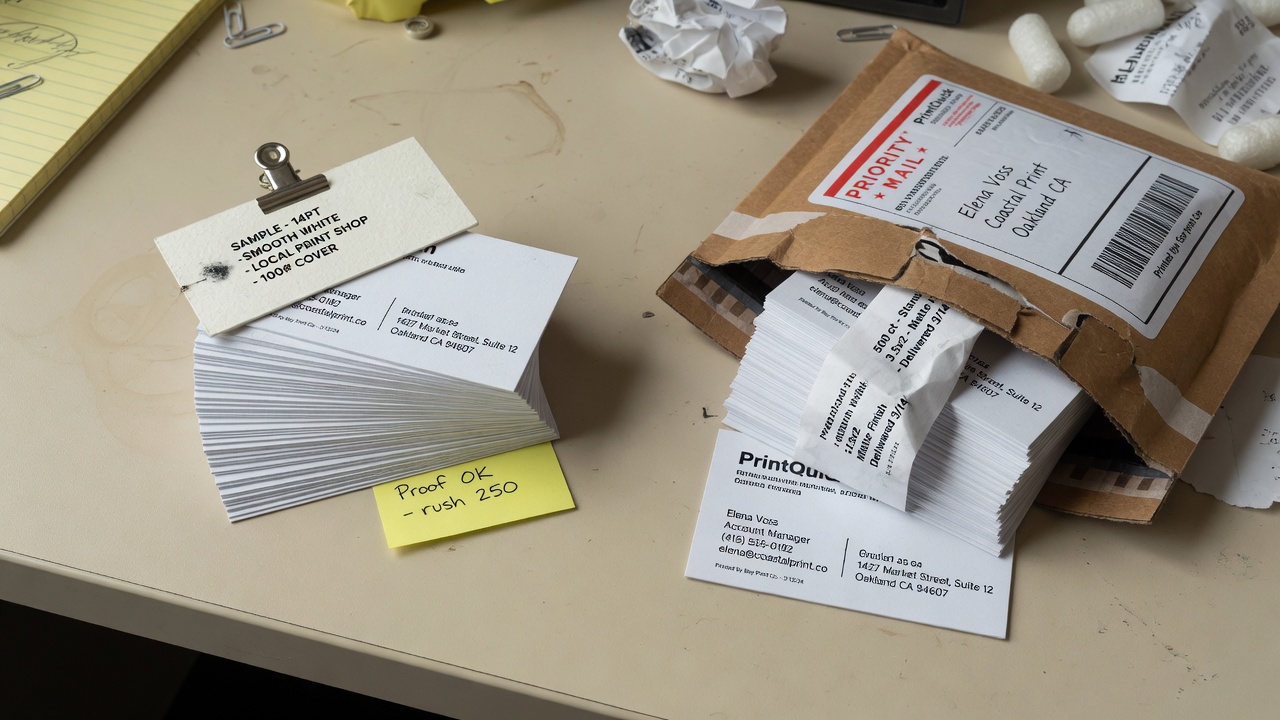
Choose a local Irvine printer when you need a paper proof on the real stock, brand color you can hold under indoor light, a reprint of a known file, or pickup at 15321 Barranca Pkwy instead of a carton on a porch. Choose VistaPrint or another online template site when the card is generic, color is not contractual, and a carrier calendar is acceptable. They are different jobs, not two prices for the same box.
That is the local printer vs vistaprint irvine decision, stated as a channel, not as a loyalty test. The rest of this page is proofs, color management, files, rush pickup, reprints, and shipping versus a counter on Barranca. I estimate this work at Avanti Printing, 15321 Barranca Pkwy, Irvine, CA 92618. If you want the honest version with a sheet of board in your hand, call (949) 387-0787 and come in. Quotes still confirm size, material, quantity, finish, and date. A cart badge is not those five facts.
People search this comparison after a template box arrived with a navy that was not the navy, after a porch delivery missed a Thursday mixer, or after a cart rejected a PDF that a shop would have printed. Sometimes they search it after an online order went fine and they wonder why anyone drives to a plant. Both searches are legitimate. Online template sites are good at shipping a standard 3.5 × 2 card to a lot of addresses. A local printer is good at the conversation that happens before the cutter. Pick the tool that matches the risk on this job.
Local printer vs VistaPrint: the decision, not the brand war
I am not going to invent a competitor’s menu or a fake unit price. VistaPrint, and sites built like it, sell a web-to-print product: you pick a SKU, drop a file or a template, approve an on-screen mockup, pay, and wait for a carrier. Avanti sells a print job: you send a spec and a file, we preflight, we quote, we print, you pick up on Barranca or we ship if you ask. Those workflows disagree about proofs, color, time-to-hand, and what “reprint” means. Use this table as the conversation.
| Question | Local printer (Avanti on Barranca) | Online template site (VistaPrint-class) |
|---|---|---|
| What you approve | A PDF for layout, then a paper proof on the stock if color or finish is the brand | An on-screen mockup of a card, often a 3D render, on a backlit display |
| Color | CMYK (or a stated simulation of a spot). We can aim at a swatch and look at it indoors | Whatever the cart converts from RGB or from its template library, through a plant profile you do not see |
| File | A print-ready PDF we preflight; we can repair or rebuild and quote that work | A template, or an upload into a SKU. Auto-preflight may reject, crop, or convert without a person |
| Time to a hand in Irvine | Quoted production after a printable file, then pickup at 15321 Barranca Pkwy | Plant time plus a shipping label plus transit plus your porch or suite reception |
| Rush | A conversation with an estimator. The clock starts when the file is actually printable | A paid upgrade that still ends in a box on a truck. Transit does not compress because you clicked expedite on the print line |
| Reprint | Same job ticket, same PDF, “250 more of this.” We still confirm the five facts | Reorder if the SKU, template, and account still exist. Menus move. Files get re-uploaded |
| Design | Quoted as file prep or custom layout when the art is not press-ready | A template library. Fine when the template is the card you want |
| Counter | Walk-in Monday–Friday, 8:00 a.m. to 5:00 p.m. You can hold the stock | No Irvine counter. Chat or email if something is wrong after the box arrives |
| When it is the right tool | Brand color, paper proof, messy files, multi-name lists, a known pickup date | Generic black type on white, no proof ritual, you can wait on a carrier |
A local printer and VistaPrint are not two prices for the same object. One sells a conversation, a proof, and a pickup. The other sells a SKU and a tracking number. If you only needed a tracking number, the cart already won. If you needed the navy to be the navy, it did not.
I print standard business cards in Irvine from both kinds of origin files: a clean PDF/X, and a Canva export that still needs a grown-up. The channel you pick should follow the risk, not a habit of opening the same bookmark. A template cart is not immoral. A local plant is not automatically “premium.” Premium is a finish line on a quote, not a ZIP code.
Get pricing for a local card quote
Who this comparison is for in Irvine and Orange County
This write-up is for the person who has to live with the box, not the person collecting vendor opinions for a slide deck. Founders in Irvine Company suites, brokers working Spectrum opens and Newport showings, clinic administrators on Barranca and Alton, attorneys who still jot a department number on the back, contractors who keep a pack in a bag between Tustin and Santa Ana, consultants on chamber and BNI calendars, office managers ordering eight names from a spreadsheet. You are buying a hand-off object for Orange County. The other person holds it for two seconds. Color, edge, and whether you actually had the cards on Thursday all show up in those two seconds.
I split buyers into jobs, because the channel should follow the job:
- Brand-critical cards. A hospital teal, a law-firm navy, a restaurant ochre that already lives on a fascia or a menu. You need a paper proof on the stock. Local.
- High-churn names with a frozen layout. Labs near UCI, medical device seats along Alton, startups in the Spectrum. You will reprint. Local wins if we keep the master and you send a name list. A template cart wins only if you enjoy rebuilding the template every time a title moves.
- One generic name, no brand color, no deadline that cares about a porch. A side project, a first student card, a temporary role, a one-time conference where black type on white is enough. Online is fine. I mean that.
- Thursday mixer, file still moving on Tuesday. Pickup on Barranca is a different clock than a carton in a truck. Local, and put the date on the quote. A broken file does not start either clock.
If you are ordering for a whole floor, do not force every seat through a template because the owner’s nephew used VistaPrint in college, and do not force every intern onto a custom duplex spec because the owner liked a sample. Owner cards and staff cards can share a layout and split the channel, the stock, or both. That is a normal two-line conversation. Send the list. Write quantity next to each name.
Geography matters only where it changes the hand-off. Pickup at 15321 Barranca Pkwy is a lunch errand from a lot of Irvine Company parks, the Spectrum, and the Alton medical strip. It is a planned drive from Laguna or Anaheim. Shipping is geography-agnostic until the label is wrong, the suite will not sign, or August heat sits on a porch for six hours. Tell me which of those is your week.
When an online template site is the right tool
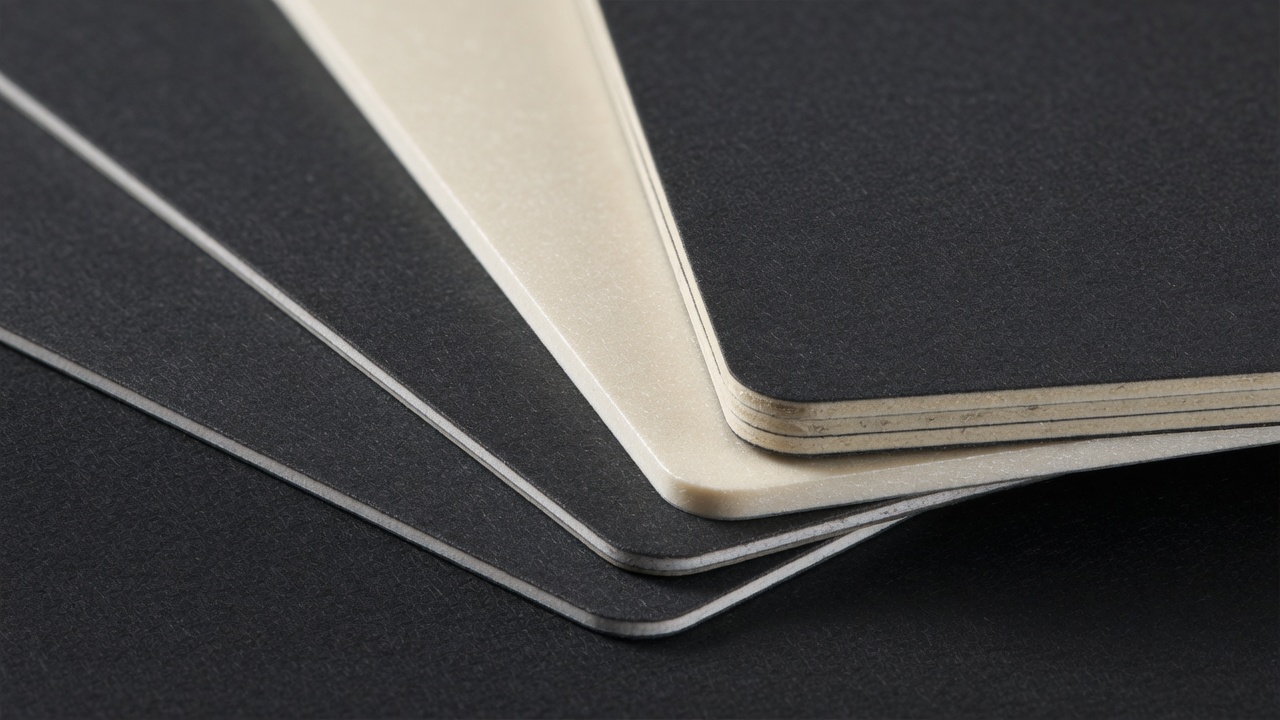
I will not pretend every card should come through this dock. Template carts exist because a large fraction of cards are simple, and simple cards do not need a press-side seminar. If I talked you out of a cart that would have been fine, I wasted your time. Here is when I tell people to stay online, or to go online on purpose.
The card is generic and you know it. Black or dark gray type on white or cream, a logo that is already a decent vector or at least a clean 300 ppi mark, no full-bleed navy, no “this teal is the brand.” A lot of consultants, tutors, notaries, and first-time LLC cards live here. A template that is actually 3.5 × 2 with a sane margin will produce a usable card. You are not failing as a professional. You are matching spend to risk.
You cannot pick up, and you do not have a person who can. You are traveling. You work from a home office in a city without a shop you trust. You need the box at a hotel near a show. A local Irvine pickup is a bad product for that week. We can ship too — say so on the quote — but if the job is a simple SKU and the address is already in your cart, using the cart is rational.
You are testing a name, a title, or a layout you expect to throw away. A 100-card online order as a field test is a legitimate use of a template. Just do not treat that box as the brand. If the test works, bring the real file here for the version you will reprint. Do not scale a template you already distrust to a thousand because the unit price dropped.
The template is the design you want. Some people like a particular cart layout. If you are happy with it, color is not contractual, and you accept the mockup as a layout check rather than a color contract, order it. I would rather you like your cards than win an argument about ICC profiles.
There is no file, and you do not want to pay for design. Template libraries exist for that gap. We will quote custom design and print-ready file preparation if you want a layout built to your logo and text. That is a line item. If you do not want that line item and you are fine with a template, the cart is doing its job.
What I will not tell you: that online cards are “fake,” that a template is always ugly, or that shipping is a moral failure. Shipping is how most printed matter in this country moves. It is a calendar and a heat and a porch problem, not a character problem.
The honest limit of the cart, even when it is the right tool: you are approving a picture of a card. You are trusting an automated crop. You are trusting a plant you will not visit. For black type on white, those trusts are cheap. For a full-bleed brand panel, they are expensive. That is the whole section.
Proofs: a render is not a sheet of board
This is the part of local printer vs vistaprint irvine that actually reprints boxes. Proof means different objects in the two channels. If you use the same word for both, you will approve the wrong thing and then argue with physics.
On a template site, the “proof” is almost always a soft proof: a pixel mockup on a backlit screen. Sometimes it is a flat JPEG of the layout. Sometimes it is a 3D card on marble, in a hand, on a desk with a plant. That 3D card is advertising. It has drop shadows, fake thickness, and a color engine aimed at making you click buy. It is useful for catching “Your Name Here,” a missing phone digit, and a logo sitting on the trim. It is not useful for deciding whether the navy is the navy. You cannot feel film on a render. You cannot see a white hairline at the cut. You cannot see that 100K black will look charcoal on coated stock.
At a local printer, a proof can be two different objects, and you should say which one you are buying:
- A PDF proof. Layout, type, spelling, trim, whether front and back flip correctly. Color on a PDF is a rumor. It is a good rumor if your monitor is even vaguely sane and you are looking at it indoors. It is a bad rumor on a phone in a Barranca parking structure at noon.
- A paper proof on the stock. The board you are buying, the coating or film you are buying, the file we will print. This is the proof that settles brand color. It takes time. Put it on the quote. It is cheaper than 500 cards you will hide in a drawer.
I will not pretend a paper proof is free, instant, or always required. If the card is black type on white 16pt C2S, a PDF is usually enough. If the card is a full-bleed teal that already lives on a clinic fascia on Alton, look at paper. If you refuse the paper proof, you are buying the conversion. That is allowed. Write it down so nobody pretends we promised a monitor.
How to look at a paper proof without lying to yourself:
- Look at it indoors, under the kind of light you actually hand cards in — an office, a restaurant, a lobby — not in courtyard sun and not under a jeweler’s lamp unless that is your room.
- Hold it at actual size. Do not pinch-zoom a photo of the proof and then reject a 0.5% hue shift you would never see in a handshake.
- Compare it to the object that has to match, if there is one: a letterhead, a sample from last year, a painted panel. Do not compare it to Instagram.
- Read the type as if you did not design it. Suite, cell, URL, license line. Color arguments hide spelling errors.
- Approve in writing. “Looks good” in a text thread is an approval. So is silence if you asked us to proceed by a date. Be explicit.
Template-site habits that are not proofs:
- Screenshot of the cart. Compression, and you cropped the bleed.
- The 3D mockup’s “matte” or “gloss” filter. That is a picture of plastic, not your film.
- A colleague’s “it looks fine on my iPad.” Their iPad is not the plant profile.
- Approving on a plane Wi-Fi connection at 30 percent brightness. You approved a dim rectangle.
If an online box arrives and the color is wrong, you are in their reprint policy, not in a conversation at a cutter. Some of those policies are fair. Some want you to eat the job because you clicked a checkbox next to a render. Read the checkbox. I cannot unclick it after the porch.
If you bring that online box to Barranca as a complaint about their navy, I can use it as a reference for a new local job. I cannot honestly “match VistaPrint” as if their plant were a Pantone. I can aim at a swatch you like, including a card you already hold, and you can approve a paper proof of our printing. That is a new quote. It is not a warranty on a cart you paid somewhere else.
Color: RGB carts, ICC profiles, and a navy you can hold
Screens mix red, green, and blue light. Presses mix cyan, magenta, yellow, and black ink or toner. A template cart is a screen that then sends a file to a plant. The plant converts. Conversion is a mapping, not a promise. Bright mint, neon orange, electric blue, and website teal are the usual casualties. They dull. That is gamut, not a press operator in a bad mood.
The International Color Consortium publishes the profile format those mappings use. An ICC profile describes a device or a color space so a file can be translated instead of guessed. I am not asking you to become a color scientist. I am asking you to notice that a hex you copied from a website is an RGB recipe, and that VistaPrint-class uploaders will convert it through a pipeline you do not control. A local shop will also convert if you send RGB. The difference is whether a person can show you the result on the stock before you own 500 of it.
What I do with color on a local card job:
- Prefer a PDF already in CMYK, or a PDF/X with a stated output intent.
- If you have brand CMYK values, we use them. If you have a Pantone number, we simulate it in CMYK unless we spec a true spot. Simulation is close, not identical. Say if close is not enough.
- If you only have a hex or a screenshot, I convert and you approve a proof. Do not skip the proof because “it is just a card.”
- Small type stays 100K. Large black panels get a stated rich black if you want them dense. RGB 0-0-0 left in a file is not a recipe; it is a hope.
- We view color indoors. Irvine courtyard sun and Spectrum garage lighting make phones lie.
What a template cart typically does, stated without a courtroom tone: it accepts a wide range of uploads so the buy button works. RGB JPEG, PNG, PDF, a template fill. The automation will fit the art to the SKU, convert to the plant’s working space, and move. That automation is why the cart is fast and why a hospital teal becomes a different teal. Nobody at that plant is walking a swatch to your suite on Barranca.
Brand-matching across objects is a local problem. If the same navy must live on a card, a letterhead, and a rigid sign, you are matching three surfaces, not one hex. Online cards will not know about the sign. We will not magically match a sign we did not print unless you bring the object or a measured value. Bring the object.
Canva-to-cart is a common Orange County path. Canva is an RGB house. “PDF Print” is better than a PNG and still a conversion you did not control. If that PDF then goes into a template uploader, you stacked two conversions. For black type on white, stacked conversions still look like a card. For a full-bleed ochre, stacked conversions are how you get a muddy orange and a disappointed chef.
Gray and black traps that show up in both channels:
- RGB gray that converts with a pink or blue cast.
- Four-color black on 8-point type, letters go chubby or chromatic.
- A 100K flood that looks charcoal on coated stock; the buyer wanted a piano panel.
- A logo PNG with a pale “transparent” halo that appears on a tinted field.
I can catch those in prepress if I see the file. An auto-preflight may only care that the document is 3.5 × 2. Those are different quality bars. Neither bar is a personality. They are what you paid the channel to care about.
If color is contractual, write the values. Put them in the quote. Approve paper. If color is “close enough for a mixer,” say that too. I would rather print a job you already forgave than a job you plan to reject against a phone.
Files: templates, auto-preflight, and a PDF we can print
A print-ready business card file is still 3.5 × 2 inch trim, 0.125 inch bleed on all sides, CMYK, 300 ppi at actual size or true vectors, fonts outlined or embedded, live type 0.125 inch inside trim, two pages, front then back. That spec does not change because a cart showed a green checkmark. The checkmark means the file fit a SKU. It does not mean the logo is a vector.
Template sites are built around a picture frame. You drop a logo in a circle, type in a box, pick a background. That is a legitimate way to make a simple card. It fails when:
- The template’s “bleed” is a checkbox and your navy still stops at a neat rectangle.
- The logo you dragged is a website PNG. The cart accepts it because it fills the frame. The handshake will show the staircase.
- Front and back are designed as one wide canvas. The plant splits it. The split is not where you thought.
- The safe area in the template is tighter than the corner you later asked to round, and the phone number sits in the radius.
- You used a font the cart cannot embed, and the name that leaves the plant is not the name you typed.
Auto-preflight is a robot. Robots are consistent and unimaginative. They will bounce a file for the wrong page size. They will sometimes resample an image rather than refuse it. They will convert RGB without asking if the teal is sacred. A person at a local counter will stop and say “this logo is 72 ppi; we can redraw it as a paid file job, or we can print the staircase.” That sentence is the product. It is also why production time is quoted after we see a file we can actually print. A green checkmark in a cart can start their plant clock on a file I would have held.
What I want from you on a local job:
- A PDF, two pages, bleed on, fonts outlined or embedded.
- A vector logo even if it is also placed in the layout.
- CMYK values for any color that cannot drift.
- A name list as a spreadsheet if there are several people. Longest name and longest title must fit.
- A sentence if the art is not ready and you need design.
What I will take as a starting point, not as print-ready: a Canva share, a PNG, a photo of a card you like, a VistaPrint reorder PDF you downloaded from an old account. We can rebuild. Rebuilding is a design quote. Put “need file prep” on the request so nobody pretends the art is ready.
If your only file is the online card itself, photograph it in even light as a reference, then retype the text and relink the logo. Do not ask a plant to reprint a photograph of a photograph. Glare on a cell-phone shot is not a font.
Email and chat apps compress. If you WhatsApp me a layout, I received a sausage. Upload a PDF, or walk a drive to 15321 Barranca Pkwy. Do not screenshot the PDF and send the screenshot. Template carts also compress on upload; a 300 ppi file can leave their server softer than it arrived. If the logo is a vector, keep it a vector through the whole path.
Imposition is our problem, not yours. Do not send a letter-size sheet of ten cards “to help.” Do not send the cart’s 3D mockup as the print file. Send the flat art. If you need us to build the flat art from a text list and a logo, that is the design link above, not a secret press setting.
Barranca pickup versus a shipping label
This is the logistics half of the comparison, and it is the half people underestimate until a Thursday. A local job can end in your hand at 15321 Barranca Pkwy, Irvine, CA 92618. An online job ends in a box that a carrier tries to put somewhere you named. Those are different clocks. They are not a morality play about supporting local business, though you are allowed to care about that on your own time. They are a mixer-on-Thursday problem.
Our clock, stated without a fantasy: you send size, material, quantity, finish, date, and a printable file. We preflight. If the file fails, the clock does not start. If the file is clean, we produce to the quoted date and you pick up during Monday–Friday, 8:00 a.m. to 5:00 p.m., or we ship to an address you wrote down. Rush is a conversation, not a SKU I will invent on this page. Put the date you need them in a hand. I will tell you whether the job fits. I will not promise a slot I do not have. I will not pretend a broken Canva link is a reason to skip preflight.
A template cart’s clock is plant time plus label time plus transit plus the last mile. Expedite on the print line does not make Interstate 5 shorter. A carton in a trailer in August is a small oven. Coated cards will usually survive. Soft-touch film and stacked packs can take a curl or a block if the box cooks on a porch. That is handling, not a reason to fear shipping. It is a reason not to treat a porch as a climate-controlled counter.
The United States Postal Service shipping pages are honest in a way marketing calendars are not: service standards are not guarantees. Private carriers have their own language for the same idea. Weather, volume, an incorrect suite, a gate code, a receptionist who will not sign, a “front door” that is a loading dock — those eat days. If your job is a chamber breakfast at 7:30 a.m., a 10:30 a.m. delivery window is a miss even if the tracking says delivered.
Pickup on Barranca, practically:
- You can look at the top card before you leave the building. If something is wrong, we are still in the same room as the job ticket.
- You are not hoping a porch pirate in a townhome complex is honest.
- You can take 250 now and leave the rest of a larger carton if that is how we packed it and you asked.
- A lunch from an Irvine Company suite on Jamboree or a Spectrum office is a normal errand. From a job site in San Clemente, it is a planned stop. Plan it.
- Bring ID if someone else is collecting. Write the pickup name on the quote if it is not you.
Shipping from us, when you want it: we will. Give a real address, a suite, a phone, and whether the dock needs an appointment. Do not use a P.O. box if the carton will not fit the carrier’s P.O. box rules. Do not use an old apartment. Suite reception in some towers will refuse a box. Ask your office before you type the tower address and hope.
Shipping from a template cart: same address hygiene, plus you will not be in the room if the insert is short or the job is the wrong name. You will open a ticket. Some tickets go well. Opening a ticket the morning of a UCI career fair is a bad morning.
Heat and the last mile in this county: inland Irvine and Tustin in late summer cook cabins and porches. A box against a west-facing door for six hours is not a lab. If the card is film-laminated, get it inside. If you cannot be home, pick up here or ship to the office that is staffed. Do not use a vacation rental as the ship-to for a professional card order unless you like improvising.
Quoted turnaround depends on the job we actually have — file, finish, quantity, and the date you wrote. A shipping estimate on a cart is a different document. Do not mix them in your head and then call either of us late.
Request a proof and Barranca pickup quote
Reprints, job tickets, and leftover SKUs
Reprint is the other half of why people come back to a local counter. A template cart reprint is “order again” if the product still exists, the template did not move a logo, your account still opens, and you upload the same file into the same SKU. That often works. It fails when the board name changed, the template was retired, the account was an intern’s Gmail, or you cannot remember which of four PDFs was the one that looked acceptable.
A local reprint is a job ticket. We still have the PDF, the stock line, the finish line, and the quantity history if you ordered it here. “250 more of job X” is a sentence. We will still confirm size, material, quantity, finish, and date, because those five facts drift: a new hire, a new suite, a new film preference, a mixer date. Confirming is not friction. Confirming is how we do not reprint last year’s title by accident.
What a good reprint path looks like:
- One master layout, live type on your side even if you sent us outlines.
- Names as a list, not as twelve Canva links.
- A job number or a date on your copy of the PDF.
- A short run first if the identity is still moving; a larger run only after a box has been emptied without a file change.
- When a line changes — title, cell, suite, email domain — stop handing the remainder. Throw them. A local reprint of 100 correct cards is cheaper than three months of fiction.
What a bad reprint path looks like:
- Re-uploading to a cart because it is faster than finding last year’s file, and accidentally using a new template that shifted the logo 1/16 inch.
- Ordering 1,000 online because the unit price looked like a win, then changing title in nine weeks. I will not invent their prices. I will say the leftover math is the same in every channel: remaining wrong cards have zero usefulness.
- Asking us to “match the online cards exactly” without a paper sample. Bring the sample. Matching a memory of a cart render is not a spec.
- Leaving the master in a personal Canva folder named finalFINAL2. When that person leaves the Spectrum office, you do not have a reprint path. You have archaeology.
Multi-name offices should not reprint through twelve storefront accounts. Send one layout and a spreadsheet. We will quote per name. A template cart can do variable names too, in some SKUs. If it does, and the names are simple, use it. If the longest title collides and nobody is looking, you just bought a stack of collisions. Quantity multiplies a tight lockup. It does not hide it.
Stock continuity: mills and merchants change grades. A local estimator will tell you if last year’s 16pt C2S is not on the floor and what the substitute will feel like. A cart will substitute inside a SKU name that still says “premium matte” and you will find out in the handshake. Ask. On a local reprint, ask. On a cart, read the current product description as if you had never ordered it, because maybe you have not, not this year.
If you hated the online box, bring it. I will not mock it. I will ask what you hated: color, edge, flex, film, type, the fact that it arrived on Friday. Those are different next jobs. Color is a proof. Flex is a caliper. Film is a finish line. Type is a file. Friday is a date and a pickup. Do not change all five at once unless you want a new mystery.
Mistakes that reprint a whole box, in both channels
These are channel-and-proof reprints I see from the Barranca counter. Not theoretical. Not a customer named in a testimonial.
- Approved a 3D mockup, rejected the navy in the handshake. The render was RGB theater. Fix: paper proof on the stock if the color is the brand. Or forgive the conversion in writing before we print.
- No bleed, white hairline after the cut. Happens in carts and in emailed PNGs. Fix: 0.125 inch of actual ink past trim. A local preflight should catch it. An auto-preflight might crop instead.
- Website PNG logo, staircase in the mixer light. The cart accepted the frame fill. Fix: vector mark, or a paid redraw.
- Shipped to the old suite, or to a tower reception that will not sign. Tracking said delivered. The cards are in a different company’s mail room. Fix: pickup here, or a staffed ship-to you confirmed.
- Expedited print, standard transit, mixer on Thursday. The plant was on time. The truck was a truck. Fix: pickup on Barranca, or a date that includes the last mile.
- Wrong name because the template still said the intern’s placeholder on the back. Soft proofs are for reading. Read the back.
- Reordered online, template had moved, logo now sits on the trim. Fix: open the flat file, not the 3D view, every time you reorder. Or reprint from a local job ticket.
- RGB teal from Canva, two conversions, muddy result, no proof. Fix: CMYK values and paper. Physics will not apologize.
- 1,000-card cart order, title changed in a month. Unit price was not leftover cost. Fix: short runs until the identity survives a box. This is true locally too. I will not cheer for a fat local order of a soft title either.
- Compressed chat-app JPEG as the upload. Type went soft. Fix: a PDF upload, not a photo of a screen.
- Assumed a local shop could “just match” an online SKU without a sample or a spec. “The usual VistaPrint card” is not material, finish, or caliper. Bring a card or write the five facts.
- No date, no quantity, no finish on the local request, then surprise. Quotes confirm size, material, quantity, finish, and date. A channel comparison does not relax that sentence.
The cheapest reprint is the one you do not do. A five-minute read of a proof is cheaper than a thousand cards with the old suite, and cheaper than a thousand cards with a teal you will not hand to a hospital administrator.
Returns: custom print is generally not a sweater. Neither channel wants a used name in a restock bin. If the error is ours, we make it right. If the error is an approved file, you own the file. If the error is a cart checkbox next to a render, you are in their policy. Read policies before you need them, which is the opposite of how people behave the morning of a show.
Orange County logistics an out-of-state plant does not see
Not every local color belongs on a card spec. These do, because they change proofs, heat, pickup, and whether a tracking number is a plan.
Proofing in parking-lot sun. Irvine Company lots and Spectrum garages are bright. A phone cranks saturation. You approve a carnival, then reject a normal CMYK card. Proof indoors. This is true whether the proof is our PDF or a cart mockup.
Mixer and show dates. Irvine Chamber breakfasts, BNI tables, UCI-adjacent vendor days, Anaheim Convention Center weeks. The date is a fact. Put it on the quote. A plant in another state cannot put the box in your hand at 8:00 a.m. in Irvine unless the carrier already did its job yesterday. Pickup here can. Neither channel can print a file you have not sent.
Suite and tower receiving. Some Irvine towers will not take a carton at the lobby. Some require a dock appointment. Some assistants throw unlabeled boxes on a mail shelf that is not yours. Pickup avoids that theater. If you ship, write the suite, the company name as the lease shows it, and a phone that gets answered.
Heat. Inland parked cars and west porches in late summer. Do not store the online carton in the Civic. Do not leave our carton on a dash after pickup. Film and stacked packs dislike that more than a 16pt aqueous card does. The Civic is not a warehouse in either channel.
Medical and device corridor on Alton and Barranca. Credential lines, long titles, and teals that already exist on a fascia. Paper proof. Local. A template cart will print a card. It will not know about the fascia.
Campus and startup title weather. Short runs, a master file, reprints. A local job ticket is built for that. A cart can do it if you are disciplined about templates. Most offices are not.
Job sites between Tustin, Santa Ana, and Costa Mesa. Someone can swing by Barranca. Shipping to a trailer is how boxes die in gravel. Pickup, then a pack in a bag, not in a cup holder with screws.
Hospitality in the Spectrum and Woodbridge. Grease and lotion. Finish is a separate line — do not accidentally order uncoated from a cart because the mockup looked “soft.” If you need to feel film versus coat, that is a counter conversation. Online is a guess you then wear on your hands.
HOA and office-park visitor rules. They rarely change a card. They change whether your designer can drop a drive at our dock during lunch. Call (949) 387-0787 if you are sending a person. Do not assume a loading-dock novel. We are a print shop on Barranca, not a closed campus. Still, names on the quote help.
Local does not mean a different mill than the rest of California. It means your proofing light, your heat, your suite, and your Thursday are specific. A national cart is built not to care. Sometimes that is efficient. Sometimes that is how a teal dies.
What to send so the quote is a local job
A usable quote request is short. Missing one of these is how you get a number that does not match the box, or a pause while we reverse-engineer a PNG of a cart mockup.
- Size. 3.5 × 2 inches, or the custom size in inches. If you already built bleed, say so.
- Quantity. Per name and total. “250 each, 4 names.” Do not write “a box.”
- Material. Board caliper and coated or uncoated, or “recommend.” Do not write “premium” alone. Do not write “like VistaPrint” without a sample in the envelope.
- Finish. Aqueous, film, uncoated, none — as a chemistry, not a mood. Film both sides unless you say otherwise.
- Sides. 4/4 or 4/0, or plain English.
- Proof. PDF only, or paper on the stock. If brand color is sacred, say paper.
- Date. The date you need them in a hand in Irvine. A mixer, a start date, a show. The clock starts on a printable file.
- Pickup or ship. Pickup at 15321 Barranca Pkwy, Irvine, CA 92618, or a ship-to with a suite and a phone. If someone else is collecting, their name.
- The file, or a sentence that you need design. PDF with bleed preferred. If the art is a template or a Canva link, write that. We will quote a print-ready layout from your text and logo instead of pretending.
Helpful extras:
- CMYK or Pantone for any color that cannot drift.
- A vector logo.
- A physical sample of a card you want to aim at, including an online box you almost liked.
- Which lines might change in six months, so we do not cheer for a fat quantity.
- Whether anyone writes on the back. That sentence prevents a film-on-both-sides surprise. It is a finish fact, not a channel fact, but it walks in with the channel conversation.
That list is the job. I can estimate from it. I cannot estimate from “usual cards, not the cheap online ones, soon.” I also cannot estimate from a competitor’s current homepage. I quote our job. Walk-ins Monday–Friday, 8:00 a.m. to 5:00 p.m. Call (949) 387-0787 if you want to hold stock next to an online card you already own. Send the same spec through the quote form if you cannot come in.
For a broader view of what we print besides channel debates, start at the Business Cards Irvine home page and then send the quote with the five facts: size, material, quantity, finish, and date. Daily-carry work still runs through Irvine business cards we print from supplied art or a rebuilt file; the channel, the proof, and the pickup are what this page is for.
FAQ
Is a local printer always better than VistaPrint for Irvine business cards?
No. A local printer is better when you need a paper proof, brand color on the real stock, a file repaired, a multi-name list, a reprint from a job ticket, or pickup on Barranca on a date you can plan. An online template site is better when the card is generic, color is not contractual, you cannot pick up, and a carrier calendar is acceptable. They are different jobs. Use the one that matches the risk.
Can I upload the same PDF to VistaPrint and to Avanti?
If it is actually print-ready — 3.5 × 2 trim, 0.125 inch bleed, CMYK, 300 ppi or vectors, fonts outlined or embedded — both channels can take it. The cart may still convert, crop, or wrap it in a template. We will preflight and tell you if something will reprint. A Canva RGB PNG is not that PDF in either place. Do not treat a green checkmark as a color contract.
Will you match an online site’s price?
I will not invent a competitor’s cart, and I will not quote a number on this page. Send size, material, quantity, finish, and date. I quote our job, including proofing and pickup if those are part of it. Unit price on a simple template SKU is often the cart’s advantage. A paper proof, a repaired file, and a Thursday pickup are usually ours. Those are different invoices. Compare them as different invoices.
What kind of proof should I approve?
A PDF proof for spelling, trim, and flip. A paper proof on the stock if the color or the finish is the brand. A 3D mockup on a template site is a layout check and an advertisement. Do not approve brand navy on a phone in a parking lot. If you skip paper, you are buying the conversion. Write that down.
How does Barranca pickup compare with shipping?
Pickup puts the box in your hand at 15321 Barranca Pkwy during weekday hours, after a quoted production date, and you can look at a card before you drive away. Shipping adds a label, transit, a porch or a lobby, and heat. Expedited print does not shorten Interstate 5. For a Thursday mixer in Irvine, pickup is the plan that does not depend on a last mile. We can still ship if you ask and you give a real address.
When is an online order actually the right call?
Generic black type on white, no sacred brand color, no paper-proof ritual, you can wait on a carrier, and you are fine with a template or a simple upload. Testing a title with 100 cards you expect to throw away is also a fair use. Do not scale that test to a thousand. Do not use a cart for a hospital teal that already lives on a fascia unless you are willing to accept whatever the plant converts.
If the online box comes out wrong, can you reprint it locally?
We can print a new local job aimed at a result you like. Bring the physical cards as a reference, plus a real file or a request for design. I cannot warranty another company’s plant, and I cannot honestly “match VistaPrint” as if their profile were a Pantone. I can aim at a swatch and you can approve a paper proof of our printing. That is a new quote with the five facts on it.
What do I send to get an accurate local quote?
Size, material, quantity, finish, and the date you need them in a hand. Add proof type, pickup versus ship, sides, and a PDF or a note that you need design. If you have an online sample, say what you liked and what you did not. I will not invent a caliper or a date to fill a blank. Call (949) 387-0787 or use the quote form.
Pick the channel that matches the job, then print it
Local printer vs VistaPrint in Irvine is a proof, color, file, reprint, and pickup decision. A template cart is the right tool for a generic card and a tracking number. A local plant is the right tool for a navy you can hold, a file you can repair, a job ticket you can reprint, and a box you can lift at 15321 Barranca Pkwy. Do not trash a cart that would have been enough. Do not trust a render with a brand color. Quotes confirm size, material, quantity, finish, and date — write all five, and write whether you are picking up or waiting on a porch.
If you want this decided with a sheet of board instead of a mockup, come to Avanti Printing, 15321 Barranca Pkwy, Irvine, CA 92618, bring the online box if you have one, and ask to look at stock under indoor light. Or send the spec, the date, and the PDF through the quote form. Call (949) 387-0787. Pick the channel that matches the job. Then we can print the card you actually meant to hand.