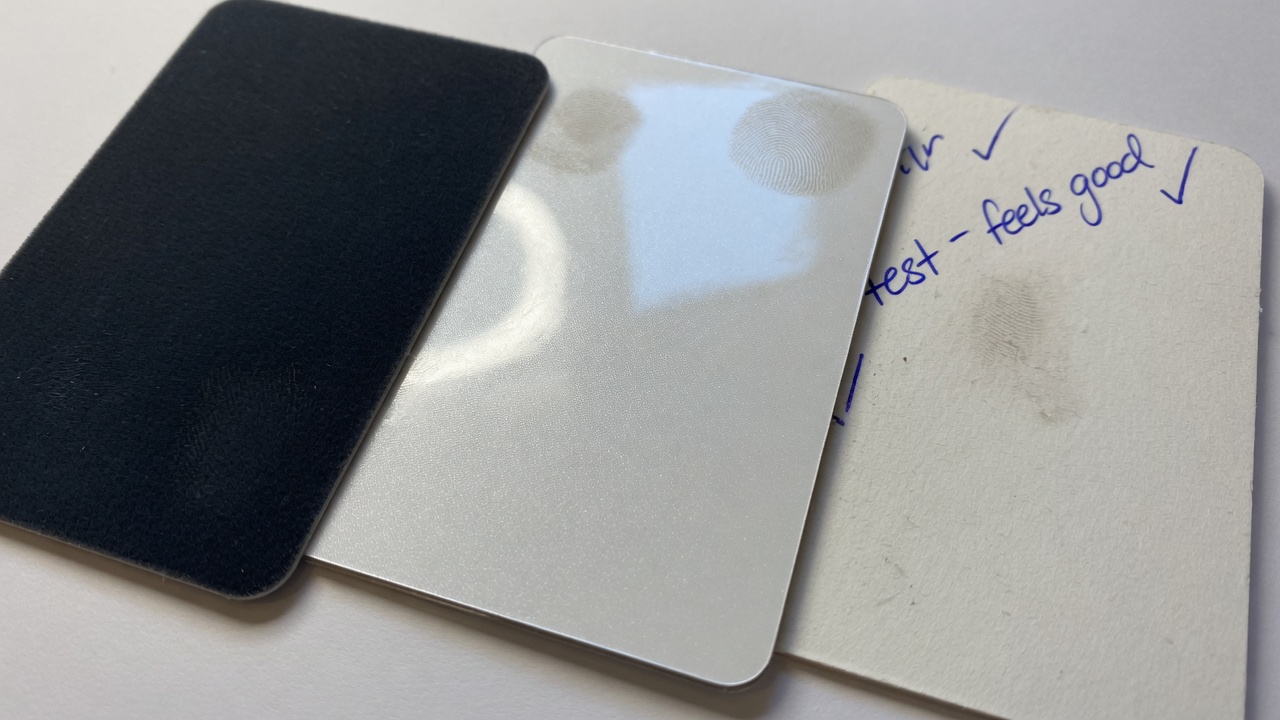
Soft-touch vs silk on an Irvine business card is a surface, not a thicker board. Silk lamination is matte plastic film that kills courtyard glare. Soft-touch, also sold as velvet, adds rubbery drag. Uncoated stock takes a ballpoint. Aqueous and UV flood protect ink without film. Choose the surface for fingerprints, writing, and pocket wear.
People search soft touch vs silk business cards after a cart offered both, a mixer card came back shiny, or a pen refused to write on the back. Those are three different failures. Gloss is not “more professional.” Velvet is not “thicker.” Uncoated is not “cheap.” Each surface is a tool. I estimate this work at Avanti Printing, 15321 Barranca Pkwy, Irvine, CA 92618. If you want the honest version, call (949) 387-0787, come in, and put a thumb and a ballpoint on actual swatches. Product names lie. Fingers and pens do not.
This guide is the coating and film conversation. Thickness is a separate line on the quote. Foil and spot UV are a later finishing conversation; they sit on top of a surface you already chose, and they do not replace this choice. Quotes still confirm size, material, quantity, finish, and date. If finish is “nice matte,” you have not specified a finish.
Who this surface choice is for in Irvine and Orange County
This is for the person who approves the card spec and then has to carry it. Founders in Irvine Company suites, brokers working Spectrum opens and Newport showings, clinic administrators on Barranca and Alton, attorneys who still jot a department number on the back, contractors who keep a stack in a cup holder, consultants who work BNI tables and chamber mixers, hospitality managers whose cards live next to lemon oil and hand lotion. You are buying a hand-off object for Orange County, not a render.
The other person holds the card for two seconds, glances at the name, and either pockets it, sets it on a high-top, or — if you designed it for this — writes on it. Surface shows up in those two seconds as glare, drag, and whether the card already looks handled. Surface shows up a week later as scuff in a wallet, oil from sunscreen, a fuzzy uncoated edge, or a soft-touch panel that has gone shiny at the thumb.
I split the job, because the surface should follow the job:
- Write-on cards. Brokers, site supers, clinic schedulers, anyone who still puts a gate code, a suite, or a next appointment on the back. Start uncoated, or C1S with an uncoated back, or a light aqueous that still has tooth. Do not film both faces and then test a pen in the parking lot.
- Daily mixer cards. Chamber breakfasts, UCI-adjacent vendor days, indoor lunches, Anaheim Convention Center weeks in a tote. Silk film or a satin aqueous on 16pt C2S is the boring, correct default for most of those rooms. You want readable type in glare and a face that does not collect every thumb in the room.
- Object cards. Principals, luxury listing agents, interior designers, architects who want the suede read. Soft-touch film earns its keep when the card will sit on a walnut table, not live in a jeans pocket with car keys. Dark full-bleed panels fight you here. Say so before we flood navy on velvet.
- Wipe-down cards. Restaurants, dental front desks, job-site dust, outdoor Spectrum tables in August. UV flood or film. Uncoated will look tired first. Soft-touch will look oily. Pick protection on purpose.
If you are ordering standard business card printing in Irvine for a whole office, do not force every seat onto velvet film because the owner liked the sample. Owner cards and staff cards can share a layout and split the finish. That is a normal two-line quote.
Coat, film, and uncoated are three different objects
Start here or you will argue with a quote that was never wrong. Shops use “coating” as a junk drawer. I do not. On a card quote in this plant, the words mean this:
- Flood coating is a liquid laid over the printed sheet and dried or cured. Aqueous (AQ) is water-based. UV flood is a UV-cured polymer. Both live in the micron range. They change sheen and rub. They barely change caliper. They are not a plastic skin.
- Film lamination is a plastic sheet glued to the printed sheet. Silk (matte / satin OPP) and soft-touch (velvet) are films. Typical card films sit in the 1.2–1.5 mil band per side; that is a typical industry range, not a certificate for your carton. Two sides of film add a few thousandths of an inch you can measure. They also change friction, sound, and whether a pen can bite.
- Uncoated stock is the sheet as the mill finished it, with no flood and no film. Fibers are the surface. Ink sits in them. A ballpoint can write. Abrasion shows sooner. Color reads duller than the same file on C2S.
Aqueous and UV flood are coatings. Silk and soft-touch, in this shop, are films. Uncoated is neither. If a cart says “silk” without the word film or the word coat, ask which object they are selling. The thumb cannot tell you the chemistry. A pen and a micrometer can.
“Silk” is the word that causes reprints. In offset work, silk can mean a low-gloss aqueous or varnish. On a business-card menu, silk usually means matte or satin film. Soft-touch is almost always a tactile film, not a varnish with a fancy name. If you write “silk cards” in an email, I will write back and ask: coat or film. That is not pedantry. A silk aqueous card still takes a hesitant ballpoint. A silk-laminated card will not.
C1S and C2S are mill language: coated one side or coated two sides, meaning the mill’s clay coat, not our AQ flood. You can print uncoated. You can print C2S and then AQ, UV, or film. You can print C1S and leave the back as a writing pad. Do not say “coated” when you mean “laminated,” and do not say “matte” when you have not picked a chemistry.
Paper labs measure specular gloss of paper and paperboard at 75 degrees with methods such as TAPPI T 480. Film and other nonmetallic surfaces are often read with geometries in ASTM D523 (20°, 60°, 85°). I will not pretend we certificate every job to those methods. I will say this: gloss UV reads high, uncoated reads low, silk film sits in a glare-killing middle, and soft-touch is a friction story more than a gloss-unit story. If two samples “look the same” on a phone photo, they are not the same card. Photos flatten sheen. Courtyard sun does not.

Side-by-side: AQ, UV flood, silk film, soft-touch, uncoated
Use this as a counter conversation, not a lab report. Board caliper is assumed in the usual 16pt C2S neighborhood unless you say otherwise. Film adds mils. Coatings do not impersonate film.
| Surface | What it is | Glare in an Irvine courtyard | Pen / pencil | Fingerprints on a dark panel | Pocket and tote wear | Best default job |
|---|---|---|---|---|---|---|
| Uncoated | Fiber surface, no flood, no film | Low glare; type stays readable | Ballpoint, pencil, most gels | Oil stains, not shiny prints | Fibers scuff; ink rubs onto the next card | Write-on, paper-forward brands |
| Aqueous (AQ) flood | Thin water-based coat, gloss or satin | Satin AQ is quiet; gloss AQ still reflects | Sometimes a hesitant ballpoint; not a notepad | Better than UV gloss; worse than uncoated | Light rub protection; not a plastic shield | Everyday professional card without a film feel |
| UV flood | UV-cured polymer flood, usually high gloss | Can become a mirror at 2 p.m. | No. Skating rink. | Every thumb shows on navy and black | Strong scuff resistance; hairline scratches still show | Wipe-down, indoor tables, saturated color |
| Silk lamination | Matte or satin OPP film, both faces unless you say no | Kills glare; type stays readable outside | No. Plastic. | Hides some oil relative to gloss; not magic | Tough against tote abrasion; edges can still white | Mixer and convention default when you do not need to write |
| Soft-touch (velvet) film | Tactile film with rubbery drag | Low glare; suede read | No. Worse than silk for ink. | Dark floods collect a museum of thumbs | Burnishes shiny at high-wear spots; hates keys | Desk-object and principal cards, lighter fields |
If you are torn only between silk film and soft-touch, you are not torn about protection. Both are films. You are torn about friction and about how a dark panel will look after twenty handshakes. That is the whole soft touch vs silk business cards argument, stated without a product poem.
Get pricing for soft-touch, silk, or uncoated cards
Aqueous coating: the quiet professional flood
Aqueous coating is a water-based flood, often run in-line on offset and available as a flood on many digital card jobs. Typical dry film is a few microns — a typical industry range, not a promise on your box. Gloss AQ pops saturation a little. Satin or matte AQ calms it. Neither turns the sheet into plastic. You can still hear paper when you drop the card on a table.
What AQ does well:
- Holds ink against light rub in a box, a drawer, and a reasonably clean tote.
- Keeps a paper-like hand. Clients who hate “the laminated menu feel” often wanted AQ and did not have the word.
- Stays in the micron range, so wallet fit does not change.
- Lets a hesitant ballpoint leave a ghost on some satin formulas. That is not a writing spec. It is a maybe. Test the actual coat.
What AQ does poorly:
- Wipe-down in a kitchen or a sunscreen-heavy outdoor mixer. Oil sits. Dust embeds.
- Impersonating silk film. A satin AQ card will still scuff sooner than matte OPP. If your test is a week in a canvas tote against metal water bottles, film wins.
- Hiding a weak sheet. AQ on 14pt still flexes like 14pt.
I write satin AQ on 16pt C2S when the brand is a professional services firm that lives in air-conditioned Irvine suites, does not need a suede stunt, and does not need to jot notes. Attorneys who do not write on the card, CPAs, consultants, medical-device sales who hand the card indoors — this is the quiet spec. It photographs as “a real card” without announcing a finishing department.
Gloss AQ is the version people order when they say “a little shine, not plastic.” It still reflects in a plaza at midday. If your hand-offs are University Center outdoor tables in July, I will push you toward satin AQ or silk film. If your hand-offs are a conference room on Barranca, gloss AQ is fine.
AQ is also the finish I use when someone wants protection and still wants the option of a later finishing conversation — a stamp, a deboss, something that does not like a plastic skin. Film can fracture or scar under a die. AQ is less of a fight. That is not a tour of specialty processes. It is why you should not laminate first and then remember you wanted the sheet to move.
Both sides. A single-side AQ flood on a two-sided print is how cards curl in a parked car. Coat both faces unless you have a C1S writing back, in which case we talk moisture and storage, not magic.
UV flood: sheen, scuff, and a skating-rink face
UV flood is a polymer coat cured with ultraviolet light. It is thicker than AQ in the way a coat of enamel is thicker than a wipe of wax — still microns, still not a ply, still not film. The common card version is high gloss. Satin UV exists. If you do not say satin, you are buying the mirror.
Color sits hot under gloss UV. Saturated reds and deep navies look expensive on a walnut table under downlights. The same card in an Irvine Company courtyard at 2 p.m. becomes a glare problem. The name you paid to have read is now a highlight. Silk film exists because of that sentence.
Scuff resistance is the reason to buy UV flood instead of AQ. Cards that ride in a restaurant apron, a toolbag, or a stack that strangers riffle at a booth will survive UV better than AQ. Hairline scratches still show, especially on dark solids, because gloss advertises every abrasion as a white tick. Protection is not invisibility.
The pen test fails on purpose. UV flood is a skating rink. Ballpoint skates. Gel skates. Pencil does nothing useful. A permanent marker will mark it and then smear in a pocket for the rest of the card’s life. If anyone on the team writes on cards, UV flood both sides is the wrong spec. A writable back means we keep UV off that face, or we change the stock.
Fingerprints: gloss UV on a dark full-bleed panel is a fingerprint museum with better lighting. Lotioned hands at a dental front desk, sunscreen at an outdoor open house, kitchen hands at a tasting — all of them print. You will see this by day two. Fixes, in order: lighter field, texture or a large uncoated-looking photograph instead of a flat navy, satin UV instead of gloss, or silk film. Soft-touch is not the fingerprint fix people think it is. It trades a shiny print for an oily matte smudge.
Heat and block: Orange County trucks and dashboards are not a lab. Fresh UV against fresh UV in a hot stack can offset if cure and airing were rushed. Store boxes inside. Do not treat the Civic on Barranca as a warehouse. This is handling, not a reason to fear UV. It is a reason to put a date on the quote that allows the coat to finish.
UV flood is not film. It will not add the mils or the snap of lamination. It will not give you the suede drag. If a vendor says “UV coating for a laminated look,” they are selling sheen. Ask whether the line is flood coat or film. I will price them as different lines because they are different operations.
Silk lamination: glare control with a plastic skin
Silk lamination, on a card quote from this counter, means a matte or satin polypropylene film glued to the sheet. It is the surface I reach for when someone says they want soft touch vs silk business cards explained and then admits they work outside, hate fingerprints, and do not write on the back. Silk is the mixer film. Soft-touch is the desk film. That split will save you a reprint.
What the film does:
- Kills specular glare so type stays readable in sun, under downlights, and next to a window wall in an Irvine tower.
- Adds a measurable skin. Typical 1.2–1.5 mil OPP per side is a common shop range. Two sides on 16pt board land you nearer a 19pt finished card. If the quote still says “16pt silk,” ask whether 16pt is the board going in or the card coming out.
- Seals the sheet against some moisture, grease, and tote abrasion. A week in a backpack with a water bottle is kinder to silk film than to AQ or uncoated.
- Changes the sound. You get a quieter click than gloss film, a more plastic click than AQ. If your brand is cotton stationery, you will hear the lie.
What silk film will not do:
- Take a useful pen line. The back is plastic. Plan a writable area or pick a different spec.
- Hide every fingerprint on navy. It hides some. Dark panels still oil. They oil less dramatically than gloss UV, more than a light gray field.
- Replace a second ply of paper. Film is not duplex. Do not buy silk to fix a floppy 14pt if stiffness was the complaint. Buy board, or say you only wanted scuff and glare control.
- Emboss as kindly as uncoated or AQ. Film can fracture or go shiny at a deep stamp. If a stamp is in the brand, put it on the quote before we lock film. Extra decorative finishes are a later conversation; they are not how you pick silk versus velvet.
Silk versus gloss film is a glare choice. Gloss film is wipe-down and snap and a fingerprint magnet. I rarely spec gloss film for Orange County outdoor hand-offs. I spec it for indoor color pop and for crews who need to wipe dust off a card. Silk is the courtyard and convention default.
Edges: film is trimmed with the card. A white flash at the edge is the board core, not a defect in the silk. Dark floods make that flash more visible. If the edge bothers you, that is an edge-color conversation, not a reason to skip film. Keep it on its own quote line.
Curl: film on one face only is a moisture antenna. Inland Irvine in late summer will show you. Laminate both faces unless you are deliberately building a C1S-style hybrid, in which case we talk about it in writing.
Premium laminated business cards live in this silk-and-velvet world. They take a bindery step a flood coat does not. Put the date on the quote. Film is an operation, not a checkbox that prints itself.
Soft-touch (velvet) film: drag is not luxury by itself
Soft-touch is a tactile film. Clients call it velvet, suede, rubberized, “the expensive one.” The expensive part is the drag. Your thumb slows down. The brain reads that delay as cost. The board underneath can still be 14pt. If you want the suede and the snap, say both: 16pt plus soft-touch, two lines. Do not assume the film includes a caliper upgrade.
The drag is friction, not stiffness. A soft-touch 14pt card can feel “thicker” than a gloss 16pt in a blind hand-off and then taco-bend in the same fingers. Have the buyer bend the sample. Do not argue with their fingers using a product name.
Where velvet earns the extra line:
- A principal card that will sit on a table in a listing appointment or a design consult.
- Light or mid-tone fields, cream stocks, photography with air, type-forward layouts with plenty of unprinted film.
- Indoor rooms. Soft-touch in a quiet office is a small pleasure. Soft-touch in a jeans pocket with keys is a burnish experiment.
Where velvet fails:
- Navy, black, and forest full bleeds. Every thumbprints. Soft-touch does not hide oil; it displays oil as a dull smudge you cannot buff out the way you sometimes can on gloss. I have watched people “clean” a velvet card and polish a shiny patch into the suede. That patch does not go back.
- Pocket carry with keys, coins, badge clips. High-wear corners go shiny. The suede is a nap. Abrasion knocks the nap down. Silk film scuffs less theatrically.
- Writing. Worse than silk. The rubbery face grabs a pen and then refuses a line. Marker smears forever.
- Heavy ink that was not dry. Mottling under tactile film is a real bindery problem. Dark floods need dry time before the film goes on. Put the date on the quote. Do not squeeze a velvet navy into a calendar that only worked for AQ.
- Heat. A laminated pack on a dashboard on Barranca in August can curl or, in a bad case, show edge lift. Soft-touch is still a film. Store it inside.
Soft-touch versus silk is not a quality ranking. It is a use ranking. If the card is a desk object, velvet can be the right read. If the card is a daily-carry mixer card for a team that lives in totes and parking lots, silk film or satin AQ will look newer at week three. I would rather you love the silk sample than bury a velvet run in a glove box.
Dark velvet also photographs badly in raking light: mottle, thumb sheen, dust that will not flick off. If the card has to look good in a phone photo on a listing flyer, test that photo on a real swatch. A PDF mockup of “soft-touch navy” is a rectangle, not a surface.
For soft-touch and silk premium card stocks, I want you to hold both films on the same board, same layout if you have one, in the same lighting you actually use. Window light at our counter on Barranca is closer to an Irvine plaza than a designer’s calibrated monitor.
Uncoated stock: the writing surface, with the scuff that comes with it
Uncoated means the fibers are the finish. No AQ, no UV, no film. Ink sits in the sheet instead of on a sealed face. Color is duller than the coated proof on your screen. That dull is not a press error. Ask for a proof on the real stock when the brand color is the brand.
The pen test is why people order it and then forget to say so. A ballpoint writes. A pencil writes. Many gels write. Fountain pens write and may feather depending on the mill. That is a feature for brokers, supers, and anyone who still treats the back as a notepad. It is also why uncoated cards in a stack will offset a little ink onto each other if you riffle them hard on day one. Let them sit. Do not rubber-band a fresh pack in a hot car.
Pocket wear is the cost. Uncoated edges go fuzzy. Dark ink rubs. A week in denim will show. A restaurant apron will show faster. Sunscreen and hand lotion do not leave a shiny fingerprint; they leave a darker stain in the fiber. You cannot wipe it. You live with it or you change surface.
I spec uncoated when:
- The brand is paper-forward: architects who sketch, some attorneys, nonprofits, winemakers, certain interior designers who want stationery, not a tile.
- Someone will write on the card in the field, every day, not once as a stunt at the counter.
- You want a letterpress-adjacent read without pretending film is cotton.
I do not spec uncoated when the card lives in a kitchen, a job-site cup holder with screws, a sunscreen-heavy open house, or a tote that also holds a water bottle and a battery pack. Those jobs want film or at least UV flood. You can still have a writable back: C1S, or uncoated back / coated or filmed front, as a hybrid. Hybrids curl more. They are still the right answer if the back is a notepad and the front has to survive.
Cotton and other specialty uncoated sheets are a mill conversation. They print differently, score differently, and cost differently. Recycled uncoated is its own spec; confirm caliper and shade on that mill, because bulky recycled sheets can read thicker than their grade and can be dirtier in the sheet. Do not write “eco uncoated” and assume we share a definition. Name the mill or come feel it.
Uncoated is not a discount grade. A well-designed uncoated 16pt card can look more expensive than UV-gloss 14pt, because people still read fiber as care. Layout carries more of that read than buyers want to admit. If the file is a stretched logo on a dusty photograph, uncoated will not save it. Fix the file. Then pick the sheet.
If the layout still needs work, say so. Custom business card design in Irvine should follow the surface: uncoated wants type and margins; velvet wants air around dark panels; UV gloss wants you to admit the courtyard. Do not design a navy flood for uncoated and a hairline reverse for velvet on the same artboard and call it one brand.
Three field tests: pen, fingerprint, pocket
Ignore the marketing names for ten minutes and run the tests the card will actually face. I keep a ballpoint, a gel, a pencil, a Sharpie, and a couple of ruined phone-case wallets at the counter for this reason. Bring the pocket you actually use. Two minutes here is cheaper than a thousand-card mood swing.
The pen test
Write a phone number and a gate code on the back. Wait five seconds. Rub with a thumb. Then wait a minute and pocket-rub.
- Uncoated: ballpoint and pencil pass. Gel usually passes. Fountain may feather. This is the notepad.
- Satin AQ: ballpoint sometimes leaves a pale, skippy line. Treat it as a no if writing is a daily job. Treat it as a maybe if you only need an initial.
- Gloss AQ and UV flood: fail. The line skates or beads.
- Silk film: fail for ballpoint. Sharpie marks and never dries. That mark will transfer in a wallet.
- Soft-touch: fail, with extra smear. The nap grabs ink and holds a smudge.
If half the team writes and half the team wants velvet, that is two finishes or a hybrid back, not a group vote for the suede. A Sharpie on film is not “writing.” It is a stain.
The fingerprint test
Use a dark panel sample if your layout has one. Press a lotioned thumb. Hold it under window light, then under downlight. Walk it outside.
- Gloss UV: shiny prints, very visible, sometimes buffable, always back tomorrow.
- Soft-touch: dull oily prints, not buffable without burnishing the nap.
- Silk film: quieter prints; still there on navy.
- Satin AQ: visible, less theatrical.
- Uncoated: stain in the fiber, no highlight.
Light fields forgive all of these. If you love velvet and you love navy, pick one. The combination is how a principal card looks handled before the first lunch.
The pocket-wear test
A U.S. business card is typically 3.5 × 2 inches. It then lives in a leather bifold, a MagSafe wallet, a phone-case slot, a badge sleeve, a jeans pocket with keys, or a tote with a water bottle. Abrasion is not theoretical in those places.
- Silk film is the tote and convention survivor. Anaheim Convention Center weeks are riffle-and-tote weeks. Silk looks newer at the end of the day than AQ or uncoated. Badge sleeves are happier with film that is not duplex-thick; that is a caliper note, not a coating poem.
- UV flood survives grit and wipe-down. Hairline scratches on dark gloss will show in a badge-reel clip.
- Soft-touch in denim with keys burnishes. If the owner carries one card in a clean inside jacket pocket, velvet can last. If the team stuffs a dozen in a back pocket, order silk.
- Uncoated in denim pills at the edge and transfers ink. Fine for a shirt pocket. Poor for contractors and line cooks.
- AQ is the in-between. Office pockets, yes. Job-site cup holders, no.
Heat is part of pocket wear in this county. A card against a phone in a sun-soaked cup holder is a laminator you did not ask for. Film can take a curl. Uncoated can take a wave. Keep boxes inside. Keep the carry pack in a bag, not on the dash.
Request a coating and stock quote
How color and files behave on each surface
The press does not care that you paid for velvet if the file is wrong. Spec the file as a 3.5 × 2 inch card with 0.125 inch bleed, live matter 0.125 inch off trim, CMYK, 300 ppi images, fonts outlined or embedded — then add what the surface cares about.
- Uncoated: expect a drier, less saturated read. Rich black panels can look mottled if the file is a single black instead of a built black; that is a file conversation on press, not a reason to film the sheet. Hairlines hold better than on a spreading coat, then get destroyed in a pocket. Do not put micro type in a dark reverse and blame the mill.
- AQ: closest to “what you saw on the coated proof,” especially gloss AQ. Satin AQ calms contrast a little. Standard card files behave.
- UV flood: saturation jumps. A navy that looked corporate on screen can look like a piano. If that is the point, good. If the brand navy is a specific PMS-adjacent formula, proof on the coated sheet with the flood, not on a bond laser print. Hairline reverses can fill if the coat is heavy. Keep reverse type out of the 6-point basement.
- Silk film: slightly calms gloss and can warm or cool depending on the film. Fine-line reverses usually hold. Full-bleed photos look like prints under glass that lost the glass — flatter, more even, less “wet.” That is often what you wanted when you hated UV glare.
- Soft-touch: dark solids can mottle if the sheet was not dry, and they will show every handling mark. Avoid hairline reverses; the nap and the film adhesive are not a place for 0.25-point strokes. Give dark panels air. A cream field with black type on velvet looks considered. A 100% ink navy flood on velvet looks like a fingerprint project.
Do not send a flattened 72 dpi PNG of the whole card and then pick a tactile film. You will buy the film twice: once to see the mistake, once to fix the file. PDF with bleed. If you need us to build the file, say that on the quote instead of hoping a screenshot scales.
C1S hybrids: front file and back file are different jobs. The front can be a flood or a film. The back needs to stay a writing surface, which means no film and usually no UV. Keep the back layout as type on a light field. A full-bleed photo on the writable back defeats the pen and still scuffs.
Rounded corners eat the corner of your safe area. Mention them. They are not “standard cards.” They also change how a laminated edge catches a wallet slot. Square-cut film corners are a little plow. If pocket-fit matters, say so before we cut.
Color on uncoated versus color on film is not something I will “match by eye on the monitor.” If the same logo must live on letterhead, an uncoated card, and a silk card, we are matching three surfaces, not one file. That is allowed. It is a proofing problem. Budget proofs on the real stocks.
Reprint mistakes we see from the Barranca counter
These are finish-related reprints. Not theoretical. Not a customer named in a testimonial.
- Ordering “silk” and receiving film when they wanted a paper-like satin coat. Or the reverse. Fix: write “silk film (matte laminate)” or “satin aqueous flood.” Those are different SKUs.
- Soft-touch on a navy full bleed that showed every thumb in a sunlit courtyard. The mockup was a flat rectangle. The film was real. Fix: lighter field, texture, silk film, or accept the museum of thumbs.
- Two-sided film, then anger at the pen. The back was plastic. The gate code still needed writing. Fix: uncoated, C1S, or AQ with a tested tooth. Do not laminate both sides and then get angry at the pen.
- Comparing a soft-touch 14pt sample to a gloss 16pt sample and calling velvet “thicker.” They compared drag to caliper. Feel both films on the same board, or ignore the feel test for thickness.
- UV gloss cards that were unreadable at an outdoor Spectrum table. Indoor proof, outdoor job. Fix: silk film or satin AQ if the hand-off is outside.
- Uncoated cards in a restaurant manager’s apron. Grease and abrasion by Friday. Fix: film or UV, and a writable back only if they still take notes.
- Single-side film or single-side AQ that curled in a parked car. Coat or laminate both faces, store inside.
- Velvet film applied over a dark flood that was not dry, then mottled. Bindery is chemistry plus time. Put the date on the quote.
- Sharpie “signatures” on silk film that transferred through a whole pack in a rubber band. Film does not absorb. Stacking wet marker is how you print a second, uglier job on the next card.
- No finish named, then surprise at the result. Quotes confirm size, material, quantity, finish, and date. “Matte premium” is not a finish. If one of the five facts is missing, the spec is a wish.
The cheapest reprint is the one you do not do. Swatches exist so you can be boring and correct. A PDF cannot take a pen test.
Orange County handling that actually changes the finish
Not every local color belongs on a card spec. These do, because they change oil, glare, heat, and abrasion.
Courtyard and plaza glare. Irvine Company towers, University Center, Spectrum outdoor tables, Newport waterfront meetings — the sun is a lighting designer who hates gloss. Gloss UV and gloss film become mirrors. Silk film and satin AQ keep the name readable. If your week is half indoor, half plaza, silk wins. Uncoated also reads in sun; it then scuffs in the bag on the way back to the car.
Sunscreen and lotion. Outdoor opens, clinic desks, spa-adjacent hospitality. Oil is the enemy of dark floods. Uncoated stains. Gloss UV prints. Soft-touch smudges. Silk film is the least theatrical of the sealed faces. Light fields help every chemistry.
Heat and parked cars. Inland Irvine in late summer cooks a cabin. Film and adhesive dislike that more than a 16pt AQ card does. If your team lives in a truck between Tustin job sites and a Barranca office, laminated packs belong in a bag, not on the dash. Curl is a storage problem as much as a finish problem.
Convention weeks. Anaheim Convention Center traffic means badge sleeves, tote-bag abrasion, and stacks on counters that get riffled by strangers. Silk film survives the riffle. Uncoated shows it. Soft-touch looks great on the counter and then burnishes in the badge reel. Pick the card for where it will spend the day, not for the first five seconds on the table.
Medical and dental. Lotioned hands, sanitizer, a front-desk stack that a hundred people touch. UV or silk film for the public stack. Soft-touch only if the card is a consult leave-behind that sits in a folder, not in the candy-bowl of cards.
Restaurants and tasting rooms. Grease, wine, damp bar rails. Uncoated dies. AQ struggles. UV flood and film wipe. Soft-touch holds smells and oil in the nap. I spec silk or UV here unless the chef’s personal card is a paper-forward exception that lives in a shirt pocket.
Job-site grit. Contractors who keep cards in a cup holder with screws will destroy uncoated and scuff AQ. Laminated silk 16pt is the spec. Soft-touch will survive the grit and then look polished at every corner. Velvet is the wrong toughness.
Campus and high-churn offices. UCI-adjacent labs and medical groups reprint names. Do not trap a velvet-and-navy spec in a box that will be wrong in ninety days. A simpler AQ or silk on a sensible board is enough. Finish is not where you spend money that titles will outrun.
Office-park pockets. Slim bags, badge clips, MagSafe wallets. Film both sides still usually slides on 16pt. The veto is height, which is a board conversation. The finish veto is burnish and oil, not slot thickness. If the card cannot share a pocket with an access badge, it will be left on the desk, which defeats the point of printing it.
Local does not mean a different mill than the rest of California. It means your oil, sun, and tote pattern is specific. Tell me where the card lives after the handshake.
What to send so the quote names the surface
A usable quote request is short. Missing finish is how you get a number that does not match the box.
- Size. 3.5 × 2 inches, or the custom size in inches.
- Quantity. The actual number you will take. If you want two finishes, two quantities.
- Material. Board caliper (14pt / 16pt / duplex if you already know), coated or uncoated mill sheet, C1S or C2S if you need a writable back.
- Finish, in chemistry words. Uncoated; aqueous gloss or satin; UV flood gloss or satin; silk / matte film; soft-touch / velvet film. Film both sides unless you say otherwise. Do not write “matte premium.”
- Sides. 4/4 or 4/0, or plain English (“color both sides”).
- Writing. Yes or no, and on which face. This one sentence prevents the pen-test reprint.
- Extras. Rounded corners, edge color, a stamp — listed, not implied by a mood board. Foil and spot UV stay a later finishing conversation until the surface is locked.
- Date. The date you need them in a hand in Irvine. Film on dark floods needs room to dry and nip.
- Pickup or ship. Pickup at 15321 Barranca Pkwy, Irvine, CA 92618, or a ship-to address.
- Files or a note that you need design. PDF with bleed preferred. If the file is not ready, say so.
That list is the job. I can estimate from it. I cannot estimate from “soft nice cards, usual amount, soon.” If you want to feel AQ, UV, silk, velvet, and uncoated before you lock the line, say that. Ten minutes at the counter will save you a paragraph of adjectives.
Walk-ins Monday–Friday, 8:00 a.m. to 5:00 p.m. Call (949) 387-0787 if you are coming with a pen and a wallet. Send the same spec through the quote form if you cannot come in.
For a broader view of what we print besides coating debates, start at the Business Cards Irvine home page and then send the quote with the five facts: size, material, quantity, finish, and date. Daily-carry work still runs through Irvine business cards we print for ordinary professional carry; the finish line is what this page is for.
FAQ
What is the real difference in soft touch vs silk business cards?
Both are films on this menu. Silk (matte or satin OPP) kills glare and takes tote abrasion without a suede nap. Soft-touch adds rubbery drag and reads as “expensive” on a table. Soft-touch burnishes shiny in a keys-and-denim pocket and shows oil on dark panels. Silk is the mixer default. Velvet is the desk-object default. Neither is a thicker board. Neither takes a useful pen.
Can I write on silk or soft-touch laminated cards?
Not in a way you will like. Ballpoint skates. Gel skates. Pencil does nothing. Permanent marker marks and then transfers in a wallet. If you need a gate code on the back, order uncoated, C1S, or a tested satin aqueous — or film the front only and leave the back as a writing surface. Test the actual back, not a different mill’s swatch.
Does aqueous coating feel like silk lamination?
No. AQ is a thin flood in the micron range. Silk lamination is a plastic skin in the mil range. Satin AQ can look low-glare and still sound like paper. Silk film seals, scuffs later, and will not take a pen. If you hate plastic and you do not need tote armor, AQ. If you work outdoor tables and convention totes, silk film.
Will UV flood hide fingerprints on a dark card?
No. Gloss UV on navy or black is a fingerprint highlight reel. You may buff a print and then put a new one on it at the next handshake. Satin UV is quieter. Silk film is quieter still. Soft-touch trades a shiny print for an oily smudge you cannot buff without burning the nap. The real fix is a lighter field, or a surface plus a layout that does not flood dark ink to every edge.
Which finish survives a jeans pocket and a tote at Anaheim?
Silk film, or UV flood if you need wipe-down and can live with gloss. Soft-touch burnishes at the corners against keys and badge clips. Uncoated pills and transfers ink. AQ is fine for an office pocket and light for a convention tote that also holds a water bottle. Spec the finish for the longest part of the card’s day, not the hand-off photo.
Does soft-touch make a thin card feel like a thick one?
It can fool a thumb because drag slows the hand. It will not impersonate stiffness. Bend the sample. If the buyer’s test is “does it feel coated and considered,” velvet on 14pt may pass. If the buyer’s test is “does it fight my bend,” buy board. Put caliper and film on two lines so you are not accidentally comparing a laminated 14 to a bare 16.
Uncoated or silk for an outdoor Spectrum mixer?
Silk if the card has to look new at 4 p.m. after sun, sunscreen, and a tote. Uncoated if someone will write on it and you accept scuff as the cost. Gloss UV is the worst outdoor glare of the sealed faces. Soft-touch outdoors on a dark card is an oil collector. For most teams handing cards in a plaza, I start at silk film on 16pt C2S and only move if writing or a paper brand requires it.
What do I need to send to get an accurate card quote?
Size, material (board and whether the mill sheet is coated), quantity, finish in chemistry words, and the date you need them. Add whether anyone writes on the card, sides, rounded corners, and pickup on Barranca versus ship. Attach a PDF with bleed or say you need design. I will not invent a film to fill a blank. Call (949) 387-0787 if you want to match swatches first.
Pick the surface on purpose, then print it
Soft-touch vs silk is a friction and glare choice between two films. Uncoated is the writing surface. Aqueous is protection that still feels like paper. UV flood is sheen and scuff with a skating-rink face. Fingerprints follow dark panels. Pens follow tooth. Pockets follow abrasion and heat. Thickness is a different line. Foil and spot UV stay a later finishing conversation until this one is done. Quotes confirm size, material, quantity, finish, and date — write all five, and write finish as a chemistry, not a mood.
If you want this decided with actual film instead of adjectives, come to Avanti Printing, 15321 Barranca Pkwy, Irvine, CA 92618, bring a pen, and ask to see silk, velvet, AQ, UV, and uncoated on the same board. Or send the spec and the date through the quote form. Run the pen test. Run the thumb test. Then we can print the surface you meant.