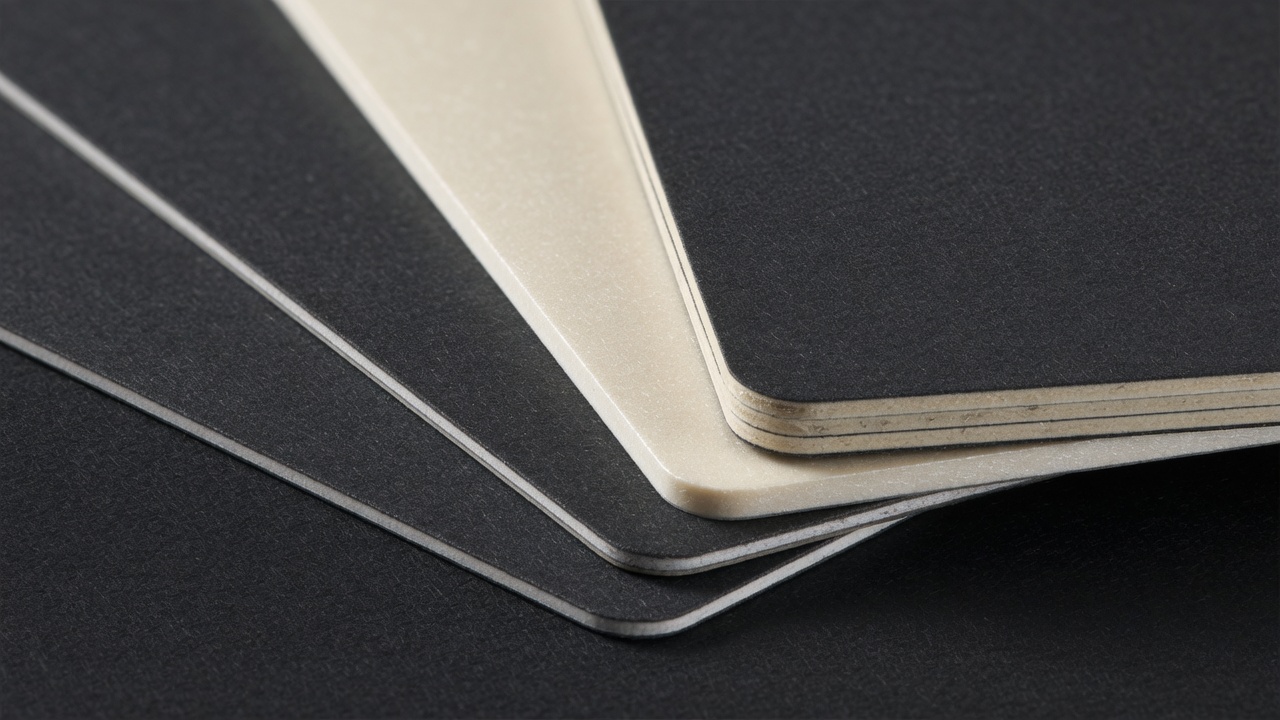
For most Irvine and Orange County networking, 16pt coated card stock is the default. 14pt is enough when you reprint often, mail stacks, or need every card to slide into a thin wallet slot. 32pt laminated duplex is a two-ply build that feels like a credit card. Ask for caliper, not just “thick,” and confirm coating separately from thickness.
That is the whole decision, stated plainly. The rest of this guide is how those numbers are measured, why a laminated 14pt card can fool your fingers, when duplex 32pt fights a pocket, and what to put on a quote so you do not reprint a thousand cards that feel like the wrong object. I estimate this work at Avanti Printing, 15321 Barranca Pkwy, Irvine, CA 92618. If you want a hand on actual swatches, call (949) 387-0787 and come in. Fingers beat a product page.
People type 16pt vs 14pt business cards into a search bar because an online cart offered both at two different prices and did not explain the unit. In a North American print shop, “pt” on cover stock is almost always caliper: thousandths of an inch. It is not gsm. It is not the typographic point you use in InDesign. It is not a finish. Get those four ideas apart and the rest of the menu starts to make sense.
Who this thickness choice is for in Irvine and Orange County
This write-up is for the person who has to approve a card spec, not the person collecting samples for fun. That usually means a founder, an office manager, a broker, a clinic administrator, or a marketing lead who also has to live with the box in a desk drawer. You are buying for Irvine Company suites, Spectrum offices, UCI-adjacent labs, medical device firms along Alton and Barranca, restaurants in the Spectrum and Woodbridge, and crews that live in trucks between job sites in Tustin, Santa Ana, and Costa Mesa.
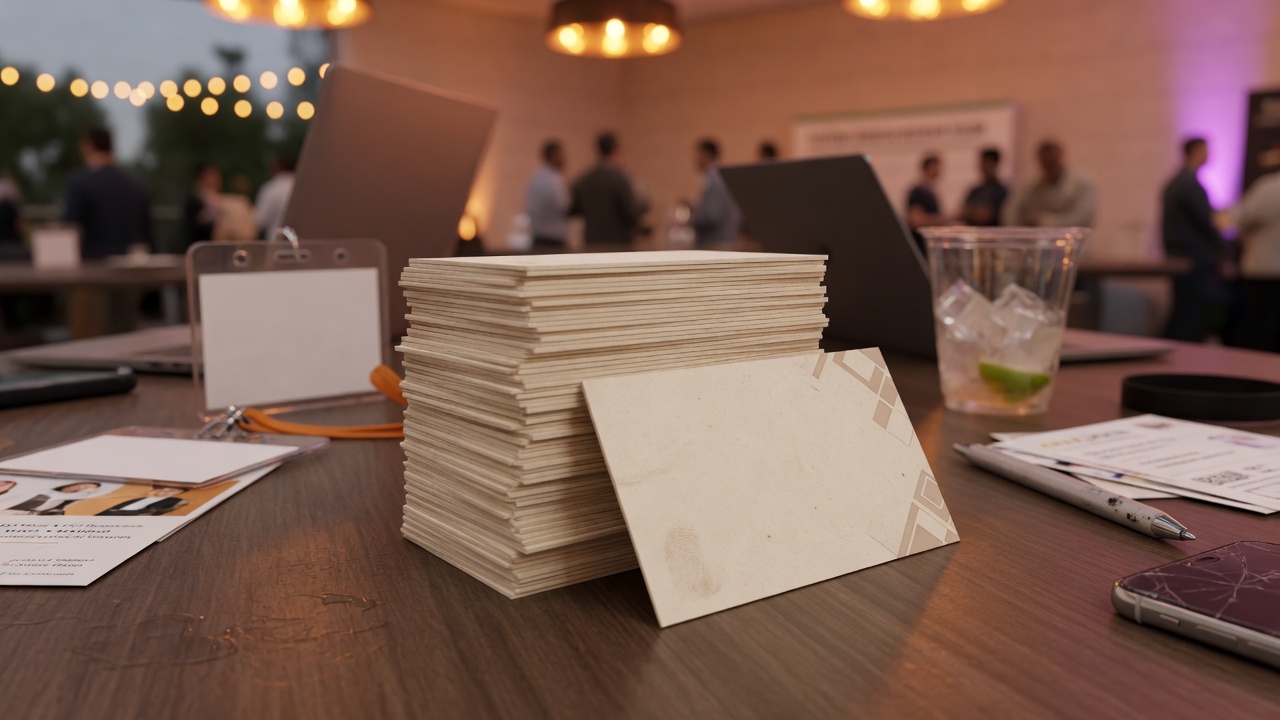
If you hand cards at a mixer, the other person holds the card for two seconds, glances at the name, and pockets it or sets it on a high-top. Thickness shows up in that two-second hold. If you mail cards inside a leave-behind folder, thickness shows up as stiffness and as a slight change in package weight. If your titles change every six months, thickness shows up as money you do not want to trap in a luxury ply that will be outdated before the box is empty.
I split buyers into three jobs, because the stock should follow the job:
- High-churn cards. New hires, rotating sales seats, event staff, resident physicians, interns at UCI-adjacent companies. 14pt, often with a simple aqueous or gloss coat, is usually enough. You will reprint. Design the spec so reprinting is boring and cheap, not a special project.
- Daily professional cards. Brokers, attorneys, CPAs, clinic directors, consultants who work the Irvine Chamber and BNI tables. 16pt C2S, often with silk, gloss, or soft-touch film, is the workhorse. It photographs as “a real card,” survives a tote bag, and still fits most wallets.
- Object cards. Principals, luxury listing agents, architects, interior designers, hospitality directors. Duplex 32pt with film on both faces is a small object, not stationery. Use it when the card is meant to sit on a desk, not disappear into a slim phone-case slot.
If you are ordering standard business card printing in Irvine for a whole office, do not force every seat onto 32pt because the owner liked the sample. Owner cards and staff cards can be two lines on the same quote. That is normal.
Caliper, “pt,” and gsm are not interchangeable
Start with the unit, or you will argue with a quote that was never wrong.
In U.S. commercial printing, a point of board caliper is 0.001 inch. A 14pt sheet is specified around 0.014 inch. A 16pt sheet is specified around 0.016 inch. A 32pt duplex card is specified around 0.032 inch. Converted to millimeters, that is roughly 0.36 mm, 0.41 mm, and 0.81 mm. Those are targets, not lab certificates for your carton. Mills publish a caliper; shops quote the mill grade; the sheet in the box sits in a range around that grade.
North American labs measure single-sheet thickness with methods such as TAPPI T 411, which uses a specified presser foot and pressure. That matters because squeezing a bulky uncoated sheet and a dense coated sheet with the same fingers will lie to you. A dense 16pt C2S can feel “thinner” than a puffy 14pt uncoated even when the micrometer disagrees. Stiffness (resistance to bending) is a different property from caliper. Duplex builds are stiff because they are a sandwich, not only because they are tall.
One point of board caliper is one thousandth of an inch. Gsm is mass per area. Aqueous coating and UV coating add almost no height. Film lamination adds mils you can measure. If a quote says “16pt” and does not say whether that is raw board or finished card, ask.
Gsm (grams per square meter) is a European and mill-weight habit. It tells you how much fiber and coating sit on a square meter of paper. It does not tell you height. Two 350 gsm sheets from two mills can caliper differently if one is dense and coated and the other is bulky and uncoated. Typical shop talk, stated as ranges rather than a formula:
- 14pt C2S cover is often sold in the neighborhood of 270–310 gsm, sometimes labeled near 100 lb cover depending on the mill’s basis.
- 16pt C2S cover is often sold around 350–400 gsm, sometimes near 130 lb cover.
- 18pt C2S shows up on some menus as a step between 16pt and duplex.
- 32pt duplex is often marketed as a 600–700 gsm equivalent because it is two plies plus adhesive. That “gsm” is a sales shorthand, not a sheet you can buy as one mill grade in every case.
Basis weight in the U.S. (lb cover, lb text) is a third system. It is the weight of a ream of a parent sheet size, not a 3.5 × 2 inch card. I will not pretend 100 lb cover is always 14pt. It is often in that band. Confirm caliper on the quote.
Then there is the typographic point: 1/72 inch, used for type size. A 10 pt name on a 16pt card is ten typographic points of type on a sixteen-thousandths-of-an-inch board. Mixing those in an email is how you get a confused designer and a calm estimator who has seen the mix-up before.
What you should put in writing: mill grade or caliper (14pt / 16pt / 32pt duplex), coated or uncoated, C1S or C2S, and the finish as a separate line (aqueous, UV, gloss film, matte film, soft-touch film). If you only write “thick glossy cards,” four different builds can match that sentence.
14pt vs 16pt vs 32pt duplex, side by side
Use this table as a shop conversation, not as a lab report. Finished caliper moves when you add film. Gsm bands are typical mill ranges, not conversions.
| Spec | 14pt C2S | 16pt C2S | 32pt laminated duplex |
|---|---|---|---|
| Target caliper (raw board) | 0.014 in / ~0.36 mm | 0.016 in / ~0.41 mm | ~0.032 in / ~0.81 mm, two plies |
| Typical gsm band (coated) | ~270–310 gsm | ~350–400 gsm | Often sold as ~600–700 gsm equivalent |
| Hand feel, unlaminated | Real card, slight flex | Noticeably stiffer snap | Credit-card object; little flex |
| After 1.5 mil film both sides | Often lands near 17pt finished | Often lands near 19pt finished | Can exceed a credit-card slot |
| Wallet / badge sleeve | Easy | Easy in most sleeves | Check the pocket before you print 1,000 |
| Best default job | High reprint, mail stacks, staff | Everyday Irvine professional card | Principal / luxury leave-behind |
| Bindery time | Straightforward cut | Straightforward; film adds a step | Duplex plus film; longer by nature |
The 0.002 inch gap between 14pt and 16pt does not sound like much on a ruler. Between thumb and forefinger it is the difference between “paper” and “card” for a lot of people. The jump from 16pt to 32pt is not another 0.002 inch. It is a second sheet and a glue line. Do not shop those two jumps as if they were the same kind of upgrade.
Get pricing for 14pt, 16pt, or 32pt cards
How film lamination changes thickness and feel
Lamination is a plastic film glued to the printed sheet. It is not a flood UV coat, and it is not an aqueous flood. Those two coatings sit in the micron range. Film sits in the mil range. Typical OPP gloss or matte film on cards is often in the 1.2–1.5 mil band per side; some scuff-resistant and soft-touch films run a little different. Two sides of 1.5 mil film add about 0.003 inch. A 14pt sheet can leave the laminator nearer 17pt. A 16pt sheet can leave nearer 19pt. If your quote still says “16pt laminated,” ask whether 16pt is the board going in or the card coming out. Both habits exist. The honest quote names both.
Feel changes more than the micrometer does, because film changes surface friction and sound.
- Gloss film adds snap, scuff resistance, and a click when you drop the card on a table. It also shows scratches in a purse and fingerprints on dark solids. Good for outdoor Spectrum events and job-site dust if you need wipe-down. Harsh under raking office light if the design is a full-bleed dark panel.
- Matte / silk film kills glare. Type stays readable in a sunlit Irvine courtyard. It still adds body. It hides some fingerprints relative to gloss, not all.
- Soft-touch / velvet film is the one clients describe as “expensive” even on 14pt, because the rubbery drag slows the thumb. That drag is not stiffness. A soft-touch 14pt card can feel “thicker” than a gloss 16pt in a blind hand-off and then flex more when you bend it. If you want both the suede surface and the 16pt snap, say both on the quote. Do not assume the film includes the caliper upgrade.
Film also seals the sheet against moisture pickup, grease, and some abrasion. That is why restaurant managers and clinic front desks often want laminated 16pt even if they do not care about the extra mils. A 14pt uncoated card in a kitchen or a sunscreen-heavy outdoor mixer will look handled. A laminated 16pt will look handled later.
Heat is the Orange County caveat. A laminated pack left on a dashboard on Barranca in August can take a curl or, in a bad case, show edge lift if the film was stressed at trim. Store boxes inside. Do not treat the car as a warehouse. Single-side film is worse for curl than film on both faces; coat or laminate both sides unless you have a reason not to.
Duplex 32pt is usually two printed sheets with adhesive between them, and then often film on the two outer faces. You are stacking board + glue + board + two films. That is why a “32pt laminated” card can measure north of 32pt and why it can fight a slim wallet even when the menu said 32.
Coating is not thickness
This is the mix-up I hear most after “make it thick.” Someone holds a gloss 16pt card and a matte 14pt card and thinks the gloss one is a heavier grade. They are reacting to light, not caliper. Aqueous coating is a thin protective flood, often done in-line. UV coating is a thicker polymer flood than aqueous, still not a ply. Either can be gloss or satin. Neither will turn 14pt into 16pt.
What coatings do well:
- Hold ink against rub in a box or a bag.
- Change how color sits (gloss pops saturation; satin calms it).
- Speed or slow handling, depending on cure.
What coatings do poorly:
- Impersonate duplex stiffness.
- Hide a flimsy sheet. A 14pt with flood UV still flexes like 14pt.
- Guarantee a luxury read. Uncoated cotton at 16pt can look more expensive than UV-gloss 14pt, depending on the brand.
If you want protection without a plastic feel, aqueous on 16pt C2S is the quiet professional spec. If you want wipe-down and scuff resistance, film. If you want the suede read, soft-touch film. If you want height, change the board or duplex it. Put finish and board on two lines. I will price them as two lines. That is how you compare 16pt vs 14pt business cards without accidentally comparing a laminated 14 to a bare 16 and calling it a mystery.
Uncoated stock deserves its own sentence because it breaks the “pt equals luxury” habit. An uncoated 16pt or a cotton sheet can feel softer and more fibrous, take writing from a pen, and look like stationery rather than a plastic tile. It will scuff sooner in a pocket. It will also emboss more kindly than film, which matters if you plan a blind stamp. Recycled uncoated is a separate conversation; the short version is: confirm caliper on that mill too, because bulky recycled sheets can read thicker than their grade.
How duplex 32pt is actually built
Most “32pt” business cards in this market are not a single mill sheet that grew up. They are two 16pt sheets laminated back to back (or 16pt plus 16pt with a glue line), trimmed as one card. Some shops will duplex 14pt to 14pt and still sell the result near 28–30pt. If you need the credit-card thud, write “32pt duplex” and ask for a caliper on the finished piece, not a nickname.
Build options you will see on a serious quote:
- Print, then duplex. Front sheet printed, back sheet printed, adhesive, nip, cure, then trim. Front and back are two files on two sheets. Registration of the two faces is a bindery problem, not only a press problem.
- Mill duplex board. A pre-bonded board that you print as one thick sheet if the press can feed it. Not every digital press wants to. Confirm, do not assume.
- Duplex plus outer film. The common luxury build: two plies, then gloss, matte, or soft-touch on the outside. Edges show a thin glue line unless you paint them.
The edge is information. On a duplex card you can often see a hairline of adhesive or a change in core color. Some buyers like that, the way they like the strata in a stacked board. Some hate it. Painted or colored edges hide the sandwich and add a third color story. Edge painting is its own production step and its own quote line. I will not pretend it is “just the 32pt.”
Premium thick-stock business cards live in this duplex-and-film world. They take more bindery time than a 14pt cut-and-box job. That is not a moral judgment. It is a calendar fact. If you have a hard date, put the date on the quote with the stock, because duplex and film are extra operations, not a checkbox that prints itself.
Stiffness is the reason people upgrade. A duplex card resists the “taco” bend you can give a 14pt card without trying. It stays flat on a walnut conference table. It makes a sound. If your brand is quiet paper, that sound can be wrong. If your brand is a physical product — architecture, wine, interiors, surgery centers with a high-touch consult — the sound is part of the leave-behind.
There is a seam risk. Cheap duplex peels at the corner after a month in a humid gym bag. Proper nip and adhesive do not. If a corner lifts, it is a production defect, not “how 32pt is.” Ask for a sample from the actual process, not a leftover from a different glue system.
A practical pick: match the stock to the job
Here is the decision framework I walk through at the counter. You can run it in an email.
| Question | If you answer yes | Stock to start with |
|---|---|---|
| Will most of these cards die in a month because names change? | Do not trap budget in duplex. | 14pt C2S, aqueous or gloss coat |
| Do you hand the card at mixers, lunches, and site visits? | You need snap and scuff resistance. | 16pt C2S, film or aqueous |
| Must it drop into a slim phone-wallet every time? | Stay under credit-card height. | 14pt or 16pt, watch the film build |
| Is the card a desk object for a principal? | Height and stiffness are the point. | 32pt duplex, usually with film |
| Will you emboss or deboss? | Film can fracture; test the build. | Often 16pt, film choice matters |
| Grease, sunscreen, job-site dust? | Uncoated will look tired first. | Laminated 16pt |
| Mailing a stack inside envelopes? | Height is fine; weight adds up. | 14pt or 16pt unless the pack is the gift |
Two stocks on one order is allowed. A principal on 32pt duplex and the rest of the team on 16pt, same layout, same color, different caliper, is a common Irvine office pattern. Keep the layout file identical so you are not managing two brands. Change only the stock line.
Quantity belongs in the framework because duplex does not only cost more per card. The box is bulkier. A thousand 32pt cards occupy more drawer than a thousand 14pt cards. If you have a receptionist drawer and a trunk box, say so. I would rather spec 500 duplex for the people who should carry them and 1,000 of 16pt for everyone else than watch a 32pt carton yellow in a closet.
Pocket-fit, wallets, and badge holders
A U.S. business card is typically 3.5 × 2 inches. A payment card under ISO/IEC 7810 ID-1 is 85.60 × 53.98 mm with a nominal thickness of 0.76 mm (about 30 mil) and a published thickness tolerance that, in common summaries of the standard, runs on the order of ±0.08 mm. That puts many credit cards in a band around 0.68–0.84 mm. Your card does not have to meet ISO 7810. Your wallet does not care. The slot was cut for that credit-card height.
Raw 14pt (~0.36 mm) and raw 16pt (~0.41 mm) sit well under that band. Laminated 16pt, depending on film, often still slides. Duplex 32pt at ~0.81 mm is already in credit-card territory. Add two films and you can overshoot what a slim sleeve will accept without a fight. Metal money clips, MagSafe wallets, and the card slots in phone cases are less forgiving than a leather bifold. Irvine offices are full of those slim wallets. Test the actual pocket.
Conference badge holders are the other fit problem. Anaheim Convention Center weeks produce thousands of lanyard pouches sized for a badge, not for a 32pt tile. If you are stuffing a card into the back of a badge sleeve, 14pt or 16pt behaves. Duplex 32pt can bulge the pouch or refuse to share the slot with the badge. For a booth stack on a counter, 32pt is theater. For a card meant to ride in the badge all day, it is a nuisance.
Rounded corners change fit slightly — a later topic of their own — but on 32pt they also change how the card catches the mouth of a slot. A square-cut 32pt corner is a little plow. If pocket-fit matters, say so before we cut.
I keep a caliper and a couple of ruined phone-case wallets at the counter for this reason. Bring the wallet. It is a two-minute test that prevents a thousand-card mistake.
Request a stock and finish quote
When 14pt is enough
14pt is not a consolation prize. It is the right spec when the card is a tool you will replace. I recommend it in writing in these cases:
- Names and titles move. Growing startups in the Spectrum, medical groups adding associates, property teams that restaff by season. The cost of 32pt is wasted if half the box is wrong in ninety days.
- You need a pile. Open houses, career fairs at UCI, booth duty, chamber mixers where you hand fifty cards and expect twenty to hit a trash can. Flex is acceptable. Being out of cards is not.
- The card rides in a folder or a mailer. Inserted cards do not get the two-second “thud” test. They need to sit flat and not blow the package out of a letter classification if you are mailing. Even 32pt is far under USPS letter thickness limits, but a thick card in a thin envelope looks lumpy and can scuff the envelope from inside. 14pt or 16pt inserts cleanly.
- Writing on the back. Some brokers still jot a cell number or a gate code. Uncoated 14pt or 16pt takes a ballpoint. Film does not. If you must have film on the front, say so; we can talk C1S or a writable back. Do not laminate both sides and then get angry at the pen.
- Budget is the constraint, honestly. There is no prize for a duplex card that delayed the reprint you actually needed. 14pt C2S with a decent flood coat looks like a business card. Pair it with a clean layout and good type. Layout carries more of the “expensive” read than people want to admit.
14pt with soft-touch film is a hybrid I will also defend. You get the suede thumb and some scuff resistance without the duplex calendar. It will not snap like 16pt. If the buyer’s test is “does it feel coated and considered,” it often passes. If the buyer’s test is “does it fight my bend,” it fails. Have them bend the sample. Do not argue with their fingers using a product name.
What 14pt will not do: impersonate a membership card, survive as the only leave-behind in a luxury listing appointment, or make a thin logo file look expensive. Fix the file. Then pick the board.
Why 16pt is the usual Irvine default
When someone says “just make them nice” and has no wallet constraint, I start at 16pt C2S — the grade behind most Irvine business cards we print for daily carry. The extra 0.002 inch over 14pt is cheap insurance for a card that will be handed, dropped in a tote, and found a week later. It still cuts clean. It still rounds. It still takes aqueous, UV, or film. It is the grade most analog trays in desk drawers were designed around.
For 16pt vs 14pt business cards, the honest difference in a handshake is stiffness and a slightly duller flex sound. Color quality is not the difference. Press, file, and coating drive color. Do not buy 16pt to fix a 72 dpi logo. Buy 16pt to fix a floppy 14pt that embarrassed you once.
16pt laminated is the default I write for:
- Real estate teams who work indoor opens and outdoor weekend signs (the card, not the sign).
- Clinic and dental offices where the card sits at a front desk and gets handled with lotioned hands.
- Consultants who live in coffee meetings from University Center to Newport.
- Anyone who wants soft-touch without stepping into duplex pricing and calendar.
16pt uncoated is the default I write when the brand is paper-forward: architects who sketch on the back, nonprofit directors, some attorneys who want a letterpress-adjacent read without letterpress. Uncoated 16pt will scuff. If the scuff would bother you on day ten, move to a silk film and keep the 16pt board.
If you are torn only between 14 and 16 and you will not feel samples, take 16pt. The regret I hear is almost always “I wish they felt sturdier,” not “I wish they were flimsier and I had saved the step.” The regret on 32pt is the opposite: “They do not fit my wallet” and “I still have 800 with last year’s title.”
When laminated duplex 32pt earns the extra ply
Order duplex when the card is supposed to be an object. That is a smaller set of jobs than Instagram implies.
Good duplex jobs:
- Principal or rainmaker cards in a firm that already has staff on 16pt.
- Luxury residential listing kits in Irvine, Newport, and Laguna, where the card sits on a kitchen island with the brochure.
- Hospitality, interior design, high-end contractor, and architecture leave-behinds.
- A small run for a keynote or a board meeting where fifty people will put the card on the table and look at it.
Bad duplex jobs:
- Five thousand cards for a hiring surge.
- Any card that must live in a phone-case slot.
- A first order when the logo files are still moving.
- A “make it thick” request with no one willing to feel a sample.
Duplex changes production. Two sheets, adhesive, cure, outer film if specified, then trim. Stock and finish change how long production takes; duplex is one of the finishes that adds operations. I will not quote a date until quantity, material, finish, and your needed-by date are on the same form. That is not stalling. That is how bindery actually works.
If you want the 32pt read without painting edges, accept that a careful eye will see the ply. If that bothers you, budget the edge. If you want a colored core rather than a paint, that is a mill-and-split conversation, not a coating conversation. Keep it on the quote as its own line.
One more duplex truth: the card will not make a weak layout strong. A 32pt card with 8-point gray type and a stretched logo is a thick mistake. Fix hierarchy first. Then buy the ply.
Emboss, corners, and finishes that fight thick stock
Thickness and film change what finishing will survive. This is not a tour of every specialty process. It is the cracking and peeling list I wish people asked about before they fell in love with a mockup.
Emboss and deboss. A blind emboss on uncoated 16pt can look excellent because fibers move. The same die on gloss film can fracture the film at the crown of the relief, especially on a deep female die. Soft-touch film can go shiny or scar at the stamp. Duplex 32pt can take a shallow deboss more happily than a mountain-high emboss, because you are compressing a sandwich. If emboss is part of the brand, say it before we lock film. We may spec a film that stretches, a shallower die, or uncoated stock. A test smash on waste sheets is cheaper than a full run of cracked logos.
Deep stamps on film. A deep mechanical stamp on a laminated duplex card is a thickness problem before it is a design problem. The ply, the film, and the stamp all have to agree, or the film fractures and the sandwich marks. If a stamp is already in the brand, put it on the quote before we lock film so we do not build a card the die cannot finish.
Rounded corners. On 14pt and 16pt this is easy. On 32pt the die has to be sharp and the lift has to be controlled or you get fuzzy board at the radius. Mention corners on the quote. Do not assume “standard cards” includes a radius.
Heavy ink plus film. Dark full-bleed panels under gloss film are a fingerprint magnet. Under soft-touch they can mottle if the sheet was not dry. Build drying time into the date. This is one reason a duplex-plus-film card is not a same-spec as a 14pt aqueous card even if both are “business cards.”
Scoring and folding. Most cards do not fold. Folded cards and tent cards are a different product. If you insist on a fold in thick board, you need a score, and coated thick board cracks at the score unless you groove it right and sometimes still does. Do not surprise bindery with a fold on 32pt.
The estimator question is simple: “After we print, what else happens to this sheet?” Each answer is a chance for the board and the film to disagree. List those operations.
File setup for thick and laminated cards
The press does not care that you paid for 32pt if the file is wrong. Spec the file as if the board were 14pt, then add the extras duplex cares about.
- Size. 3.5 × 2 inches trim unless you have a reason to go custom. Custom is fine; it is a different quote.
- Bleed. 0.125 inch on every side. Full-bleed color on duplex still needs bleed on both sheets.
- Safe type. Keep type and logos at least 0.125 inch off trim, more if you are rounding corners (the radius eats the corner of your safe area).
- Color. CMYK, 300 ppi at actual size for images, fonts outlined or embedded. Rich black for large panels if you want them dense; that is a file conversation, not a caliper conversation.
- Two faces, two pages or two files. Duplex is not a license to put front and back on one artboard without naming them.
- No “I’ll send a PNG of the whole card.” A flattened 72 dpi export is the most expensive way to buy 32pt, because you will buy it twice.
If front and back are two physical sheets, identical margins matter more, not less. A front that is 1/16 inch off the back is visible as a thick edge of the wrong color. Build to the template. Do not design to the edge of a screenshot.
Soft-touch and dark panels: avoid hairline reverses that will fill. Gloss film: avoid giant uncoated-style photographs that will look plasticky; that is taste, not a rule. Uncoated: expect color to sit duller than the coated proof on your monitor. Ask for a proof on the real stock when color is the brand.
Reprint mistakes we see from the Barranca counter
These are the thickness-related reprints. Not theoretical. Not a customer named in a testimonial.
- Ordering 14pt while describing 32pt. The cart said “premium.” Premium was a coating. The board was 14pt. The box arrived and flexed. Fix: write the caliper in the purchase line. Say 14pt, 16pt, or 32pt duplex, in those words.
- Comparing a laminated 14pt sample to an uncoated 16pt sample and picking the wrong number. They were comparing film to fiber. Feel both with the same finish or ignore the feel test.
- 32pt cards that do not fit the phone wallet the owner actually uses. The desk sample felt great. The pocket failed on Monday. Fix: bring the wallet.
- Emboss on gloss film that crazing-cracked at the highlight. The mockup was a 3D render. The film was real. Fix: test smash, or move the stamp to uncoated, or shallow the die.
- Soft-touch on a navy full bleed that showed every thumbprint in a sunlit courtyard. Soft-touch is not magic. Dark panels still oil up. Fix: lighter field, texture, or a different film.
- Single-side aqueous on 16pt that curled in a parked car. Coat both sides, store inside.
- Duplex corners lifting because someone rushed the cure and trimmed too soon. Duplex needs time. Put the date on the quote; do not squeeze operations that have to chemically finish.
- A 32pt run with last year’s title because “we might as well get the thick ones.” You now own a luxury paperweight. Fix: small duplex quantity for stable names; 16pt for the rest.
- No date, no quantity, no finish on the request, then surprise at the result. Quotes confirm size, material, quantity, finish, and date. If one is missing, the spec is a wish.
The cheapest reprint is the one you do not do. Samples exist so you can be boring and correct.
Orange County conditions that actually change the spec
Not every local color belongs on a card spec. These do.
Heat and parked cars. Inland Irvine in late summer cooks a cabin. Film and adhesive dislike that more than a 14pt aqueous card does. If your team lives in a truck between Tustin job sites and a Barranca office, laminated packs belong in a bag, not on the dash. Curl is a storage problem as much as a stock problem.
Coastal vs inland handling. Newport and Laguna meetings happen in humidity and sunscreen. Uncoated cards pick up oil. Laminated 16pt is a better mixer card there. An Irvine indoor suite with air conditioning is kinder to uncoated 16pt. If you work both, film wins.
Convention weeks. Anaheim Convention Center traffic means badge sleeves, tote-bag abrasion, and stacks on counters that get riffled by strangers. 16pt film survives the riffle. 14pt uncoated shows it. 32pt looks great on the counter and then fails the badge sleeve. Pick the card for where it will spend the day, not for the first five seconds on the table.
Campus and medical turnover. UCI-adjacent labs and medical offices reprint names. 14pt or 16pt, not duplex, unless you are printing the chief of staff.
Office-park pockets. Irvine Company towers are full of slim bags and badge clips. If the card cannot share a pocket with an access badge, it will be left on the desk, which defeats the point of printing it.
Outdoor Spectrum and farmers-market tables. Wind is a banner problem, not a card problem. Sun glare is a coating problem: gloss can become a mirror; silk or matte film keeps the type readable. Dust is an uncoated problem. None of that requires 32pt.
Job-site grit. Contractors who keep cards in a cup holder with screws will destroy uncoated 14pt. Laminated 16pt is the spec. Duplex 32pt will survive the cup holder and then refuse the wallet at the supplier desk. I would still start at laminated 16pt unless the contractor is using the card as a mini leave-behind in a bid kit.
Local does not mean you need a different mill than the rest of California. It means your handling pattern is specific. Tell me where the card lives after the handshake.
What to send so the quote is real
A usable quote request is short. Missing one of these is how you get a number that does not match the box.
- Size. 3.5 × 2 inches, or the custom size in inches.
- Quantity. The actual number you will take, not “maybe a thousand.” If you want two stocks, two quantities.
- Material. 14pt, 16pt, or 32pt duplex; coated or uncoated; C1S or C2S if you know.
- Finish. Aqueous, UV, gloss film, matte film, soft-touch film, none. Film both sides unless you say otherwise.
- Sides. 4/4 or 4/0, in those terms or in plain English (“color both sides”).
- Extras. Rounded corners, edge paint, emboss — listed, not implied by a mood board.
- Date. The date you need them in a hand in Irvine, not the date of the mixer minus a wish. Duplex and film need room.
- Pickup or ship. Pickup at 15321 Barranca Pkwy, Irvine, CA 92618, or a ship-to address.
- Files or a note that you need design. PDF with bleed preferred. If the file is not ready, say so.
That list is the whole job. I can estimate from it. I cannot estimate from “thick premium cards, usual amount, soon.” If you want to feel the three grades before you lock the line, say that. Swatches exist for 14pt, 16pt, and duplex 32pt, with and without film. Ten minutes at the counter will save you a paragraph of adjectives.
Walk-ins during Monday–Friday, 8:00 a.m. to 5:00 p.m. Call (949) 387-0787 if you are coming with a wallet to test. Send the same spec through the quote form if you cannot come in.
For a broader view of what we print besides caliper debates, start at the Business Cards Irvine home page and then send the quote with the five facts: size, material, quantity, finish, and date.
FAQ
What is the real difference between 16pt vs 14pt business cards?
Caliper. 16pt is specified around 0.016 inch, 14pt around 0.014 inch. You feel it as stiffness more than as a visible step on the edge. Color, coating, and layout are separate choices. If you laminate the 14pt, you can land near a bare 16pt in height and still flex more than a 16pt board, because film is not a second ply of paper.
Is a 32pt card always two 16pt sheets glued together?
In this market, usually yes: duplex from two 16pt sheets, or a similar two-ply build. Some menus will duplex 14pt to 14pt and still say “thick.” Write “32pt duplex” and ask whether the number is raw board, glued board, or board-plus-film. A finished laminated duplex card can measure over 32pt.
Does lamination make 14pt feel like 16pt?
It can fool a thumb because film adds drag, sound, and a couple of mils. It will not fully impersonate 16pt stiffness. If your test is a bend, buy 16pt. If your test is scuff and a suede surface, film on 14pt may be enough. Compare samples with the same film, or you are not comparing board.
Will 32pt laminated duplex cards fit in a wallet?
Sometimes. Raw 32pt is already near credit-card thickness under ISO/IEC 7810’s ID-1 neighborhood of 0.76 mm. Outer film can push you past what a slim phone-case slot or metal clip will take. Bifold leather is more forgiving. Test the pocket you actually use. Do not test a display wallet in a shop drawer.
When is 14pt enough for Irvine networking?
When you reprint often, hand out stacks, insert cards in folders, or need every card to drop into a thin slot. A clean 14pt C2S with a decent coat will not embarrass you at a chamber mixer. It will not do the desk-object job of duplex. Match the stock to the two-second hold and to the reprint cycle, not to a generic “premium” label.
Do aqueous or UV coatings add real thickness?
Not in the way board does. They add protection and change gloss. They do not turn 14pt into 16pt. Film lamination is the finish that changes caliper enough to mention on a micrometer. If a vendor says “UV coating for extra thickness,” they are selling sheen. Ask for caliper if height is the goal.
Can I emboss laminated 16pt or duplex 32pt?
Sometimes, with a shallow die and a film that can stretch, and after a test. Gloss film cracks at a deep crown. Soft-touch can scar. Duplex can crush or show the ply at the stamp. Uncoated board takes a blind emboss more kindly. Put the stamp on the quote before we lock film so we are not un-laminating you in conversation after the proof.
What do I need to send to get an accurate card quote?
Size, material (14pt / 16pt / 32pt duplex, coated or not), quantity, finish, and the date you need them. Add sides, rounded corners, and whether you will pick up on Barranca. Attach a PDF with bleed or say you need design. I will not invent a date or a caliper to fill a blank. Call (949) 387-0787 if you want to match swatches first.
Pick a caliper on purpose, then print it
14pt is a tool. 16pt is the default professional card in this city. 32pt laminated duplex is a two-ply object that should earn the extra operations. Film changes feel and a few mils; it does not replace a second sheet. Coatings protect; they do not thicken. Wallets and badge sleeves veto height without discussion. Quotes confirm size, material, quantity, finish, and date — write all five.
If you want this decided with actual board instead of adjectives, come to Avanti Printing, 15321 Barranca Pkwy, Irvine, CA 92618, ask to see the 32pt duplex and laminated premium stocks, or send the spec and the date through the quote form. Bring the wallet. Bend the sample. Then we can print the one you meant.